• +8618024187532
  • service@mecofence.com
× Send

MecoFence 2026 Composite Fence Field Tour Across Canada, the United States and Europe

SIX-COUNTRY TOUR September 2, 2026

The MecoFence six-country field tour runs from August to September 2026 through Canada, the United States, Italy, Poland, Germany, and Denmark. Two teams are traveling separately across North America and Europe to meet B2B partners face to face, observe real installation conditions, and return to earlier projects after delivery.

A catalog can show a color and a drawing can show a post layout. Neither tells us what a distributor hears at the counter, what slows a contractor on site, or what an installed fence looks like several seasons later.

The North America team landed in New York on August 30 and began distributor meetings that week. View the field post on Facebook.

MecoFence North America field team in Times Square, New York, on August 30, 2026.The North America field team in Times Square, New York, on August 30, 2026.

Where the MecoFence Six-Country Field Tour Is Going and Why It Matters

From August to September, MecoFence is running two field routes: one through Canada and the United States, the other through Italy, Poland, Germany, and Denmark. The teams travel separately so each conversation stays grounded in local selling, project, and installation conditions; the commercial question is the same in both regions: when low-priced WPC fence sets look interchangeable, how does a wholesaler or contractor remain the preferred choice?

The answer has to be built into a wholesale composite fence system that buyers can compare and installers can specify—not left as a marketing adjective.

If your yard or warehouse is on the route, you can request an in-person meeting during the tour.

TeamCountries on this stageTime period
North AmericaCanada and the United StatesAugust 10–September 6, 2026
EuropeItaly, Poland, Germany, and DenmarkAugust 24–September 6, 2026

In a crowded, price-led market, a low quotation can catch attention but rarely creates a lasting reason to buy from one supplier rather than another. The following competitor-listed markers show how low headline set prices have already gone:

Competitor-listed 6 ft × 6 ft WPC fence configurationCurrent price marker
183 × 183 cm WPC fence set including composite post$60–70/set
183 × 183 cm WPC fence set including aluminum post$75–85/set

Price boundary: These are competitor-listed product prices for the stated 183 × 183 cm sets, not MecoFence quotations or landed/installed project costs. Included components and commercial terms should be checked before direct comparison. Checked: August 2026.

Why Low Set Prices Do Not Create a Defensible Offer

A $60–85 fence set can win attention. It does not give a wholesaler much to defend when the next supplier offers a similar-looking set for less. For contractors, it can leave costly decisions—board, post, footing, gate, and finish—to be solved after the headline price has already been promised.

1. When Every Panel Looks the Same, Margin Turns Into Discounting

At the sales counter, a low-priced 6 ft WPC fence set gives the buyer little to explain beyond price. The MecoFence range gives the sales team visible specifications to present: 24 mm × 200 mm co-extruded boards, compared with the 158–168 mm board faces commonly seen in low-priced sets, plus a dual-tone 3D surface with eight color combinations and the same finish on both sides. The customer can see the difference before the sales conversation becomes a discount request.

2. When Every Variation Needs Another SKU, Inventory Becomes the Cost

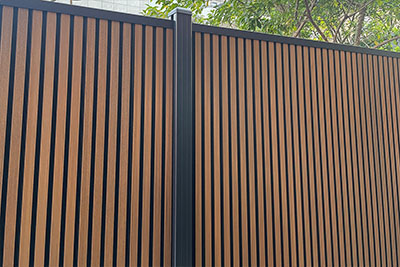
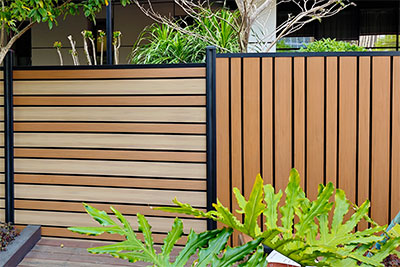
A wholesaler does not want to stock separate products just to offer two visual directions. The S-CF05 bidirectional panel installs horizontally or vertically from one SKU under utility model ZL 2024 2 0073272.3. That gives the counter team two design options while keeping the stocking decision simpler.

3. When the Quote Ends at the Board, Jobsite Risk Moves to the Contractor

The expensive problems often appear after the board price is agreed: post movement, drainage, uneven ground, gate selection, or the wrong fixing method. MecoFence brings those decisions into the system: an 80 × 80 mm, 1.7 mm-wall Y-shaped aluminum post with 60 μm coating and up to 15° adjustment; nine matching gate designs; and documented options for deck, wall, concrete-surface, and ground installation.

When a Solid Fence Creates the Wrong Trade-Off

Some projects need visual privacy without making the outdoor area feel closed in. A conventional solid WPC privacy panel can force the buyer to choose between visual screening and airflow.

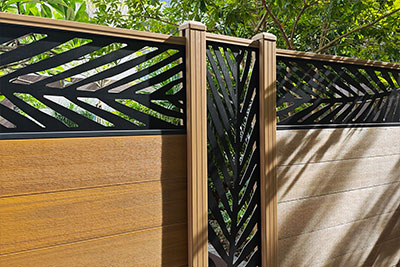
The FlowShield ASA co-extrusion PVC fence gives wholesalers and contractors another system to quote: ASA-coated PVC boards in marine-grade aluminum frames, with S-curved ventilation gaps that block sightlines while letting air move through the fence. It is an application-led option for projects where a solid privacy panel is not the complete answer—not simply another WPC price point.

A MecoFence quotation can specify the board face, surface, orientation, post, footing, and gate—not simply “a 6 ft WPC fence set.” That does not guarantee margin, but it gives wholesalers and contractors a credible basis to compete on a defined system rather than be the next supplier to cut the price.

Face-to-Face Meetings Reveal the Gaps Between a Quote and a Jobsite

A wholesale quotation answers price, quantity, and delivery questions. A useful field conversation goes further: it shows where information is missing between the factory, the warehouse, the sales counter, and the installer.

MecoFence team reviewing dual-tone composite fence samples during a face-to-face B2B meeting.Composite fence samples, profiles, and installation details reviewed face to face during the North America field tour in August 2026.

During this tour, our B2B conversations focus on operational questions such as:

  • Which fence configurations are easiest for sales teams to explain accurately?
  • Which boards, posts, rails, gates, and accessories need to be presented as one system?
  • Where do installers lose time because a drawing, label, or component list is unclear?
  • What samples and display tools help a distributor qualify a serious project inquiry?
  • What information should reach the factory before a project quotation is prepared?

A Ranking Is Not a Factory Visit

If you are building a supplier shortlist, a page promising twenty companies, twenty logos, and twenty confident verdicts is difficult to ignore. It feels like days of research compressed into minutes. Use it as a starting index, not as verification. A closer check of this list finds a product line counted as a separate manufacturer, fence systems from different material families placed beside WPC, current catalogs with no composite-fence line for some entries, and a distributor presented among factories. Once those distinctions are blurred, a buyer is no longer comparing like with like.

Top 20 Manufacturers of composite fence in the World

Names shown in the source article:

  • Trex Company
  • Unifloor New Material Co., Ltd
  • Fiberon
  • CertainTeed (Bufftech)
  • Trex Seclusions
  • Azek (TimberTech)
  • SimTek Fence
  • UPM ProFi
  • Brite Fencing
  • Eva-Last®
  • Avon Plastics (Armadillo Composite Fence)
  • WoodPlastic®
  • Everwood
  • Linyi Evergreen Wood Co., Ltd.
  • Greenwood Fence Inc.
  • NewTechWood®
  • Silvadec
  • Ecoscape UK®
  • Woodguard
  • Futurewood

List scope: These names are reproduced for reference. Inclusion here is not a judgment on every company or product named. The buyer’s concern is whether a ranking consistently distinguishes a company from a product line, one material family from another, and a manufacturer from a distributor.

Before trusting any ranking, make three quick checks: identity—does each entry represent a manufacturer rather than a product line or distributor; comparability—does each entry offer a current WPC fence in the same material category; and method—does the publisher disclose its criteria, sources, review date, and commercial relationship to the entries?

Even when a list passes those checks, it still has a structural limit. It can compare what companies publish online; it cannot see who will extrude the boards in your order, connect a sample to a production specification, inspect how the board, post, footing, and gate work together, or learn what happens when an installer needs an answer after delivery. That is where the buyer’s commercial risk begins.

Before a name moves from search result to supplier shortlist, ask for evidence behind four questions:

  • Who will actually manufacture the order? Ask for the legal factory identity, production location, and direct factory confirmation—not only a logo, company image, or trading name.
  • What can you order now? Ask for a current SKU, complete system bill of materials, drawings, and an approved sample—not a broad statement that the company works with outdoor composites.
  • What has been tested? Ask for a report that identifies the submitted material, color, surface, formulation, configuration, method, date, and result—not a certification badge detached from the product being quoted.
  • Who takes responsibility after delivery? Ask for a named technical contact, installation support, spare-part availability, warranty terms, and evidence of follow-up on earlier projects—not a generic promise of global service.

For the next step, use our seven-question guide to vetting a WPC fence manufacturer in China to review materials, documents, MOQ, quality control, lead time, OEM support, and importer references. Then use what a composite fence manufacturer actually controls to test whether the supplier can explain formulation, co-extrusion, structural integration, and in-process quality control.

A list can tell you who to look at; only verification tells you who to buy from. That is why our field teams spend this tour in yards and warehouses, speaking with the people who stock and install fence systems and returning to earlier projects after supply. The purpose is not to compile another ranking. It is to check the details that decide whether a product can be ordered, installed, supported, and sold again. A ranking is not a factory visit.

Editorial check: The company publishing the source list places itself second. The same website labels one brand “United States” in its global ranking but “China” in separate China-only manufacturer lists. Neither inconsistency proves anything about product quality; both show why authorship and methodology belong in a buyer’s review. Check who wrote a ranking before you let it rank your suppliers.

The business value is not the meeting itself. It is the reduction of avoidable gaps before stock is ordered or installation begins.

Returning to a Toronto Fence Project Supplied in 2022

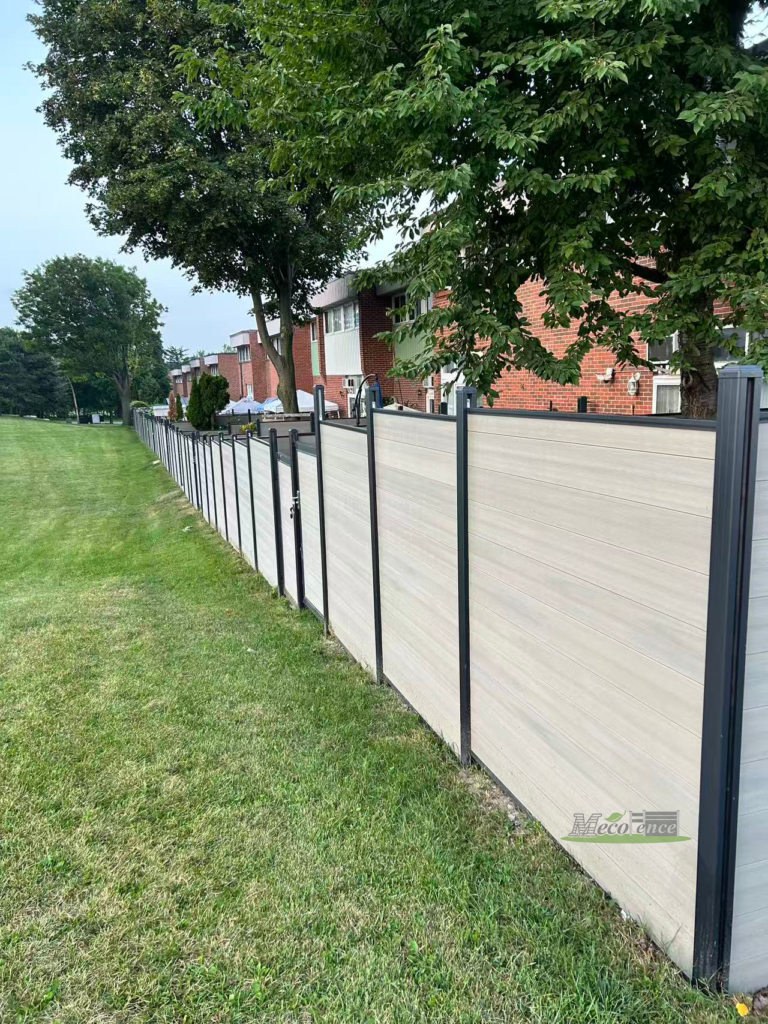
One stop on the North America tour was an earlier MecoFence project on Lomar Drive in Toronto, Ontario, where MecoFence supplied the complete fence-and-gate system. The customer purchasing period was July–October 2022, and the supplied configuration was an Ashwood-color wood-plastic composite fence-and-gate system measuring 1830 × 1800 mm, approximately 6 ft × 6 ft.

The same relationship continued after delivery. Our team returned during the 2024 Canada business trip and visited the project again in 2026.

PeriodConfirmed eventWhat it tells a B2B buyer
July–October 2022Customer purchasing period for the Ashwood-color fence-and-gate systemRecords the supply period for this project
2024MecoFence team revisited during the Canada business tripShows that communication continued after the original transaction
2026The team returned and saw no obvious visible signs of repair or component replacementProvides a current field observation

The Ashwood fence line in Toronto in August 2026, four years after supply.

A Return Visit Looks at the Complete Fence-and-Gate System

A project photograph is useful, but a return visit should examine more than color. Boards, posts, rails, connections, gate hardware, and site conditions work together, so the observation needs to follow the same system boundary.

Visible product and system condition

  • Surface condition and Ashwood-color consistency across the visible fence run
  • Board alignment and any visible movement, distortion, or damage
  • Post and rail alignment at accessible sections
  • Connection points, caps, hinges, latch, and other visible hardware

Site and maintenance context

  • Ground level, vegetation, drainage, and access around the fence line
  • Visible repair marks, replaced components, or changes to the original layout
  • Questions that require the owner, installer, or maintenance record to answer

This is field observation, not a laboratory test or a structural inspection. Where a conclusion depends on service history, test scope, or local code, the relevant records still need to be checked separately.

What Wholesalers Need Beyond a Good-Looking Sample

A good sample earns a few seconds of attention. A workable stocking program earns a second order.

When we meet wholesalers, the conversation moves quickly from color and texture to the handoff from display to order: which fence-and-gate configurations should form the core range, how boards, posts, rails, caps, fasteners, and gates should be grouped, and what a counter team needs to explain the system accurately.

The practical test is simple: can a salesperson move from a customer’s visual preference to a complete, repeatable quotation without rebuilding the system from scratch? Clear component logic, labels, samples, and a path for project-specific questions make that easier. Wholesalers considering a longer-term relationship can also review the MecoFence distributor program; program terms and current commercial conditions should still be confirmed for the local market.

What Contractors Need Before the First Post Is Set

Contractors carry the risk when a project drawing, component list, or site assumption is incomplete. Before a project is quoted, the discussion should settle the run, the ground, the exact system, and the site plan.

  • The run: fence height, bay width, total run, corners, slopes, and gate openings.
  • The ground: substrate and post-setting conditions that may change the installation approach.
  • The system: the exact board, post, rail, cap, connection, and gate configuration.
  • The site plan: access, unloading, staging, sequencing, drawings, samples, installation notes, and project-specific evidence required before approval.

MecoFence does not use a field visit to promise local installation in every market. We use it to understand what a contractor needs from a factory-side supplier and which questions must be resolved before the bill of quantities is approved.

Field Feedback Must Return to the Factory to Be Useful

Travel creates no value if a useful observation ends in a notebook. A field visit earns its keep only when an owner, next action, and verification point are clear.

For example, a question about how a gate, post, or replacement part should be grouped is not simply “feedback.” It should move from a face-to-face conversation to a documented B2B requirement, then to factory and service review, and finally back to the buyer as a verified follow-up.

Face-to-face conversation Project or market observation Documented B2B requirement Factory and service review Verified follow-up action

Some points can be fixed in a drawing, label, or component list; others need testing or product review. Either way, the useful outcome is an answer the buyer can use—not a promise that disappears after the trip.

The Questions a Buyer Actually Asks—and the Record That Answers Each One

A technical file is useful only when it answers the decision in front of you. A test report speaks for the submitted sample under its stated method and conditions; a management-system certificate with surveillance speaks to the process within its certified scope. Both can be valid evidence, but they answer different questions.

The table starts with the questions procurement, compliance, and engineering teams actually ask. Each linked record is available through the MecoFence Technical Resource Center. Read what the record covers, then complete the “Check first” step before using it in vendor approval, a compliance file, a tender, or a project decision.

The buyer’s questionRecord that answers itCheck first
Will this supplier pass our vendor audit?ISO 9001 quality-management certificate
Certificate 61126Q00098R053 covers the sales of specified wood-plastic composite product categories.
Confirm the certificate holder against the contracting entity, the certified activity against the purchased scope, and the current validity and surveillance status. Record it as one vendor-audit input alongside your own qualification checks.
Can this order carry an FSC claim?FSC Chain of Custody certificate
Certificate ESTS-COC-240458 covers trading of wood-plastic composites certified FSC 100% and is listed as valid through May 16, 2029.
Verify the seller, product scope, claim wording, certificate status, and FSC information on the quotation, invoice, and other transaction documents for the actual order.
What does this CE record support in our EU tender?WPC CE attestation record
Attestation 3N240430.FMDC98 identifies WPC, EN 14041:2018, and a voluntary non-notified verification procedure.
Confirm the exact product, listed standard, verification procedure, intended use, and the tender or local regulatory requirements before including the attestation.
What goes into my REACH compliance file?WPC REACH SVHC screening report
SGS report SDHL2404006499HI, dated May 6, 2024, screened a submitted dark-gray solid WPC sample with brown surface against its stated 249-substance scope and reports SVHC ≤ 0.1% (w/w).
Match the ordered material, color, surface, and formulation to the submitted sample. Confirm the report date and review the REACH timing note below before placing it in the compliance file.
What did the fence wind test actually show?WPC privacy-fence wind test
Intertek report 240411095GZU-001 covers a 1830 × 1800 mm privacy-fence configuration loaded at 372.1 N/m² (Beaufort 9 equivalent) for three minutes. Maximum deformation was 48.93 mm; permanent deformation after unloading was 2.45 mm, with no component disengagement or visible cracks recorded.
Match the proposed board profile, post, rail, connections, fixing method, geometry, design load, and local engineering requirements to the tested configuration before using the result.

REACH timing note: The ECHA Candidate List is normally updated twice a year. The May 2024 screening covers the 249-substance scope stated in report SDHL2404006499HI at that time. Before using it in a current compliance file, compare the report date and scope with the current Candidate List and ask whether the ordered material requires a newer screening.

Use both evidence layers: project revisits help buyers examine installed conditions, while certificates and reports answer defined management, chain-of-custody, regulatory, chemical, or test questions. The strongest file connects each decision to the right record and its recorded scope.

Questions About the MecoFence Field Tour

Separate North America and Europe teams allow each conversation to stay closer to local distribution, installation, and project requirements. The current European scope includes Italy, Poland, Germany, and Denmark, while the North America team is working across Canada and the United States.

The project used an Ashwood-color wood-plastic composite fence-and-gate system measuring 1830 × 1800 mm, approximately 6 ft × 6 ft. The customer purchasing period was July–October 2022.

Topics include stocking configurations, complete component groups, samples, displays, labeling, repeat-stock orders, project inquiries, and questions that need factory review before a distributor commits to a customer.

Yes. Contractors can provide the fence height, total run, corners, slopes, gate openings, substrate, drawings, schedule, and sample requirements for a factory-side discussion before the bill of quantities is approved.

Start with the decision you need to support, then confirm the holder or submitted sample, product or SKU, date, standard, method, scope, result, validity, and relationship to the order. Use the buyer-question table above to match each question with the appropriate record and its “Check first” step.

The Journey Continues After the Meeting

MecoFence does not treat being on site as the finish line. A field visit matters when it reveals how local distributors sell, how contractors install, and where a product, drawing, component list, or response still needs to improve.

What we learn in each market should return to the factory and come back to local partners as better-suited product choices, clearer technical guidance, and more responsive project support. That is how the work continues after the meeting: steady, practical follow-through that helps the next quotation, installation, and service decision move forward with greater confidence.

Written by

Steven He

Co-Founder & Head of Product · MecoFence

Steven leads product development and B2B partnerships at MecoFence, a WPC composite fence manufacturer based in Guangdong, China. 10+ years in composite material manufacturing, covering formulation, extrusion process engineering, and export supply chain.

Table of Contents

Planning a Fence Range or Contractor Project?

Distributors can bring a stocking or sample question; contractors can bring a site plan, drawing, bill of quantities, or installation requirement. We can review the complete fence system, supporting documents, and next practical step—and arrange an in-person meeting when our field team is in your market.

Prefer to review first? Explore Technical Resources or download the 2026 Product Catalog.