
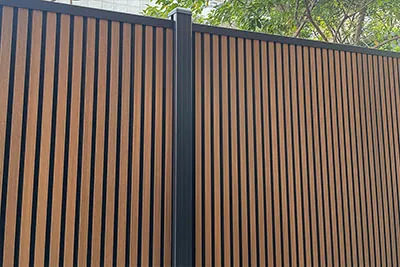
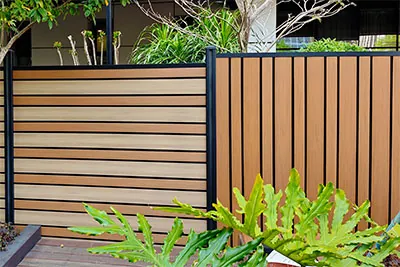
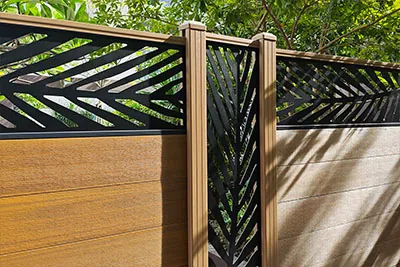
You can find a composite fence at about $25 per foot landed, $45 per foot installed, or $100+ per foot installed. Those numbers can all be valid. They are not pricing the same handoff.
Angi and HomeAdvisor publish installed ranges around $11–$45 per linear foot, while HomeGuide lists roughly $50–$100+ per linear foot. On a 1,200-foot project, the two published endpoints are $106,800 apart. Pick the wrong boundary and someone on the project team will have to explain that gap later.
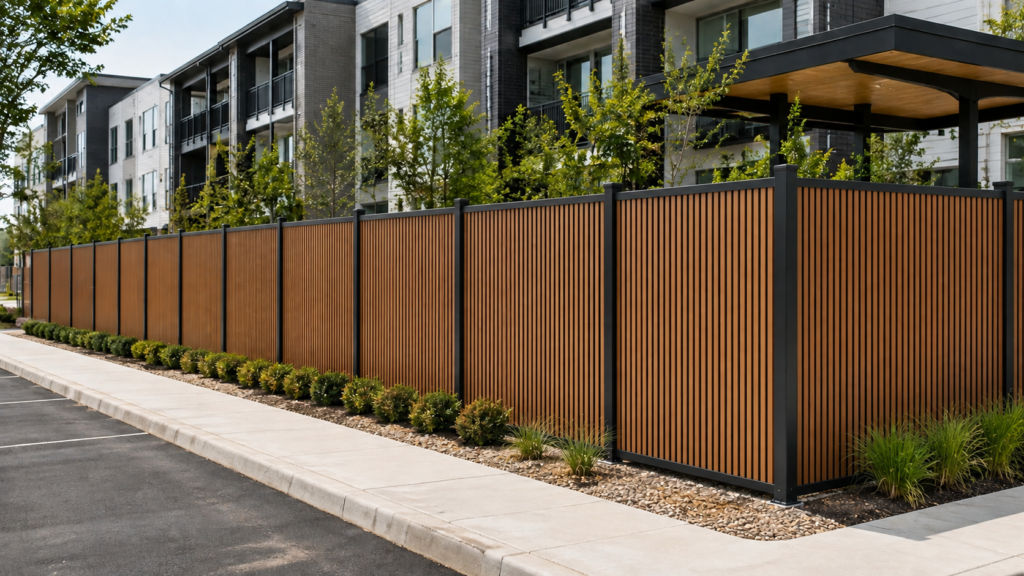
Start here: do not ask which number is cheapest until you know where each number stops. Match the complete system, destination, gates, site work, installation boundary, and quote date first.
If you buy fencing for projects, inventory, or resale, you need three different numbers: installed market price, factory-direct landed cost, and final project cost. Mixing them is how a cheap quote survives the first comparison.
A full 20ft container example below makes that boundary concrete: 200 complete 6 ft × 6 ft sets, about 1,200 linear feet, and an illustrative landed system cost of about $25.29 per linear foot before local installation.
Why Composite Fence Cost Can Run From $11 to $100+ per Foot
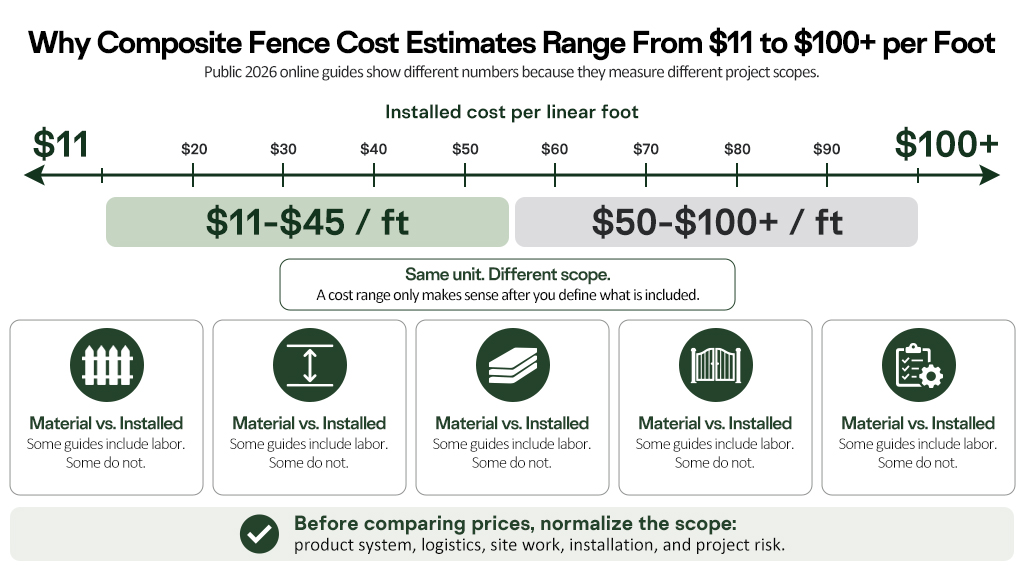
Before you compare the numbers, compare what they buy. Angi and HomeAdvisor publish lower installed ranges, while HomeGuide publishes a much higher installed range. A factory-direct landed cost sits at a different handoff again. Put them in one column before matching scope and the comparison is already broken.
| Reference / cost boundary | 2026 planning figure | What the buyer should take from it |
|---|---|---|
| Angi installed guide | $11–$45 / linear ft | Residential installed context under Angi’s assumptions, including materials and labor. |
| HomeAdvisor installed guide | $11–$45 / linear ft | A second residential installed reference; actual bids still depend on design, site, and location. |
| HomeGuide installed guide | $50–$100+ / linear ft | Higher installed context tied to different height, style, material-quality, and location assumptions. |
| MecoFence illustrative landed system | About $25.29 / linear ft | A 40HQ warehouse-landed model using stated duty assumptions; local delivery, installation, site work, overhead, and margin remain outside the number. |
Retail, dealer, and factory-direct prices can all be valid and still be far apart. Domestic pricing may include inventory, local availability, warranty handling, distribution, and reseller margin. A factory-direct landed model has a different boundary. The buyer’s job is not to find one national average; it is to make two offers describe the same fence and the same handoff point.
Two prices are not comparable until the fence is. Match fence height, board construction, posts, hardware, gates, destination, installation scope, and quote date first. The next six gaps are where a “cheap” number usually gets its advantage.
External market references: Angi composite fencing cost guide; HomeAdvisor composite fencing cost guide; HomeGuide composite fencing cost guide. Factory-direct model: MecoFence 2026 wholesale pricing and landed-cost guide.
Paste this block into an Elementor HTML widget, then place the $11–$45 vs. $50–$100+ cost-range infographic directly after the table.
Six Missing Items That Make a Fence Quote Look Cheap
A low $/ft figure often looks cheap because something is still outside it. Posts, gates, freight, and site work do not disappear; they move to another line item. Check these six gaps before you approve a supplier comparison or carry the number into a customer bid.
1. Boards Only vs. a Complete System
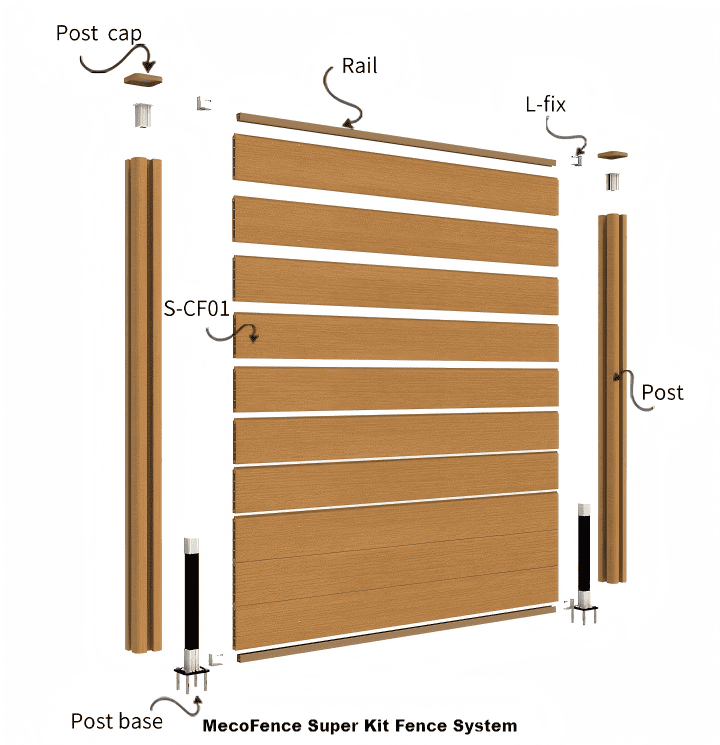
A boards-only price is not a fence-system price. You may still need to buy posts, rails, caps, brackets, fasteners, packaging, and gates. A complete quote should list every part and its quantity.
2. Different Composite Systems
“Composite” is not a specification. An uncapped WPC board and a co-extruded system can appear in the same search result and still be materially different products. Compare the cap, core, profile, wall thickness, and test documents—not the category label.
3. Fence Height and Privacy Level
A 4 ft boundary fence and a 6–8 ft privacy screen should not share one per-foot price. Taller fences need more boards, longer posts, stronger foundations, and more installation time.
4. Different Post Systems
Post material, size, wall thickness, coating, and connections affect both product cost and field labor. A lower post price can disappear if the system needs extra fabrication, stronger foundations, or rework.
5. Local Stock vs. Factory-Direct Supply
Domestic prices can include warehousing, short lead times, local support, and easier returns. Factory-direct supply can improve product cost at volume, but you must plan freight, customs, receiving, inspection, lead time, and inventory.
6. Easy Site vs. Difficult Site
Slopes, demolition, concrete mounting, frost depth, limited access, utilities, gates, and permits can change the installed budget more than a small panel-price difference. The next section puts these costs into one commercial model.
A Supplier Price Is Not a Project Cost
The useful number is the cost at the handoff you control. A distributor may stop at warehouse-landed cost. A contractor cannot. Local delivery, site work, labor, overhead, and risk still have to land somewhere in the project budget.
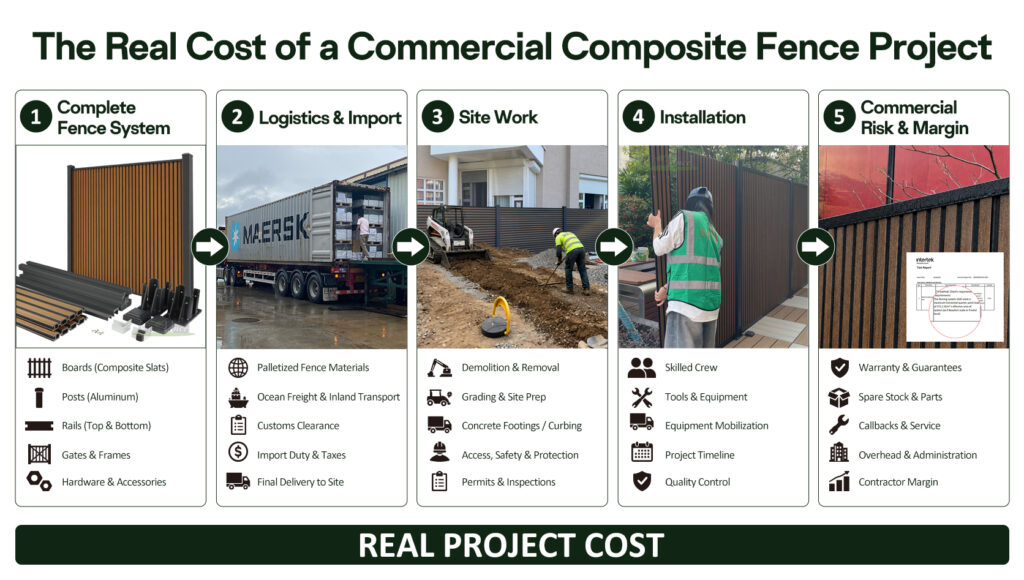
Complete system + freight and trade costs + local delivery and site work + installation labor + overhead and risk = a project cost you can defend
| Cost layer | Check before you use the number | Common blind spot |
|---|---|---|
| 1. Complete system | Boards, posts, rails, caps, brackets, fasteners, packaging, and gate assemblies | Comparing a board price with a complete kit |
| 2. Logistics and trade | FOB or CIF boundary, freight, insurance, duty, Section 301 treatment, and broker/port costs | Treating FOB as warehouse-landed |
| 3. Local delivery and site work | Drayage, final-mile delivery, demolition, excavation, concrete, and utilities | Assuming “installed” includes difficult ground work |
| 4. Installation labor | Crew hours, equipment, mobilization, mounting method, gate labor | Using a national labor average as a local bid |
| 5. Overhead and risk | Damage allowance, spares, callbacks, warranty service, schedule exposure, margin | Quoting a project before commercial risk is priced |
This five-layer check keeps warehouse-landed import cost separate from a finished contractor budget, even when both are shown per linear foot.
Factory-Direct Example: What Reaches the Warehouse per Foot
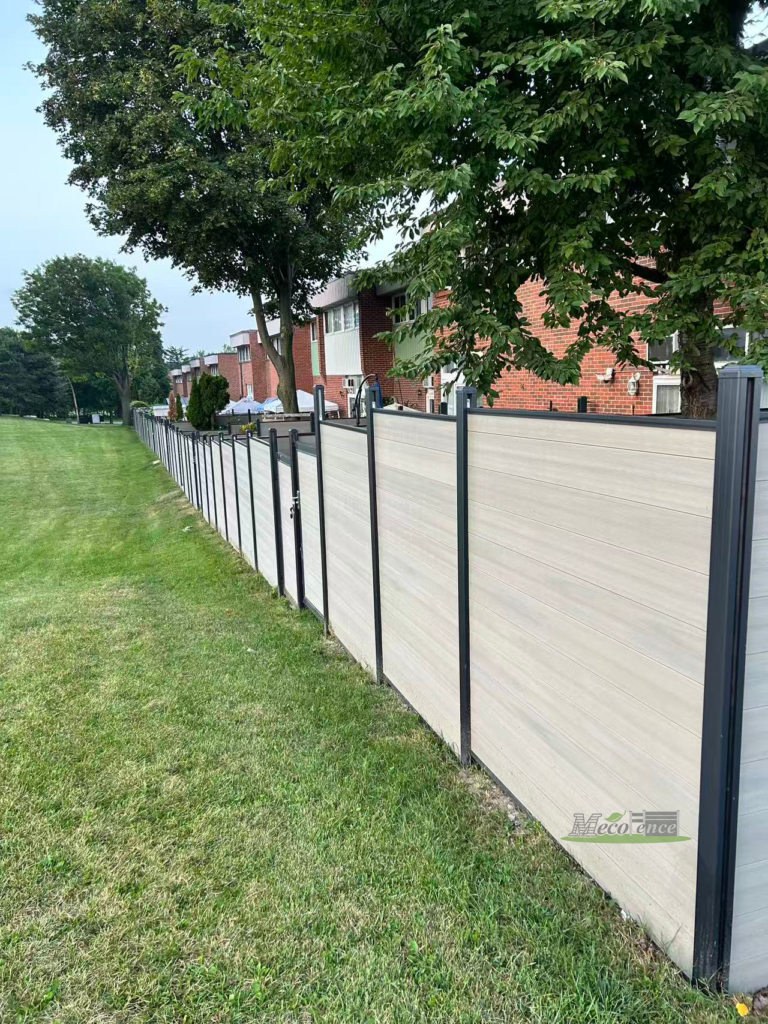
The landed-cost headline is the last line of the math, not the first. For this 1,200-foot example, start with the customs-value assumption: 200 complete 6 ft × 6 ft co-extrusion WPC fence sets in one 40HQ, before corners, gates, and spare material.
The model separates the $20,000 FOB product value from ocean freight and marine insurance. For this illustration, the duty model uses $20,000 as the customs-value base, then applies a 5.3% MFN assumption and a 25% Section 301 assumption. Those rates are modeling inputs, not classification advice.
| Cost component | 200-set working model |
|---|---|
| FOB complete systems | $20,000 |
| Ocean freight | $3,200 |
| Marine insurance | $93 |
| Illustrative MFN duty: 5.3% × $20,000 customs value | $1,060 |
| Illustrative Section 301: 25% × $20,000 customs value | $5,000 |
| Broker and port handling | $1,000 |
| Illustrative landed total | $30,353 |
| Landed system cost | $151.77 per set / about $25.29 per linear ft |
Customs boundary: do not automatically calculate U.S. duty on CIF value. CBP generally excludes international freight and insurance from transaction value when the documentation supports the deduction. Customs value can still require statutory additions such as packing, assists, royalties, or other dutiable items, and Section 301 treatment depends on the exact HTS classification. Confirm the entry with the importer’s licensed customs broker before you use this model to buy inventory or quote a customer.
HomeGuide publishes a labor planning range of $15–$30+ per linear foot. For 1,200 linear feet, that adds about $18,000–$36,000+. Combined with this working landed model, the direct subtotal is about $48,353–$66,353+ before local delivery, demolition, gates, permits, contractor overhead, margin, and unusual site conditions.
Have 1,000+ ft to price? Send the numbers that change the math.
Send the fence length, height, panel profile, post system, destination, gate quantities, and expected order volume. MecoFence can review the BOM, packing plan, freight boundary, and current landed-cost assumptions on the same scope.
Review My Landed Cost →Customs references: CBP guidance on CIF and customs value; CBP commercial-invoice valuation guidance; USTR Section 301 HTS search. For the full import model, read the 2026 WPC fence wholesale pricing and landed-cost guide.
Choose the Buying Route That Fits the Job
A 100-ft urgent job and a 1,200-ft container program should not be sourced the same way. Larger orders can improve freight efficiency, but they also move more lead-time, receiving, and inventory risk onto the buyer.
| Planning scale | Likely buying route | Decision priority |
|---|---|---|
| 50–150 linear ft | Domestic dealer or local contractor | Availability, installation, local service, short lead time |
| 300–500 linear ft | Contractor, regional distributor, or consolidated order | Specification consistency, freight efficiency, job schedule |
| 1,000–1,200+ linear ft | Factory-direct container evaluation | Landed cost, container utilization, inspection, receiving, inventory capacity |
| Repeat containers | Distributor or stocking program | SKU mix, territory, reorder speed, stock turns, gross margin |
Factory-direct supply is a volume strategy, not a shortcut for a small urgent job. It makes sense only when the product, destination, container use, warehouse space, and delivery date work together.
How Fence Height Changes Cost—Without Inventing One National Average
Taller fencing costs more. The useful question is how much more for this system, at this site, under this scope. Keep the published ranges separate. A cleaner national average would be easier to read—and easier to misuse.
| Fence height / type | Angi installed range | HomeGuide installed range | Buyer check |
|---|---|---|---|
| 3–4 ft / shorter fence | $11–$15 / ft | $50–$70 / ft for 3–4 ft picket | Do not assume the lower height makes the two scopes comparable. Check panel style, material tier, posts, and site assumptions. |
| 5–6 ft / standard privacy | $22–$34 / ft | $75–$95 / ft | Use one complete 6 ft system as the comparison baseline, then match posts, gates, installation, and destination. |
| 6.5–8 ft / tall or premium | $28–$45 / ft | $85–$100 / ft for 6.5–7 ft tall privacy; $90–$110 / ft for premium 6–8 ft decorative | Confirm post length, foundation design, wind requirements, permits, and engineering before tender. |
Sources shown separately: Angi’s 2026 height table and HomeGuide’s current composite-fence style/height table. These are homeowner installed-cost references, not commercial tender rates.
What the Same 150-Foot Length Can Look Like in Two Cost Guides
The strongest warning is not a national average; it is the gap between two published totals for the same length. A 150-foot figure can move by thousands of dollars before a contractor has even priced the actual site.
| Published example | 150 ft total | What it proves |
|---|---|---|
| Angi — general composite installed range | $1,650–$6,750 | Lower installed residential context under Angi’s methodology. |
| HomeGuide — standard 6 ft privacy example | $11,250–$14,250 | Higher installed context for a defined privacy-fence type and height. |
Same 150 linear feet; different published assumptions. Do not average the two totals. Use the contrast to force a scope check, then replace both with a local contractor bid for the actual design.
Five More Things That Can Move the Final Budget
After height is fixed, five job details can still change labor, foundations, freight, or parts count. Check them before tender to reduce change orders.
| Cost variable | How it moves the budget | Check before approving the price |
|---|---|---|
| 1. Board construction | Uncapped WPC, co-extruded boards, architectural profiles, and premium capped systems do not share one manufacturing cost. | Lock the profile, cap and core structure, wall thickness, surface finish, and required test documents before comparing quotes. |
| 2. Post and mounting system | In-ground posts, base plates, core drilling, and retaining-wall mounts change the BOM, foundation work, and crew time. | Confirm the substrate and mounting method before the BOM is priced. Use the composite fence installation guide to identify the installation variables. |
| 3. Gates | Pedestrian, double, and powered gates add separate frames, hardware, foundations, and installation labor. | List every gate type, clear opening, and operating method as a separate line item. Do not bury gates inside a per-foot allowance. |
| 4. Ground and access | Rock, slopes, utilities, demolition, drainage, and restricted equipment access can add crew hours and equipment days. | Price demolition, excavation, concrete, utilities, drainage, and restricted access as separate site-work items. |
| 5. Location and schedule | Freight, labor, permits, contractor availability, and trade costs change by destination and quotation date. | Replace national planning allowances with destination-specific freight and local bids before approving a customer price. |
Three Ways to Lower Cost Without Lowering the Fence Specification
The best cost reduction usually happens before anyone asks for a thinner board. Buying route, system standardization, freight, and installation planning can remove cost without quietly removing specification. Start with these three moves before you weaken the specification.
- Choose the buying route by volume. Use domestic stock for small or urgent jobs. Evaluate factory-direct supply when the order can use container space well and your team can manage lead time, customs, receiving, and inventory.
- Standardize the system before pricing. Lock the panel size, board profile, post system, finish, and gate types. Fewer custom parts make the BOM easier to check and reduce the risk of production or installation changes.
- Plan freight and installation together. Confirm packaging, container loading, delivery access, foundations, mounting, and gate work before production. Early decisions reduce rush freight, site delays, and field rework.
A saving is real only when it appears in an updated BOM, landed-cost model, or contractor bid. If the number cannot be shown, it is not ready to use in the project budget.
Do Not Mix Day-One Fence Cost With 10-Year Ownership Cost
Day-one cost and 10-year ownership cost answer different questions. Mix them and an expensive fence can look cheap—or a strong long-term system can look overpriced. Use day-one cost for the tender; use lifecycle cost for the ownership decision.
Use each page for one decision:
- This page: price per foot, installed cost, landed cost, buying route, and commercial project budgeting.
- ROI page: staining/sealing cycles, repair allowances, replacement risk, and 10-year ownership assumptions.
- Commercial overlay: callback labor, replacement stock, warranty service, and gross margin retained.
For the full wood, vinyl, and composite lifecycle model, use the 10-year composite fencing ROI breakdown.
Use This Five-Step Check Before You Compare Fence Bids
Most bad quote comparisons fail before the math does. One scope is incomplete, one site cost is buried, or one margin assumption is missing. Run these five checks before bid approval or before you place inventory.
- Lock the specification. Record fence height, total linear footage, panel profile, post type, gate count, mounting method, finish, and required documents.
- Match the price boundary. Convert every offer to complete-system cost, landed destination cost, or installed project cost. Never mix them.
- Separate local site work. Ask the installer to itemize demolition, excavation, concrete, utilities, difficult access, permits, and gates.
- Add risk and margin. Include spare material, damage allowance, warranty service, callbacks, price-validity dates, inventory carrying cost, and channel margin.
- Choose the buying route. Use domestic supply for small or urgent jobs; evaluate factory-direct supply when volume, lead time, container utilization, and internal logistics justify it.
This process gives a contractor, developer, purchasing team, or distributor a cost comparison they can defend without relying on one national average.
For product configurations and current import assumptions, use the wholesale pricing guide. For field sequencing and mounting variables, use the installation guide.
What MecoFence Can Price—and What It Cannot
MecoFence can price the factory side of the equation. It cannot price a US jobsite it has not seen. As a factory-direct composite fence manufacturer, we can price the product system, packaging, production, and agreed shipping scope. Your local contractor or project team must price installation, site conditions, permits, and local compliance work.
| System fact | MecoFence reference | Why it matters in a cost comparison |
|---|---|---|
| Standard panel size | 1.8 m × 1.8 m / approximately 6 ft × 6 ft | Normalizes section count and linear-foot conversion |
| Professional-grade board thickness | 24 mm | Prevents comparison with materially different profiles |
| Aluminum post reference | 80 mm × 80 mm patented Y-slot design | Clarifies post system, hardware, and installation interface |
| Wind test reference | Beaufort Level 9, Intertek report 180206062GZU-003 | Adds verifiable performance context to specification review |
| Warranty reference | 15–20 years, subject to product and application terms | Supports lifecycle and service-risk evaluation |
These details help you compare suppliers on the same basis. They do not replace a project quote. Review our factory-direct composite fence systems or send the project BOQ for a configuration review.
How These 2026 Cost Ranges Were Built—and Where They Stop
Data reviewed: August 25, 2026. The public installed-cost sources do not agree. Instead of averaging unlike jobs into one national number, this guide keeps each cost boundary visible.
Use every published range below as market context—not as a substitute for a supplier or contractor quote for your destination.
- Installed market reference — lower range: Angi composite fencing cost guide, updated July 20, 2026, reports approximately $11–$45 per linear foot including materials and labor.
- Installed market cross-check: HomeAdvisor composite fencing cost guide, updated June 17, 2026, also reports approximately $11–$45 per linear foot installed.
- Installed market reference — higher range: HomeGuide composite fencing cost guide reports approximately $50–$100+ per linear foot installed and $15–$30+ per linear foot for labor.
- Retail component examples: Home Depot composite fencing listings; products, prices, and availability vary by store and date.
- Factory-direct scenario: MecoFence wholesale FOB and landed-cost guide.
- US customs-value boundary: CBP guidance on CIF and customs value and CBP commercial-invoice valuation guidance.
- Section 301 check: USTR Section 301 HTS search; the exact 8-digit HTS subheading determines whether an additional duty applies and at what rate.
Important limit: the public fencing sources are mainly homeowner installed-cost references, not commercial bid databases. They show market context. The customs example is a working model, not a classification ruling or broker instruction.
Currency is USD unless stated otherwise. Before tender or purchase, verify local codes, permits, engineering, tax, freight, customs value, HTS classification, trade measures, labor, and local installation scope for the project location.
Composite Fence Cost per Linear Foot: Six Buyer Questions
The sources use different product tiers, heights, job assumptions, and cost boundaries. Some describe lower-cost installed residential fencing. Others describe premium privacy systems. Compare the specification and included scope before you compare the number.
A complete system price should list boards, posts, rails, caps, brackets, fasteners, packaging, and gates. Show installation, freight, duties, demolition, concrete, permits, and local delivery separately unless they are clearly included.
Do not assume gates are included. Pedestrian, double, and powered driveway gates are separate assemblies with their own frames, hardware, foundations, and labor.
Factory-direct supply makes sense when a contractor, developer, or distributor has container-scale or repeat volume and can manage lead time, customs, receiving, inspection, and inventory. Domestic stock usually fits small or urgent jobs better.
No. Landed warehouse cost can include product, freight, insurance, trade costs, brokerage, and port handling. It usually excludes local delivery, demolition, foundations, gates, permits, installation labor, contractor overhead, and margin unless those items are added.
Provide total linear footage, height, panel profile, post type, gate quantities, mounting condition, destination, required documents, target date, and expected order volume. This lets MecoFence prepare a comparable system and logistics quote.
Next Step: Lock the Specification Before You Request a Quote
Before you ask for the quote, freeze the fence. Send one specification: linear footage, height, panel profile, post system, gate quantities, mounting condition, destination, required documents, project date, and expected order volume. That is what turns a price into a comparison.
MecoFence can review the complete-system BOM, packaging, production, and factory-direct shipping scope. Your local contractor or project team should confirm installation labor, permits, engineering, local delivery, and site work.
| Your buying case | Next action |
|---|---|
| Stocking / repeat-container program | Review how to become a MecoFence distributor. |
| Defined contractor, development, or HOA project | Send the BOQ for a landed-cost and system review. |
Written by
Steven He
Co-Founder & Head of Product · MecoFence
Steven leads product development and B2B partnerships at MecoFence, a WPC composite fence manufacturer based in Guangdong, China. 10+ years in composite material manufacturing, covering formulation, extrusion process engineering, and export supply chain.
Table of Contents
Send the Project Numbers. Compare the Real Cost.
Send your project length, height, panel profile, post system, gate quantities, destination, and expected order volume. MecoFence will review the composite fence system, BOM, packing scope, and factory-direct shipping boundary so you can compare it against the same handoff point.
Check My Landed Cost →