
• +8618024187532
  • service@mecofence.com
× Send

Co-Extruded WPC Fence Post & Board: A Factory-Direct French Polynesia Project

APPLICATION JUNE 25, 2026 · 12 MIN READ

Most composite fences never face weather like this.

Year-round equatorial UV, salt-laden Pacific air, 80%+ humidity, and a hillside that flatly refuses to stay level. That was the brief behind this project in French Polynesia.

We shipped 28 sets of co-extruded WPC fence post and WPC fence board in Dark Grey — factory-direct, to one of the most remote markets on the planet. A local contractor handled the install.

One sourcing note up front: we build both aluminum and WPC posts — this project chose WPC, and with aluminum prices high and China’s aluminum export rebate gone, the cost math is a big reason why.

This is what we supplied, how it went up on a slope, and why a co-extruded post-and-board system is the right call when you’re sourcing fence for a brutal climate. Let’s walk the line.

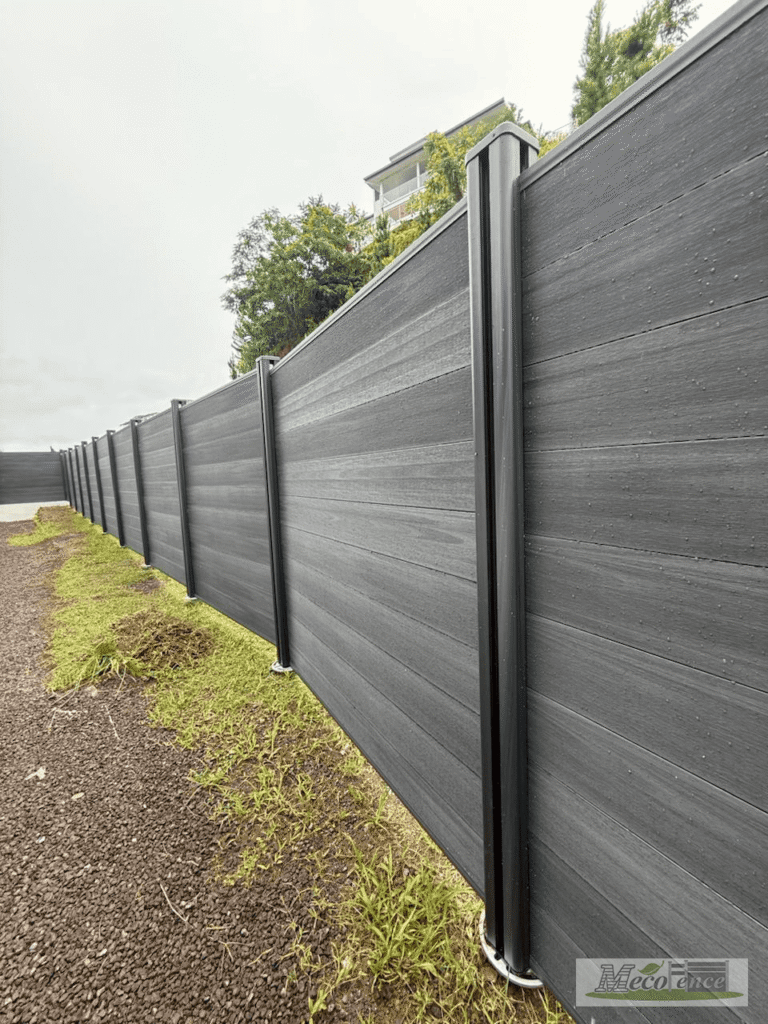
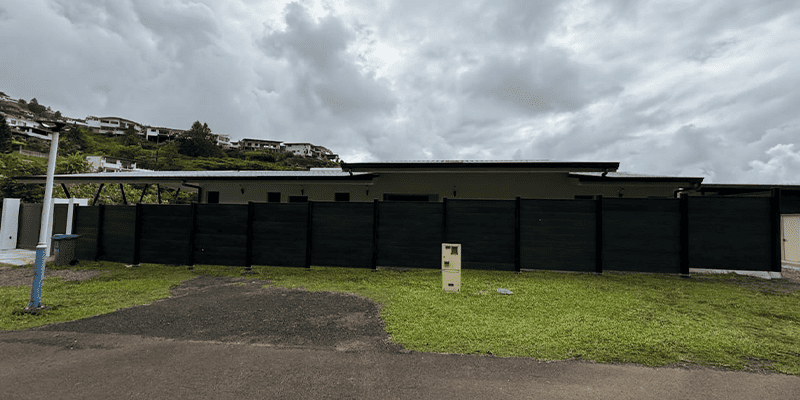
The finished Dark Grey run following the contour of the site — full-privacy horizontal boards on co-extruded WPC posts.

The Project at a Glance

No fancy renders, no design drawings — just a real export order with a clear performance demand.

DetailSpec
LocationFrench Polynesia (South Pacific)
SystemCo-extruded WPC fence post + WPC fence board
Quantity28 sets (factory-direct supply)
ColorDark Grey (color-matched post + board)
ShippedAugust 2025
TerrainSloped coastal hillside
InstallLocal contractor, horizontal full-privacy layout

A tropical island is one of the toughest environments a fence will ever live in. If you want the background on why, our guide to composite fence for coastal areas breaks down the salt-and-UV problem in detail.

Shipping fence to a remote Pacific island isn’t just a product question — it’s a supply question.

The system has to clear certification, survive weeks in a container, and go up cleanly with a local crew and no supplier on site. That’s where buying factory-direct earns its keep.

MecoFence has manufactured co-extruded WPC fence since 2014, and ships to 50+ countries. Here’s what stands behind an order like this:

  • 30,000 m² production facility — 60 extrusion lines, 100+ molds
  • ~2,100 containers shipped per year
  • Certified to ISO 9001, with CE, FSC, SGS and Intertek testing
  • Complete, color-matched kits — every post, board, bracket, base, and cap in the box
  • OEM / ODM and private-label supply for distributors and resellers

Sourcing at volume? Start with our guide to choosing a composite fence manufacturer. That’s the homework this order passed.

Why a Co-Extruded System — Not Just "Composite"

Here’s the honest part most factories skip: not all WPC is built to survive the tropics.

Uncapped, first-generation WPC absorbs moisture, swells, grows mold, and fades fast under hard sun. On a humid Pacific island, that kind of board is a 3-to-5-year product.

Co-extrusion changes the math. A protective polymer shell is bonded over the wood-plastic core in a single pass, sealing it on all sides.

That shell is what fends off UV fade, water ingress, mold, and surface staining — the exact four failure modes a coastal site throws at you. For the engineering comparison, see co-extrusion vs traditional WPC fence.

So the question for this project wasn’t “composite or wood?” It was “which co-extruded system?” That’s the key.

The Backbone: Co-Extruded WPC Fence Post

On a windy hillside, the post is the part that earns its keep. A board can only be as stable as what’s holding it.

Aluminum vs WPC Posts: Why This Project Chose WPC

MecoFence builds both — a premium aluminum post (80 mm, patented Y-slot) and this co-extruded WPC post. So we’ll give you the trade-off straight.

Most WPC fence systems still stand on aluminum, and aluminum is still an excellent post. But the cost math has shifted: prices have climbed, and China removed its 13% export tax rebate on aluminum products (effective December 2024), so aluminum posts shipped from China now land noticeably higher.

The WPC post sidesteps that swing — color-matched to the boards, insulated from the aluminum price-and-rebate squeeze, and, as these 28 sets prove, more than tough enough. For a Dark Grey island project watching cost, it was the obvious pick. Prefer aluminum? We ship that too.

Our WPC fence post is a 4″ × 4″ co-extruded profile with a Surlyn™ shell — the same tough resin used on golf balls — over an HDPE-based composite core.

Inside sits a patented anti-wobble skeleton, so the post stays rigid instead of flexing the way hollow composite posts do.
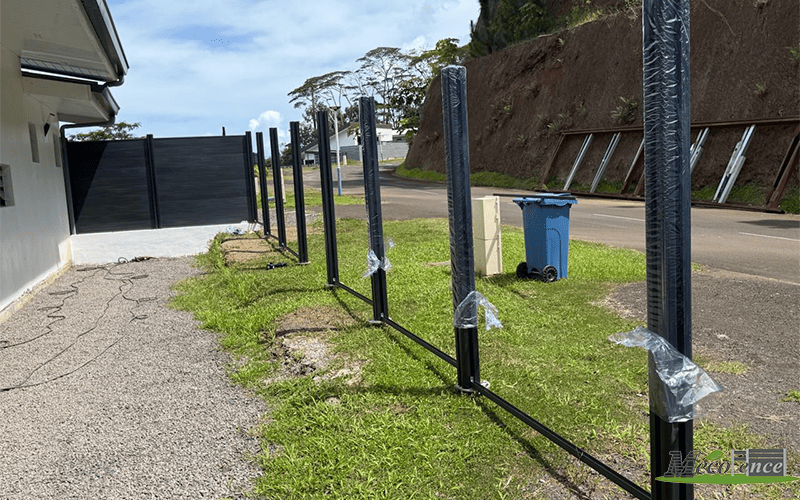
Co-extruded WPC fence posts and steel base rails being installed along a hillside in French Polynesia

Posts set and squared on their steel bases before the Dark Grey boards drop in.
WPC Fence PostSpec
Profile4″ × 4″ (≈110 mm)
Heights6 ft (1830 mm) / 4 ft (1150 mm)
CoreHDPE-based wood-plastic composite
Outer shieldSurlyn co-extrusion (golf-ball resin)
ReinforcementPatented anti-wobble plastic skeleton
Wind70+ mph when properly anchored
ColorsTeak, Dark Grey, Antique

Each post kit ships with the sleeve, steel base, cap, structural inserts, L-brackets, and hardware. Everything a local crew needs to stand it up — in the box.

The Skin: 360° Co-Extruded WPC Fence Board

The boards are where privacy and looks come together — and where the weather hits hardest.

Our WPC fence board is a 180 mm × 24 mm profile wrapped in a 1 mm, 360° co-extrusion cap. Every face is sealed — front, back, and both edges.

That full wrap is why it shrugs off swelling, fading, and staining where a single-side capped board would let moisture creep in from behind. Full stop.
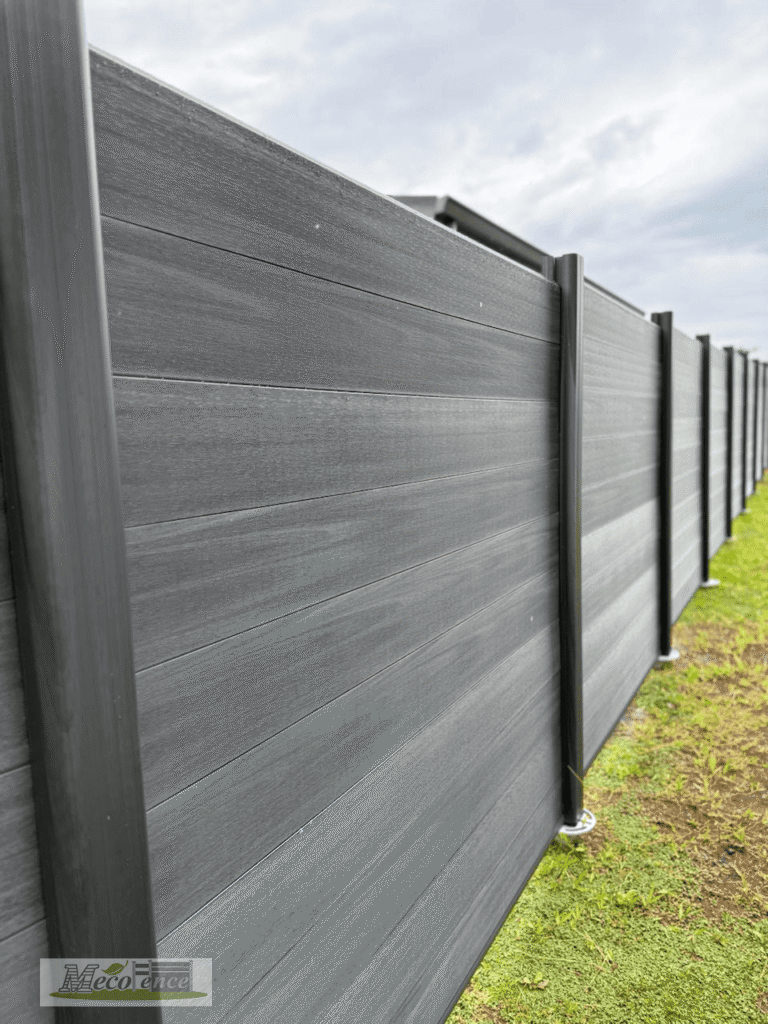
Close-up of Dark Grey 360-degree co-extruded WPC fence boards with natural wood-grain texture between WPC posts
The Dark Grey boards up close — embossed wood grain under a full 360° protective cap.
WPC Fence BoardSpec
Board size180 mm × 24 mm
Cap layer1 mm, 360° co-extrusion
Composition60% wood fiber, 35% HDPE, 5% additives
Temp range−30°C to 70°C
CertificationsFSC, SGS, 100% recyclable
ColorsAntique, Walnut, Teak, IPE, Dark Grey, Ashwood

Post and board ship in the same Dark Grey, so the whole run reads as one clean surface — no mismatched frame fighting the panel.

Tested for the Tropics

Distributors and builders don’t take “weatherproof” on faith. They want numbers. Here are the ones that matter for a hot, wet, windy site:

PropertyResultWhy It Matters Here
Fire resistanceASTM E84 Class ATop flame-spread rating
Operating temp−30°C to 70°CHandles full tropical heat load
Flexural strength27.89 MPaResists bowing in wind
Wind (post, anchored)70+ mphOpen Pacific gusts
Wind (panel test)Intertek Beaufort 9Independently verified
Chemical safetyREACH passImport-compliant

Add the 360° cap — waterproof, mold-proof, insect-proof, UV-stable — and you have a fence that treats salt air as a non-event.

Installing on a Hillside That Won't Sit Still

Flat ground is a luxury this site didn’t have.

The fence line climbs and curves along the contour, so the local crew stepped the panels — each bay set level, dropping a fixed increment to the next as the grade falls.

The modular post-and-board design makes that straightforward: boards slide into the post channels, and the system handles slopes up to 45° plus multi-angle corners.
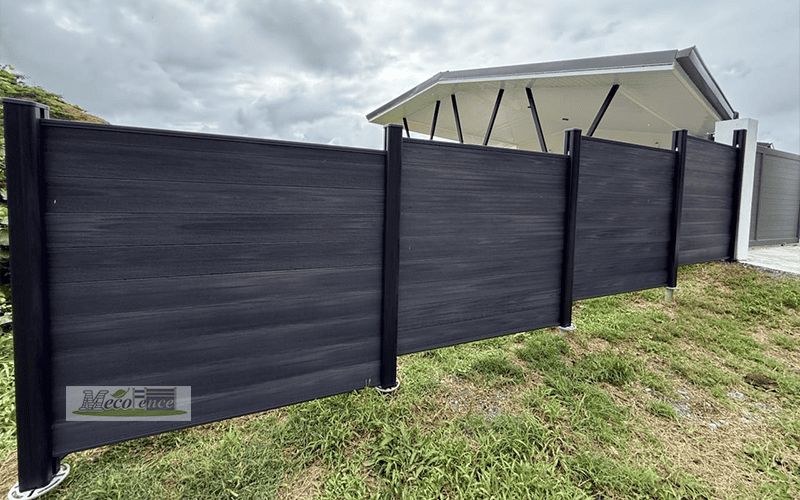
Dark Grey WPC fence panels stepping up a grassy hillside slope in French PolynesiaStepped bays follow the grade — each panel level, the line stepping down the slope.

Posts were anchored on their steel bases — the right move for both the slope and the wind load off open Pacific terrain. Because the kit ships complete and color-matched, a local contractor can build it without specialist tooling or back-and-forth with the factory.

Want the full method? Our installation guide for slopes and uneven ground covers stepping vs. raking, footing depth, and spacing.
Who We Supply — Factory-Direct

This project is a small order doing a big job. It also shows how we work: factory-direct, no middleman.

That model serves three kinds of buyers:

  • Distributors & resellers — wholesale pricing, container loads, OEM / private-label options.
  • Contractors & installers — complete, color-matched kits that go up fast with standard tools.
  • Project buyers — single-site supply for residential, commercial, or remote-market jobs.

Because everything ships in the box and the boards self-align, the supplier doesn’t need to be on site. That’s exactly what makes a remote market like French Polynesia workable.

Sourcing for resale or a project? Our composite fence range lists every profile, and our manufacturer sourcing guide covers MOQ, lead times, and what to ask before you commit.

The Result: 28 Sets, One Clean Line

Finished, the fence does exactly what the customer needed — full privacy, a modern Dark Grey face, and a profile that holds up to the island climate.
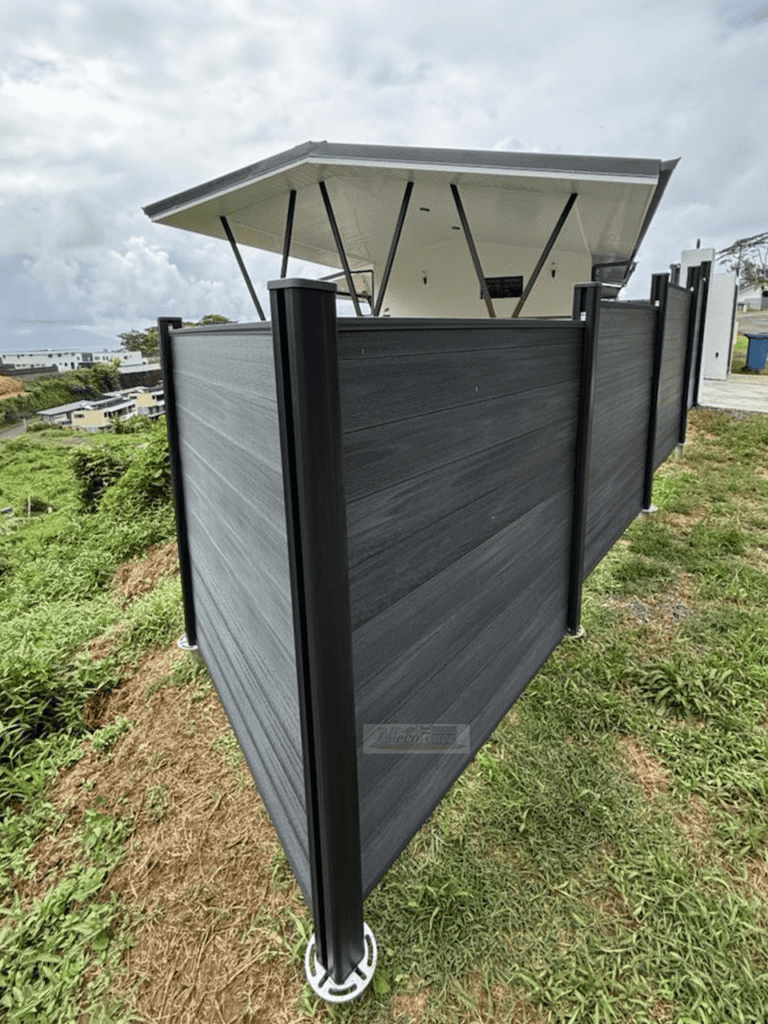
Dark Grey WPC fence panels stepping up a grassy hillside slope in French Polynesia
A corner bay on the exposed hilltop — the run wraps the boundary without a visible seam.

Backed by a 20-year residential / 15-year commercial warranty and a 25+ year design lifespan, this is a fence the owner can forget about — which, on a remote island, is the whole point. That’s it.

Playbook: Sourcing a Composite Fence for a Tough Climate

Buying for a humid, high-UV, windy site — or for resale into one? Use this checklist before you order.

  • Demand 360° co-extrusion on boards — a single-side cap leaves the back open to moisture.
  • Choose solid-core WPC posts over hollow — internal reinforcement resists flex under wind.
  • Check certifications — ISO 9001, ASTM E84, REACH and SGS/Intertek reports clear customs and reassure buyers.
  • Confirm complete kits — color-matched post, board, brackets, base and cap, so a local crew can install without you.
  • Leave expansion gaps — composite moves with temperature; honor the spec’d clearances.
  • Plan slopes early — decide stepped vs. raked panels before posts go in.

Get those six right and a composite fence will outlive most things on the property. New to the category? Start with our pillar guide: what is composite fencing.

Next Steps

This French Polynesia project is proof that a co-extruded post-and-board system belongs in the harshest climates — and that factory-direct supply reaches even the most remote markets.

If you’re sourcing for an island, coastal, or high-wind site — for a single project or for resale — the playbook above is your shortcut. Match it to our composite fence range and you’re most of the way there.

Have a tricky site or a wholesale enquiry? Let’s talk through it.

Written by

Steven He

Co-Founder & Head of Product · MecoFence

Steven leads product development and B2B partnerships at MecoFence, a WPC composite fence manufacturer based in Guangdong, China. 10+ years in composite material manufacturing, covering formulation, extrusion process engineering, and export supply chain.

Frequently Asked Questions

Yes. As a factory-direct manufacturer we supply distributors, contractors, and resellers with wholesale pricing, container loads, and OEM / private-label options. Ask us for MOQ and lead times.

We ship roughly 2,100 containers a year to 50+ countries, including remote markets like French Polynesia. Kits arrive complete and color-matched, so a local crew can install without the supplier on site.

We offer both, so it comes down to cost and color. Aluminum prices are high and China removed its 13% export tax rebate on aluminum (effective December 2024), so aluminum posts now land more expensively. A co-extruded WPC post avoids that swing and is color-matched to the boards — while still rated for 70+ mph winds when anchored. Aluminum remains available if you prefer it.

The 1 mm, 360° cap seals every face of the board, so it stays waterproof — no swelling, cracking, rot, mold, or insect damage in humid coastal air.

The Surlyn co-extrusion shell over the WPC core is engineered for UV stability, so the post resists fading and color loss even under year-round equatorial sun.

Yes. The modular system supports slopes up to 45°, multi-angle corners, and stepped bays — exactly how this French Polynesia hillside was done.

The order was 28 sets of Dark Grey co-extruded post and board, shipped August 2025. It carries a 20-year residential / 15-year commercial warranty and a 25+ year design lifespan.

Table of Contents

Sourcing Composite Fence for a Tough Climate — or for Resale?

Our factory-direct composite fence systems are built to survive UV, salt air, humidity, and wind — with wholesale pricing, container loads, and OEM options for distributors and contractors worldwide. Get spec sheets, certifications, and a project or wholesale quote.

Request a Wholesale Quote →