
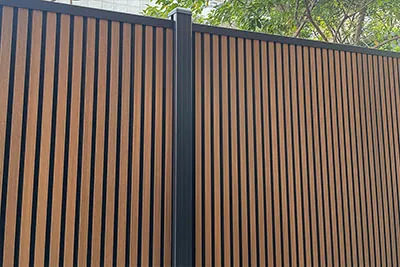
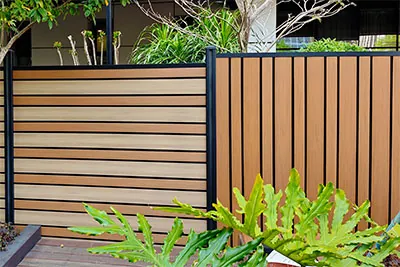
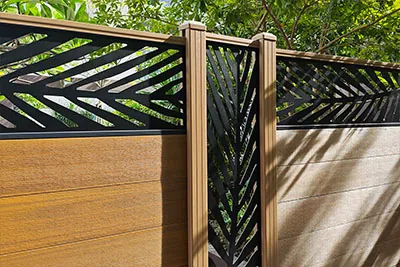
Most composite fence suppliers send the Philippines a landing page. This May, we sent a plane ticket.
Our team spent 10 days on the ground — Manila to Cebu and back — walking the same aisles your customers walk. We didn’t fly in to explain WPC to a market that already sells it. You know this market better than we ever will; treat this as a second opinion from an outside set of eyes, not a lecture.
Here’s the honest version. Not a brochure — a field report.
And yes, we’ll tell you plainly where our fence doesn’t fit, too. That part matters more than the sales pitch.
The Cheap-WPC Reckoning Has Already Started
You already know WPC isn’t new here. It’s on the shelves, it’s in the subdivisions, and your customers stopped asking “what is this material?” years ago.
Here’s what’s changing underneath that — and it’s the part worth your attention.
The first wave of cheap WPC is starting to fail in the field.
Those early low-price imports — especially the hollow, round-hole profiles — have now spent years under the Philippine sun and monsoon. And it shows: cracking, fading, sagging, surfaces chalking out.
The reason isn’t a mystery once you see how the board is built. Bargain product skips the protective outer skin, so UV and moisture attack the raw composite directly. We broke this down in our guide on co-extrusion vs. traditional WPC — read it before you commit to any supplier.
What does that mean for your business? The customers who bought on price the first time are coming back wanting something that lasts.
That’s not a threat. That’s the upgrade cycle opening up.
| What’s in the field | Bargain Hollow WPC | MecoFence Co-Extruded |
|---|---|---|
| Core | Hollow, round-hole 18mm board | Round-hole 24mm board |
| Outer layer | None (raw composite) | Co-extruded ASA/PE cap |
| After 3 years of PH sun | Cracks, chalks, fades | Color-stable, intact |
| Typhoon wind | Flexes, fails | Beaufort Level 9 tested |
| Posts | Thin steel (rusts) | 80×80mm aluminum |
| Warranty | None | 15–20 years |
Why Fence Is the Easiest Upgrade Sell on the Property
Of everything made from WPC, a fence is where failure hurts most — and where the upgrade sells itself.
A tired deck board is annoying. A fence that warps, fades, or splits is visible from the street, and the owner can’t ignore it.
It’s the first thing a visitor sees and the literal boundary of the property. When the fence looks cheap, the whole property looks cheap.
So when a homeowner or developer has already been burned by a failing fence, a solid-board, co-extruded composite fence isn’t a hard sell. It’s the obvious fix.
That’s your opening. Full stop.
What Separates a Composite Fence That Survives in the Philippines
If you’re going to stock quality and charge for it, you need to defend why it’s worth more. From what we saw on site, three things decide whether a fence holds up in Philippine conditions.
These are the questions worth asking any supplier:
- A real co-extruded cap layer. This is the UV and moisture shield. No cap, and you’re back to the chalking, fading product your market is already tired of.
- Built for heat, storms, and salt. With store-floor afternoons near 40°C, around 20 typhoons a year, and aggressive coastal salt air, heat stability, wind rating, and corrosion resistance aren’t optional.
MecoFence panels are tested to Beaufort Level 9 wind resistance and built to survive coastal salt and wind — and to stay flat where cheaper boards warp, which is exactly what makes a fence heat-resistant in a hot climate. And the post matters as much as the panel: aluminum posts don’t rust the way thin steel does in Cebu, Cavite, or Batangas.
Stock a fence that ticks those three boxes, and the failing cheap product already in the field becomes your sales pitch — not your competition.
Where the Quality Play Actually Wins
You know your own customer base far better than we do. But here’s one pattern worth a second look.
When a shop carries ten brands with no clear hero, every sale comes down to price.
And price is a race that’s hard to win against a container of commodity board. Picking one quality line to be known for is how you stop competing on price alone.
The opening we kept seeing is the opposite move: becoming the recognized quality fence name in your city. Demand for that is concentrated where a cheap fence visibly fails and someone gets blamed:
- Coastal and resort projects — where salt and wind eat lesser materials in a season or two.
- Modern subdivisions and mid-to-high-end homes — where the fence is part of the look, not just the boundary.
- Spec-driven work through architects and designers — the people who write “composite” into the drawings before a single board is ordered.
That’s where a premium fence earns a margin instead of defending one.
We Don't Just Ship. We Show Up
Most suppliers have a Philippines landing page. Very few have a Philippine boarding pass.
The difference shows up in how the relationship feels after the first order lands. So here’s a taste of how we work, straight from this trip.
One distributor took us three separate visits before we got past the front desk — phones that wouldn’t connect, a manager who was “always busy,” a relationship built one message at a time.
On our last day in the area we came back anyway, with a large sample, fully expecting another dead end. A genuinely kind security guard drove off on his motorbike to track someone down. We finally met the owner — who, it turned out, had been quietly reading our material the whole time.
In Cebu, in nearly 40°C heat, we walked past a shop with sharp-looking panels on display, went in cold, and asked for the office. That curiosity turned into one of the best conversations of the trip.
We don’t share this to brag. We share it because this is what a supplier with a plane ticket does that one with a landing page never will: knock until someone opens the door — and keep showing up.
The fence is the easy part. The partner standing behind it for the next 15 years is what you’re actually buying.
Proof, Not Just a Promise
Here’s the part that matters more than any travel story: we’ve been supplying composite fence to Philippine homes since at least 2021.
This is one customer’s install — a walnut-tone privacy fence with a slatted top and black aluminum posts, on a residential lot. Years of Philippine sun, rain, and humidity later, it’s still doing its job.
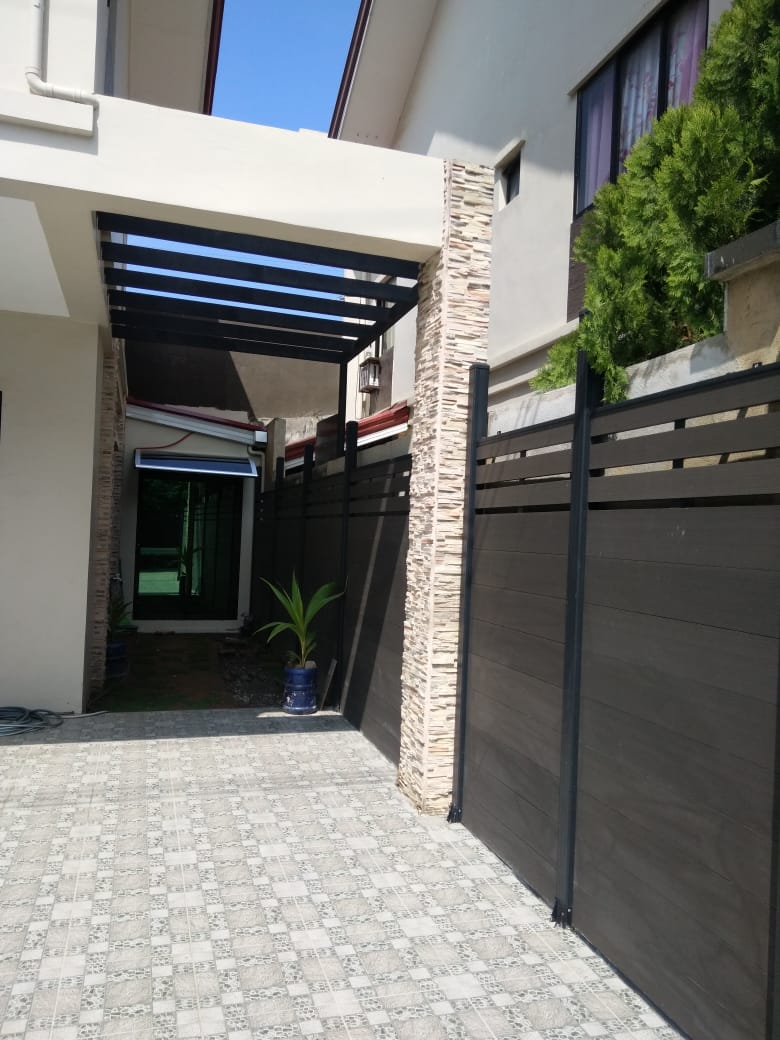
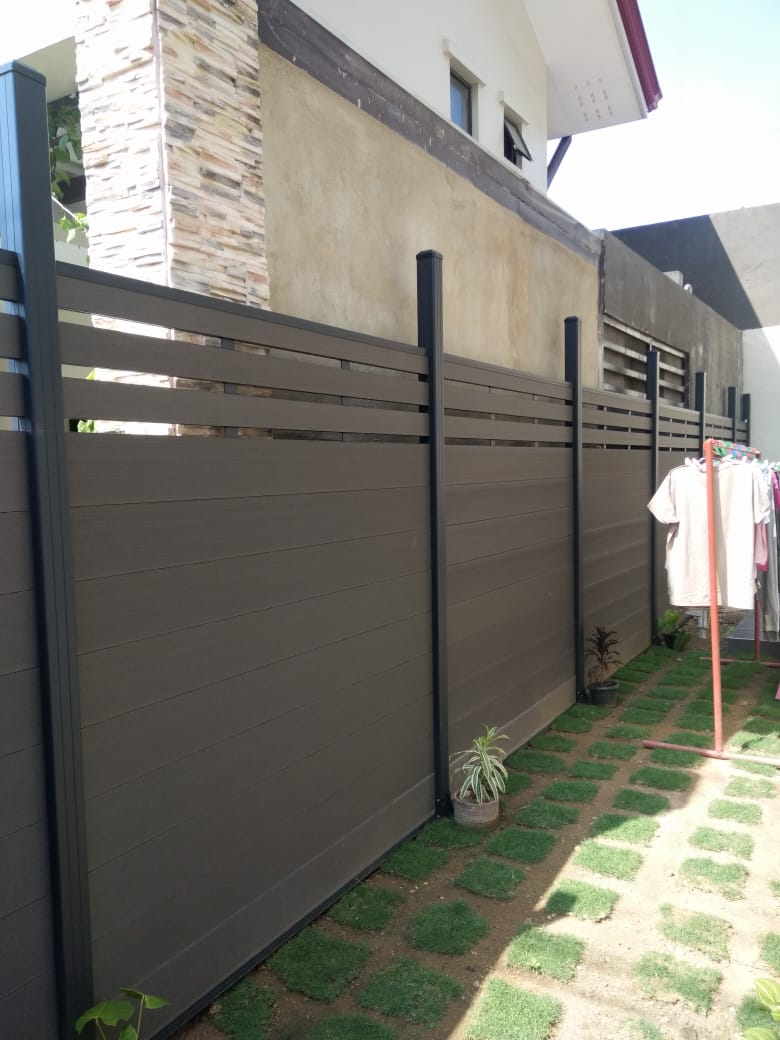
A MecoFence customer’s composite fence in the Philippines — installed back in 2021, still standing strong.
That’s the difference between a board that’s new to the market and one that’s already proven in it.
How a First Order Works — and What You Actually Get
Enough principle. Here are the numbers a Philippine importer actually needs before saying yes:
- MOQ: 100 sets — a realistic first order, not a full-warehouse gamble.
- Container sharing (LCL) supported — you don’t have to fill a 40HQ on your own; consolidate with other items to keep your landed cost sensible.
- Free samples — you only pay the freight. Put real board in front of your clients before you commit a single peso to production.
- Lead time you can plan around — roughly 15–20 days production, then about 2–3 weeks ocean freight to Manila or Cebu. Need it faster? Rush handling can be quoted separately.
- Complete kits — panels, 80×80mm aluminum posts, caps, and hardware in one shipment, so your contractor isn’t chasing five suppliers.
- Checked before it ships — every order is inspected before loading, and we handle any shortage or transit-damage claim directly, not through a generic inbox.
- Marketing support that helps you sell — short product videos, catalogs, and spec sheets you can put straight in front of your own clients. We help you move the product, not just ship it.
And to be straight with you: if your whole game is rock-bottom price, we’re not your supplier — the cheapest northern-China board will always undercut us. We’re built for the dealer who wants to sell quality and keep the margin.
While composite fence is our focus — and yours, if you want to own that keyword in your market — the same solid-core, co-extruded quality runs through our decking and outdoor ceiling lines too, for the day you’re ready to grow the range.
But first things first. The fence is the front door, and the front door is where we’re focused.
Want the full primer to share with your team? Start with our pillar guide on what composite fencing is, then read our first look at the Philippine wholesaler opportunity.
The Bottom Line
The composite fence category in the Philippines is past “new” — and not yet crowded at the top.
The bottom is a price war you don’t want to win. The top — solid board, real co-extrusion, coastal durability, and a supplier who actually turns up — is wide open.
And the customers burned by cheap product the first time? They’re shopping for the upgrade right now.
We saw it with our own eyes, across two cities and a lot of 40°C afternoons. And we’ll be back — because that’s how we enter every market.
Not with a landing page. With a plane ticket.
Frequently Asked Questions
Yes — WPC is already widely sold and installed, and customers no longer need the material explained. The real shift is toward quality: the first wave of cheap, hollow product is now failing, and the buyers who chose it on price are looking for something that lasts.
The bargain hollow profiles imported years ago are cracking, fading, and sagging because they lack a protective co-extruded cap layer. That failure is creating a clear upgrade cycle — a chance to sell a solid-board replacement to customers who already know the cheap option let them down.
Three things: a solid (not hollow) core, a genuine co-extruded cap layer for UV and moisture protection, and storm-and-salt performance — Beaufort Level 9 wind rating and rust-proof aluminum posts for coastal areas like Cebu, Cavite, and Batangas.
Where a cheap fence visibly fails: coastal and resort projects, modern subdivisions and mid-to-high-end homes, and spec-driven work through architects and designers — rather than bottom-of-market, price-only retail.
Yes. Our team spent 10 days on the ground across Manila and Cebu in May 2026, and we plan to keep coming back to support distributors in person — not just ship containers from afar.
The MOQ is 100 sets, and container sharing (LCL) is supported — so you don’t need to fill a full 40HQ to start. Samples are free; you only pay the freight. Plan for roughly 15–20 days production plus about 4–5 weeks ocean freight to Manila or Cebu (rush handling quoted separately).
Written by
Steven He
Co-Founder & Head of Product · MecoFence
Steven leads product development and B2B partnerships at MecoFence, a WPC composite fence manufacturer based in Guangdong, China. 10+ years in composite material manufacturing, covering formulation, extrusion process engineering, and export supply chain.
Table of Contents
Ready to Be the Quality Fence Name in Your City?
MecoFence ships factory-direct composite fence kits from Foshan to Manila and Cebu — solid-core, co-extruded, Beaufort 9 wind-rated, with flexible first orders and a Southeast Asia support team behind every container.
Get Factory-Direct Fence Pricing →