
Written by the MecoFence engineering team — Foshan MexyTech Co., Ltd, a composite fence manufacturer since 2009, supplying 50+ countries. Our boards are certified by Intertek, SGS, and ISO 9001, tested to ISO 11359-2 and ASTM D648, with an optional fire-rated grade tested to ASTM E84.
Most “best fence for heat” guides are written by local installers. This one is written by the people who make the fence panel — so the numbers below come from our own test reports, not secondhand summaries.
Reviewed for accuracy against our published test reports · Last updated June 2026
In late May 2026, the UK broke its all-time May temperature record twice in two days. Portugal hit 40.3°C. Summer arrived in spring.
If you sell, install, or buy fencing for a hot market, that headline is a buying signal. Because the question every customer is about to ask is simple: will this fence warp in the heat?
Here is the honest answer most suppliers dodge: every fence material moves in heat. Wood, vinyl, aluminum, composite — all of it. The real question is not whether a material moves, but whether it was engineered to move without failing.
That distinction is the whole game. Let’s get into it.
Why "heat-resistant" stopped being optional in 2026
This isn’t a one-off hot week. The trend line is the story.
- The World Meteorological Organization puts an 86% chance that at least one year between 2026–2030 beats 2024 as the hottest ever recorded.
- NOAA’s summer 2026 outlook flags above-normal heat across most of the U.S. — 36 states leaning hotter than average.
- Western Europe is now warming at roughly twice the global average rate, and the May heat dome pushed the continent straight into mid-July extremes.
For a fence, sustained high heat means one thing: repeated expansion and contraction cycles, day after day, summer after summer.
A cheap board survives one hot afternoon. A heat-resistant composite fence survives a decade of them. That’s the difference your customer pays for — even if they don’t know it yet.
Want the bigger picture on the material first? Start with our complete 2026 guide to composite fencing.
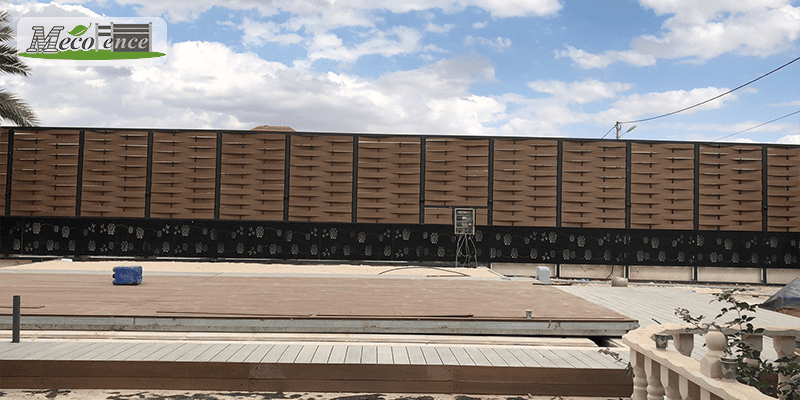
Short answer: a quality co-extruded composite fence does not warp in normal heat. It expands and contracts slightly with temperature, but our heat-grade boards stay dimensionally stable to a deflection temperature as high as 122°C — far above the surface temperature a fence reaches even in full desert sun. Warping happens only when a low-grade board is installed too tightly, with no expansion gap.
Composite fencing (WPC) is a blend of HDPE plastic and wood fiber. Like all thermoplastics, it expands when hot and contracts when cool. That’s physics, not a defect.
What matters is how much it moves, and at what temperature it starts to soften. Here are the tested numbers for MecoFence board:
| Property | Test Standard | Result | What It Means |
|---|---|---|---|
| Linear Thermal Expansion | ISO 11359-2:2021 | 4–61 ×10⁻⁶ K⁻¹ | Predictable, plan-able movement (varies by formula) |
| Deflection Temperature | ASTM D648-18 | up to 122°C | Holds its shape up to 122°C before softening |
| Fire Rating (optional grade) | ASTM E84 | Class A (FSI 25) — on request | Available as a special fire-rated board; standard boards are not fire-rated |
| Shore Hardness | ASTM D2240-05 | 70 D | Hard, dense surface that resists denting in heat |
Figures reflect our heat-optimized grades and represent best tested results; values vary by board formula. Ask for the test report on the specific SKU you’re sourcing.
The number that matters most is the deflection temperature — as high as 122°C on our heat-grade boards. Here’s why it settles the warping question:
Independent surface-temperature tests show even a dark composite board in full summer sun reaches about 150°F (≈65°C) — and laser-thermometer comparisons put capped composite right in the middle of common fence materials, cooler than dark-stained wood. That 65°C surface peak sits roughly 57°C below the 122°C point where the board would start to soften.
In plain terms: the worst-case real-world heat doesn’t come close to the temperature where shape loss begins. That’s the safety margin you’re paying for.
So does it move? Yes — at most around 6 mm per meter across a 100°C swing (less for many formulas), which is why installers leave a defined gap. Does it warp, sag, or buckle when specified and installed correctly? No.
For the full engineering breakdown of expansion math and gap calculations, see our composite fence installation guide.
Best fence materials for hot weather, compared
In hot climates, the strongest performers are composite, aluminum, and vinyl; wood is the weakest because UV and heat dry it out and crack it. Each material trades off differently across heat tolerance, fade resistance, surface temperature, and maintenance.
Here’s the honest side-by-side — not just for composite, but for every common option.
| Material | Heat / Shape Stability | UV / Fade Resistance | Hot to Touch? | Maintenance |
|---|---|---|---|---|
| Composite (capped WPC) | High — stable up to 122°C deflection temp | High — ASA/PE cap blocks UV | Moderate (dark ≈150°F); lighter colors cooler | Low — occasional rinse |
| Aluminum | High — won’t warp | High — powder-coated | High — conducts heat (black ≈150°F+) | Low |
| Vinyl (PVC) | Moderate — can bow/warp in dark colors | Moderate — may discolor | Low — doesn’t absorb much heat | Low |
| Wood | Low — dries, cracks, warps | Low — fades to grey in months | Low–Moderate | High — re-stain every 1–2 yrs |
The takeaway most suppliers won’t say plainly: every material has a weakness in heat. Aluminum stays straight but burns to the touch. Vinyl stays cool but can bow. Wood looks great for one summer, then fades.
A capped composite fence is the option that balances all four columns — which is why it keeps showing up as the recommendation for hot, sunny regions.
New to the material? Start with our pillar guide: what is composite fencing.
The honest limitations (no fence is perfect)
A page that claims a product has zero downsides isn’t worth trusting. So here are the real trade-offs of a composite fence in hot climates — and how to manage each.
- Dark colors get hot to the touch. A black or deep-brown board can hit ≈150°F in full sun. Fix: choose lighter shades (teak, ashwood, sand) for play areas or south-facing runs.
- It costs more upfront than wood or basic vinyl. You pay more per board for the cap layer and polymer. Fix: weigh it against zero re-staining and a 15–20 year service life — the lifetime cost usually wins.
- It still moves, so installation matters. Skip the expansion gap and even a great board can buckle. Fix: follow the gap spec and use a floating post — the section below covers this.
- Low-grade composite still fades. Uncapped or cheap boards can chalk in 5–10 years of harsh sun. Fix: insist on a co-extruded ASA/PE cap, not a surface coating.
None of these are deal-breakers. They’re just the difference between buying smart and buying blind.
Built for heat from day one — not adapted later
Here’s a piece of company history that matters for buyers.
MecoFence wasn’t designed for mild climates and then exported to hot ones. Our first markets were island and sunshine-beach regions — starting in New Zealand — where products face very high temperatures and typhoons from the start.
That origin shaped everything: the board formula, the cap layer, the post system. When you engineer for the harshest case first, the easy climates take care of themselves.
Three design choices carry the heat performance:
- 24mm professional-grade board — thick enough to resist the flex thin boards show under thermal load.
- Co-extrusion ASA/PE cap — a fused outer shell that shields the core from UV and locks in color.
- Patented Y-slot aluminum post — the part that quietly absorbs all that movement (next section).
Selling into a coastal or salt-air market too? The same engineering applies — see our guide to composite fence for coastal areas.
The secret to surviving heat is the post, not the board
Most people stare at the boards. The engineers stare at the post. Because that’s where heat failures actually happen.
When a board expands and has nowhere to go, it does one of three ugly things: it bows, it pinches, or it cracks. The fix isn’t a stronger board — it’s a post that gives the board room to breathe.
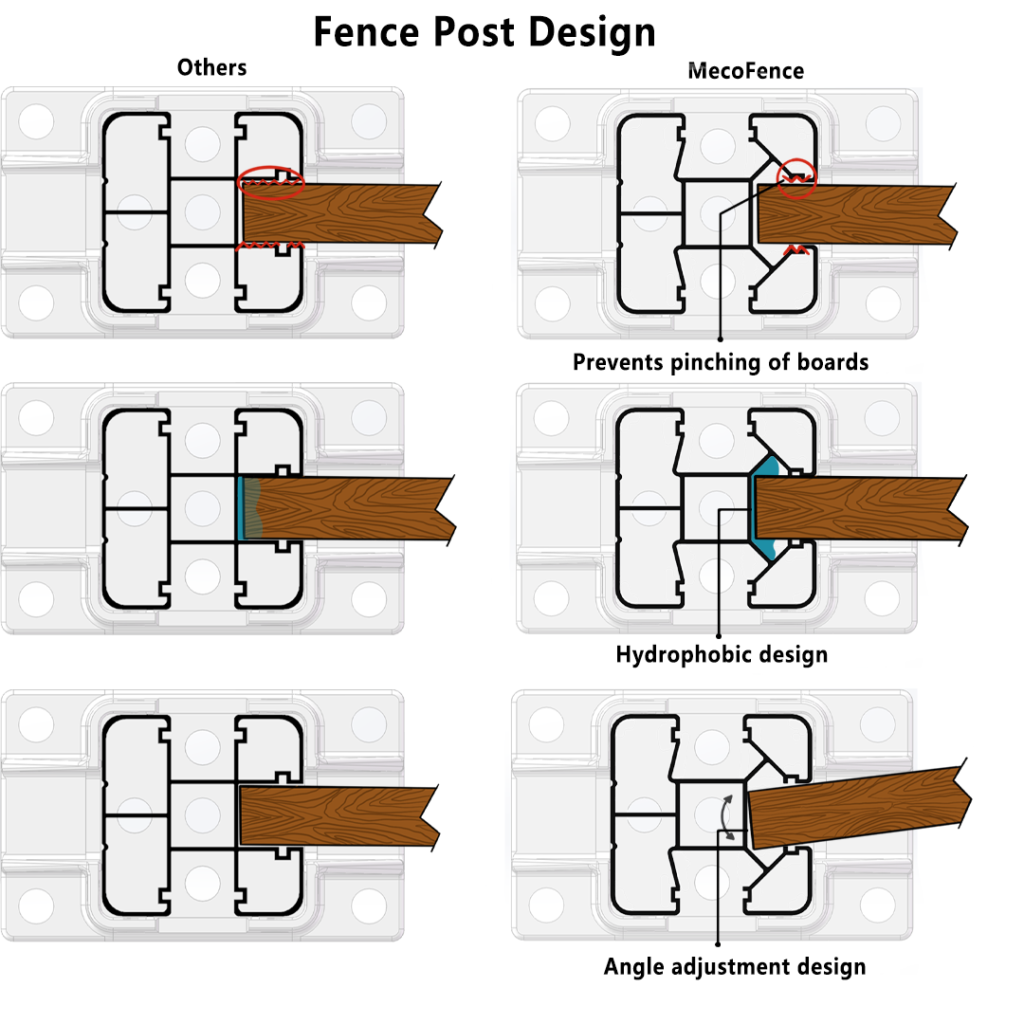
That’s what the MecoFence patented Y-slot aluminum post (80mm × 80mm) is built to do:
- Anti-pinch geometry — the Y-shaped channel reduces contact and friction, so boards expand and contract freely between posts.
- Drainage trough — the hydrophobic notch sheds rainwater fast, so heat-expanded boards never sit in trapped water.
- Small-angle adjustment — boards flex slightly within the channel to follow terrain without binding.
The result for the end user? They feel nothing. No creak, no gap, no warp. The fence just sits there looking the same in August as it did in March.
Invisible performance is the performance. That’s the part competitors can’t copy on a spec sheet.
Heat's quiet partner: UV fade
Hot climates don’t just bring temperature. They bring relentless UV. And UV is what fades a cheap fence from rich teak to chalky grey in two summers.
This is where co-extrusion earns its keep. Instead of color running only through a raw WPC body, a co-extruded board fuses a tough ASA or PE cap layer around the core during manufacturing.
That cap is the sunscreen:
- Blocks UV before it reaches the wood fiber, slowing fade dramatically.
- Seals out moisture, so heat-then-rain cycles don’t swell the core.
- Resists stains and scuffs on a surface that’s hot to the touch.
An uncapped board has none of this armor. In a hot, sunny market, that’s the difference between a 15-year fence and a 5-year complaint.
The full comparison is here: co-extrusion vs traditional WPC fence.
The installer's hot-weather playbook
Great material gets ruined by a rushed install. If you’re putting up a heat-resistant composite fence in a hot climate, these five rules protect the warranty.
- Leave the expansion gap. Never butt boards tight end-to-end. Follow the manufacturer’s gap spec — the board needs room to grow lengthwise on a 40°C day.
- Install at a representative temperature. Fitting boards tight on a cold morning guarantees a squeeze by afternoon. Account for the day’s range.
- Don’t over-fasten. Boards must float, not be pinned rigid. The Y-slot post is designed for movement — let it move.
- Acclimate the boards. Let stock sit on-site for 24–48 hours so it reaches local temperature before cutting.
- Use the matched hardware. All-aluminum or stainless components resist heat and corrosion; mixed cheap fasteners are the first thing to fail.
Get these right and thermal movement becomes a non-event. That’s the goal — a fence nobody ever has to think about.
Sourcing for a hot market? Use this spec checklist
If you’re a distributor or importer vetting suppliers for a hot-climate region, screen every quote against these five questions.
| Ask the Supplier | What a Heat-Ready Answer Looks Like |
|---|---|
| Is the board co-extruded (capped)? | Yes — ASA or PE cap, not uncapped WPC |
| What’s the deflection temperature? | High — MecoFence heat grades test up to 122°C (ASTM D648) |
| Is there documented thermal expansion data? | Tested figure (e.g. ISO 11359-2), not “it doesn’t move” |
| Does the post system allow movement? | Anti-pinch / floating design (e.g. Y-slot) |
| Need a fire rating for code or wildfire zones? | Confirm a fire-rated grade is available — MecoFence offers ASTM E84 Class A on request |
If a supplier can’t answer all five with numbers, they’re selling you a mild-climate fence for a hot-climate problem.
MecoFence ships with all five documented — and certified by Intertek, SGS, and ISO 9001. See the full range on our composite fence product page.
The takeaway
Heat isn’t the enemy of composite fencing. Bad engineering is.
A board moves — that’s physics. A heat-resistant composite fence moves without anyone noticing, because the formula, the cap, and the post were all designed for the hot case first.
With 2026 already breaking records, that’s not a nice-to-have. For a hot-market buyer, it’s the spec sheet that prevents next summer’s complaints.
Spec it right once. Forget about it for 15 years. That’s the deal.
Frequently Asked Questions
No. A quality co-extruded composite fence can have a deflection temperature as high as 122°C, far above the surface temperature a fence reaches even in direct desert sun. It expands and contracts slightly with temperature, but a correctly specified and installed board will not warp, sag, or melt.
MecoFence board has a tested linear thermal expansion coefficient of 4–61 ×10⁻⁶ K⁻¹ (ISO 11359-2), depending on formula. In practice that's at most around 6 mm per meter across a 100°C temperature swing — small and predictable, which is why installers leave a defined expansion gap and use a floating post design rather than pinning boards rigid.
A co-extruded composite fence has a fused ASA or PE cap layer that blocks UV before it reaches the core and seals out moisture. Uncapped WPC and natural wood have no such barrier, so they fade and chalk far faster in hot, sunny climates.
Look for a co-extruded composite fence with a high deflection temperature (MecoFence heat grades test up to 122°C), documented thermal expansion data, and an anti-pinch floating post system. If your project is in a wildfire zone or has a fire-code requirement, ask whether a fire-rated grade is available — MecoFence offers an ASTM E84 Class A board on request.
Standard composite fence boards are not fire-rated — don't assume any composite carries a fire rating by default. For wildfire zones or fire-code projects, MecoFence offers a dedicated fire-rated grade tested to ASTM E84 Class A (FSI 25), the highest flame-spread classification under that standard. Specify it explicitly when you order, and request the test report for the exact board.
MecoFence heat-grade board has a tested deflection temperature up to 122°C (ASTM D648) — the point at which it would begin to soften. Since even a dark board in full sun peaks around 65°C, real-world heat stays well inside that limit, which is why a correctly installed board holds its shape.
Written by
Steven He
Co-Founder & Head of Product · MecoFence
Steven leads product development and B2B partnerships at MecoFence, a WPC composite fence manufacturer based in Guangdong, China. 10+ years in composite material manufacturing, covering formulation, extrusion process engineering, and export supply chain.
Table of Contents
Sourcing Fence for a Hot Climate?
MecoFence composite fence systems were engineered for high-heat, high-UV markets from day one — with deflection temperatures up to 122°C and ASA/PE co-extrusion, plus an optional ASTM E84 Class A fire-rated grade for wildfire and fire-code projects. Get full spec sheets, test reports, and sample boards.
Request a Free Sample Kit →