
Most of what you’ve read about composite fencing is either five years out of date or written for a homeowner buying six panels at Home Depot.
You’re not that buyer.
You’re sourcing containers. You’re bidding commercial jobs. You’re trying to figure out whether this material is worth switching your entire inventory over — or if it’s just another overhyped trend.
Here’s the short answer: composite fencing in 2026 is not the same product it was in 2020. The technology has fundamentally changed. The economics have shifted.
The 30-second definition (then we go deeper)
Composite fencing is an engineered fence system made from wood-plastic composite (WPC) — a blend of wood fiber, high-density polyethylene (HDPE), and chemical additives — formed into boards, panels, and posts through an extrusion process.
Think of it as a hybrid material.
It borrows the look and feel of natural timber. It borrows the durability and weather resistance of engineered plastic. And when manufactured correctly, it outlasts both.
But here’s where it gets interesting for professionals: the term “composite fencing” now covers two fundamentally different generations of product.
Generation 1: Traditional WPC (The "Original")
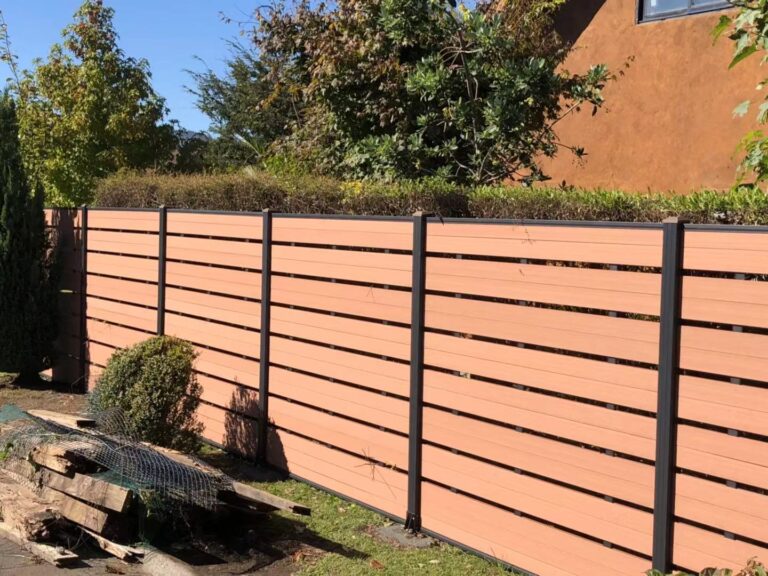
This is what most people picture when they hear “composite fence.”
- Composition: ~60% wood fiber + ~30% HDPE + ~10% additives
- Surface: Basic 3D embossing or sanding directly on the WPC core
- Post system: Typically WPC composite posts (same material as boards)
- Price point: $45–65 per 6ft × 6ft set (FOB China, Q1 2026)
First-gen WPC was revolutionary when it launched. No rot. No termites. No annual staining.
But it has real weaknesses that contractors know all too well:
- Fading. UV exposure degrades the unprotected surface. Colors wash out within 2–3 years in high-sun climates like Arizona, Australia, or the Middle East.
- Scratching. The raw WPC surface is soft. Pets, garden tools, and even pressure washing can leave permanent marks.
- Moisture absorption. Without a protective shell, the wood fiber component can absorb water over time, leading to swelling and mold in humid climates.
- Plastic appearance. Embossing patterns repeat every few feet. Up close, it looks manufactured — not natural.
First-gen WPC still sells. It’s cheaper. Some markets still accept it.
But the professional market has moved on.
Generation 2: Co-Extrusion WPC (The "Shield")
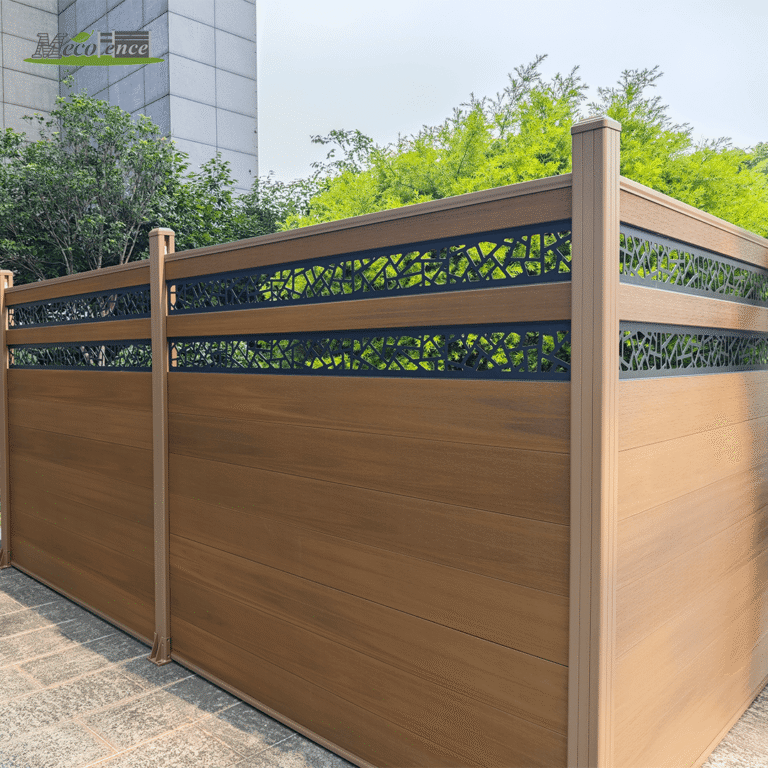
This is where the industry is headed — and where the margin lives.
Co-extrusion means wrapping the WPC core in a 360° protective polymer shell during the extrusion process. The shell and core are bonded at the molecular level. They don’t peel, delaminate, or separate.
The cap layer is typically made from one of three materials:
- PE (Polyethylene): The current market standard. Good UV resistance, hydrophobic surface, solid scratch protection.
- ASA (Acrylonitrile Styrene Acrylate): Originally developed for automotive exteriors. Superior UV stability and color retention under extreme heat. The premium choice.
- Surlyn (DuPont ionomer resin): Ultra-tough, self-healing surface. High-end applications.
What does the cap actually do?
- Blocks UV degradation — color retention measured in decades, not years
- Zero water absorption — the polymer shell is hydrophobic; moisture can’t reach the wood fiber core
- Scratch defense — the dense outer layer resists pet claws, tools, and abrasion
- Kills the “plastic look” — brushed finishes scatter light, creating a matte, architectural aesthetic instead of a shiny, synthetic one
Price point: $80–130+ per 6ft × 6ft set (FOB China, co-extrusion with aluminum posts, Q1 2026).
Yes, it costs more. Roughly 40–80% more than first-gen.
But that’s the wrong comparison. Compare it to what your customers actually want — a fence that looks premium, lasts 25+ years, and generates zero callbacks. Compare it to the cost of a wood fence that needs staining every 2 years and post replacement every 7.
That’s the real math.
Anatomy of a Modern Composite Fence System
If you’re speccing, selling, or installing composite fencing, you need to understand the five components that make up a complete system. This isn’t just boards-on-posts anymore.
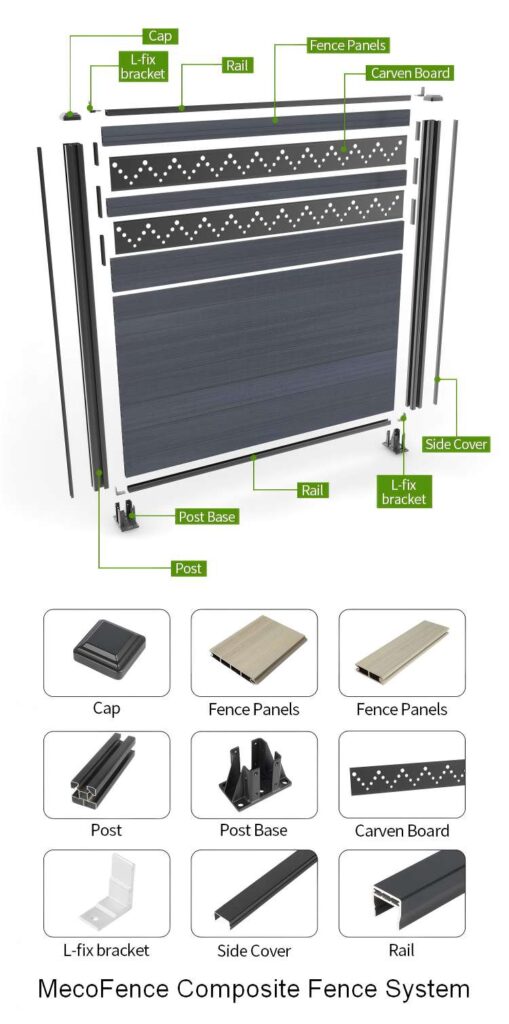
1. Fence Boards (Infill Panels)
The visible part. The part your customer touches and judges.
Key specs to evaluate:
| Spec | What to Look For |
| Width | 140mm–210mm standard. Wider = fewer boards per section = faster install |
| Thickness | 18mm–25mm. Thicker = heavier but more rigid and premium-feeling |
| Profile | Solid vs. hollow. Hollow = lighter, cheaper. Solid = higher load-bearing, better acoustic performance |
| Surface | 3D embossed (1st gen), sanded, brushed (co-extrusion), or fluted (2026 trend) |
| Color technology | Single-tone vs. dual-tone. Dual-tone = different color front/back, reduces inventory by 50% |
The 2026 trend? Fluted and slat-style boards with 3D grooves that create shadow lines and architectural depth. Flat boards are losing market share to textured profiles.
2. Posts (The Skeleton)
This is where most fence systems fail. And it’s where most cost-cutting happens.
Three options:
- WPC Composite Posts: Same material as boards. Affordable. But they flex under wind load and can sag over time. Fine for sheltered gardens. Risky for exposed locations.
- Aluminum Posts (6063-T5 alloy): The professional standard for 2026. Heat-treated aluminum provides Level 9+ wind resistance, doesn’t rot at ground level, and stays dead straight for decades. They’re typically powder-coated to match panel colors.
- Steel Posts (galvanized or no-dig): Increasingly popular for contractors who want maximum rigidity with minimum dig time. Steel provides the highest torque resistance.
Pro recommendation: Use a hybrid system — aluminum or steel posts for the structural skeleton, composite boards for the visual body. This is how you build fences that survive hurricanes and look like luxury timber.
3. Rails (The Frame)
Horizontal rails connect the posts and hold the infill boards in place.
Modern systems use aluminum rails with integrated tongue-and-groove channels. Boards slide in and lock. No visible screws. No face-nailing. Clean finish.
Older systems used WPC rails — these are prone to bowing under wind pressure, which causes boards to pop out. If your supplier is still using WPC rails, ask why.
Small detail. Big visual impact.
A flat-top cap gives a modern, clean look. A decorative cap adds traditional character. Either way, the cap’s real job is preventing water ingress into the hollow post core. Skip the cap, and you’ll get standing water, freeze-thaw damage, and premature post failure.
5. Hardware & Accessories
The invisible stuff that determines how fast your crew works:
- Base plates / surface mounts — for concrete or hard surface installations
- Spacer clips — maintain consistent board gaps for drainage and thermal expansion
- Starter clips — secure the first board without visible fasteners
- U-channel adapters — allow angle adjustments at corners and non-90° property lines
A good system includes all of this in a single SKU kit. A bad system makes you source each piece separately from different suppliers.
That’s not a small difference. That’s the difference between a 4-hour install and a full-day headache.
The 5 Questions Every Pro Buyer Needs Answered
Co-extrusion composite fencing lasts 25–30+ years. First-gen uncapped WPC? Expect 15–20 years with visible fading starting around year 3–5.
Lifespan depends on: cap layer quality (ASA wins in extreme UV), post material (aluminum outlasts composite 3x), and installation quality.
Yes. Leave 3–5mm expansion gaps between boards. Use manufacturer's spacer clips. Co-extrusion boards expand less than first-gen.
Depends on the post system. Aluminum posts (6063-T5) handle 90+ mph. WPC posts fail above 60 mph. For coastal projects, aluminum is mandatory.
Some systems achieve ASTM E84 Class A. Ask for the test certificate. If they can't produce one, the product isn't rated.
Composite costs more day one. By year 3, it's cheaper. By year 10, wood totals $2,230–4,420 vs composite at $130–200. See the table below.
| Cost component | Wood (pressure-treated) | Co-extrusion composite |
Material cost (per 6ft section) | $80–120 | $130–200 |
| Installation labor | 45–60 min/section | 20–30 min (modular kit) |
| Year 1 staining/sealing | $150–300 | $0 |
| Annual maintenance (10 yrs) | $1,500–3,000 total | $0 |
Post replacement (year 7–10) | $500–1,000 | $0 |
| 10-year total cost | $2,230–4,420 | $130–200 |
Read that last row again.
The composite fence costs more on day one. By year three, it’s cheaper. By year ten, it’s not even close.
What composite fencing is NOT (common misconceptions)
“Composite fencing is just plastic fencing.”
No. Vinyl (PVC) fencing is plastic fencing. Composite is a hybrid of wood fiber and polymer. The feel, weight, acoustic properties, and appearance are fundamentally different.
“You can use composite decking boards for fencing.”
Technically possible. Practically terrible. Decking boards are engineered for horizontal dead loads. Fence boards are engineered for vertical wind loads. They’re structurally wrong for the application.
“All composite fencing from China is the same.”
Not remotely true. China has over 200 WPC manufacturers, ranging from world-class co-extrusion factories with ISO/CE/FSC/SGS certifications to low-tier workshops. The price difference is 40–80%. The performance difference is generational.
“Composite fencing doesn’t need any maintenance.”
Almost true. You don’t paint, stain, seal, or sand. But you do clean it — soap, water, and a soft brush once or twice a year. Total annual maintenance time: 30 minutes per 50 feet.
How to evaluate a composite fence system
Material & Technology
Structural Integrity
Business Viability
Where the market is heading in 2026 and beyond
1. The death of "flat"
Flat composite boards are becoming commoditized. Price wars are brutal. Margins are shrinking.
The premium segment has shifted to 3D fluted profiles, dual-tone colorways, and slat-wall aesthetics. These boards create shadow lines and architectural depth that flat panels can’t match. Homeowners see them as “feature walls,” not just fences.
2. The aluminum tariff squeeze
In 2025–2026, AD/CVD duties on Chinese aluminum extrusions surged to 365%+ in the U.S. The Chinese government canceled the 13% export tax rebate.
WPC composite fencing — classified under HS Code 3925.90.0000 — bypasses these aluminum tariffs entirely. The smart money is moving to composite hybrid systems.
3. Regulatory tightening (EUDR)
The EU Deforestation Regulation takes effect December 2026. If you’re importing WPC into the EU, you need FSC certification and wood fiber traceability documentation — or your containers get stuck at port.
Start the compliance conversation with your supplier now.
The bottom line
Composite fencing in 2026 is no longer a niche alternative. It’s the fastest-growing segment in the fencing industry, driven by a simple equation:
Lower lifetime cost + faster installation + zero maintenance + premium aesthetics = higher margins for every link in the supply chain.
From here, your next move depends on where you sit in the chain:
- Contractors: Request physical samples. Feel the weight. Test the install speed. Run the 10-year cost comparison for your next bid.
- Wholesalers/Distributors: Evaluate whether your current inventory is first-gen or co-extrusion. If it’s first-gen, you’re competing on price with every Alibaba listing.
- Importers: Understand the tariff landscape (HS 3925.90 vs 7604/7610), get your EUDR paperwork in order, and source from a manufacturer — not a trading company.
The fencing industry is moving fast. The material science is real. The economics are proven.
The only question is whether you move with it — or watch your competitors do it first.
Written by
Steven He
Co-Founder & Head of Product · MecoFence
Steven leads product development and B2B partnerships at MecoFence, a WPC composite fence manufacturer based in Guangdong, China. 10+ years in composite material manufacturing, covering formulation, extrusion process engineering, and export supply chain.