
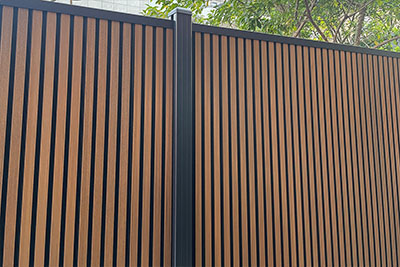
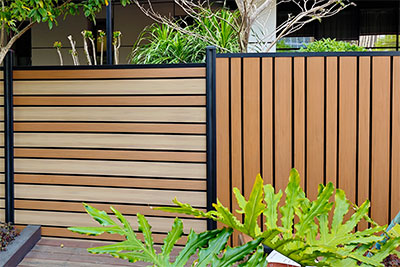
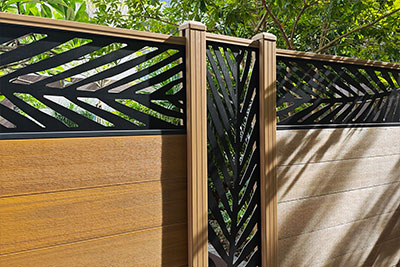
Composite fencing is a fence system that uses boards made from a mixture of wood fibers, plastic and additives. Often called wood-plastic composite (WPC), it offers a wood-like finish with less routine refinishing than timber. The boards form the infill; posts, rails and fixings complete the system.
For contractors, wholesalers and project buyers, the useful question is how that system fits the job: the board surface, supporting structure, maintenance needs and complete installed cost. This guide explains those choices before you request samples or compare quotations.
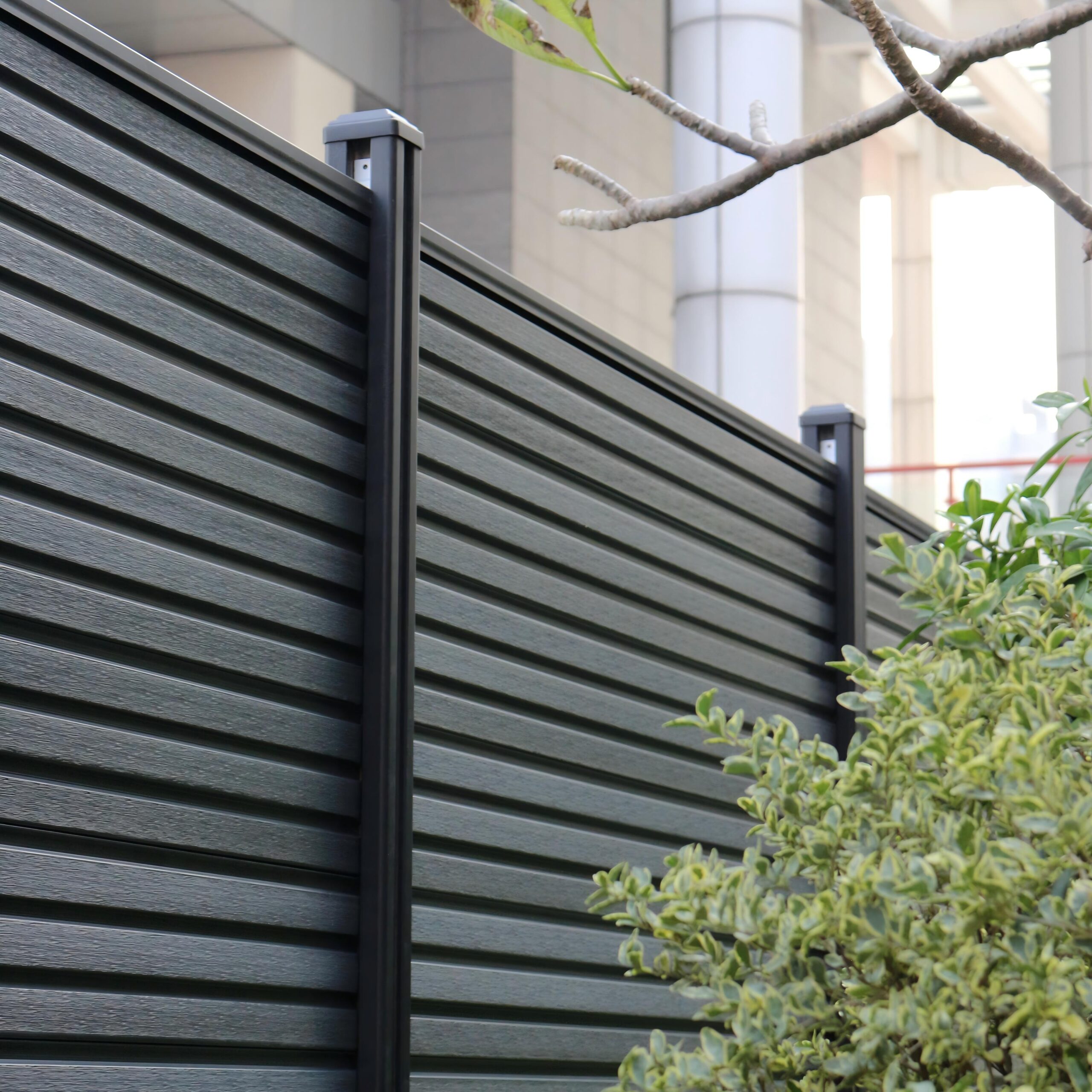
What is a composite fence made of?
Wood fiber, a plastic binder and performance additives form the WPC core. HDPE (high-density polyethylene) is one plastic used in these blends, but the recipe varies by manufacturer and profile. A wood-to-plastic percentage from one product should not be treated as an industry standard.
- Wood fibers contribute to the material’s body, stiffness and wood-like character.
- Plastic binds the fibers into a formable composite matrix.
- Additives help with processing, bonding, color and resistance to outdoor exposure.
Manufacturers blend and extrude the material through a shaped die, then cool and finish the board. Depending on the product, the profile can be hollow or solid, with a sanded, embossed, brushed or fluted surface.
Why wood and plastic are blended
WPC is a manufactured composite rather than a timber board with paint on top. The wood fibers are distributed within the plastic-based material, so the formulation and manufacturing process help determine the finished board’s properties. A wood-grain pattern describes the appearance; it does not identify the recipe underneath.
That distinction matters when two samples look alike. Their core formulation, profile and surface construction can differ, even if both are sold as “wood-effect composite.” Ask for the model and material description alongside the color name so the sample and quotation refer to the same product.
In this guide, “composite fence” means a wood-plastic composite fence. Vinyl fencing uses a PVC-based material and should not be assumed to contain wood fiber. “Capped” describes an outer layer; it does not, by itself, identify the core material.
Some composites contain recycled inputs, but the percentage and origin are product-specific. For an environmental specification, request the selected product’s recycled-content statement and supporting documents; the word “composite” alone does not establish recyclability or certification.
Boards, panels and kits describe different things
A material name tells you what the board is; a sales unit tells you what you receive. Suppliers do not always use “panel” and “kit” in the same way. Clarify the contents before comparing quantities or deciding that one offer is cheaper.
| Term | What it describes | Question to clarify |
|---|---|---|
| Board / plank | An individual length of infill material. | What is its installed coverage, and how many are needed? |
| Profile | The board’s cross-sectional shape, including any cavities and connecting edges. | Which rails and adjoining boards are compatible? |
| Panel / bay | A fence section; the offer may describe an assembled panel or components for one. | Are posts and mounting hardware included? |
| Kit / set | A packaged collection of components. | What is listed in the bill of materials, and what is excluded? |
| Fence system | The compatible boards, supports, connections and finishing parts used together. | Does the proposed configuration cover corners, ends and gates? |
These terms explain how to read an offer; they are not a universal packing standard. Once the terminology is clear, use the panel sizes and profiles guide to compare specific configurations.
What “capped” means on a WPC board
Uncapped WPC exposes the composite surface; capped WPC adds a protective polymer layer around some or all of the profile. That distinction affects how you assess staining, weathering and surface care. It is more useful than a supplier’s “generation” label.
| Buyer check | Uncapped WPC | Capped WPC |
|---|---|---|
| Surface | The WPC itself forms the exposed face. | A separate polymer cap forms the exposed face. |
| Appearance | Often sanded or embossed for a timber-like texture. | Finish depends on the cap and manufacturing process. |
| What to compare | Weathered samples, care instructions and stain resistance. | Cap material, coverage, adhesion and surface-test results. |
| Price comparison | Confirm the board and complete kit specification. | Price the same bay size, posts, rails and hardware. |
A cap can improve surface protection, but it does not make the complete fence immune to scratches, color change or moisture-related problems. Cut ends, joints and installation details still matter. Frame It All’s capped-fencing explanation provides another manufacturer’s description of this construction.
Co-extrusion describes forming the core and outer layer together during extrusion. It is a manufacturing term, not a complete performance grade. For a fuller discussion of the two constructions, read the co-extruded and traditional WPC fence comparison; assess any performance claim against the selected product’s documentation.
Ask the supplier to identify the actual cap polymer and core on the quotation. For MecoFence finish options, see the composite fencing surface guide, then approve a physical sample of the chosen profile.
The five parts of a complete fence system
A board sample is only one part of a fence quotation. A complete system also needs compatible posts, rails, caps and hardware. Missing components become extra purchasing work and site delays.
- Infill boards. Confirm profile, length, installed coverage, finish and orientation; overall board width can differ from its coverage once interlocked.
- Posts. Identify material, dimensions, reinforcement and the connection to the foundation or base.
- Rails. Check the approved top and bottom supports and how they retain the boards.
- Caps and finishing pieces. List post caps, side covers and other closures in the bill of materials.
- Fixings and mounting hardware. Include compatible brackets, fasteners, inserts and any specified base plates.
A fence can use WPC boards with metal posts and rails and still be described as composite fencing. The label usually identifies the infill, not every component in the assembly. To review the smaller connecting and finishing parts, see the fence accessories guide.
Post material alone does not establish wind performance
A solid privacy panel catches wind, so assess the whole assembly: height, bay width, posts, rails, fixings and foundations. Aluminum and steel are available structural options, but neither material name provides a universal wind rating.
For an exposed site, request evidence for the proposed configuration and have the support and anchoring design checked against the project requirements. A test on a different panel size or post arrangement is not enough to specify your fence.
When the next decision is the supporting material, the aluminum, WPC and steel post guide covers those options. Keep the post selection tied to the complete system drawing rather than selecting it from appearance alone.
Benefits and disadvantages of composite fencing
Composite is worth considering when a wood-like appearance and reduced refinishing work matter. Its suitability still depends on the budget, finish expectations and site. Compare it with wood, vinyl and metal against the same project brief.
Reasons to shortlist it
- Factory-finished colors and textures.
- Privacy, fluted and slat-style options.
- Reduced need for painting or staining on products designed for that use.
- Modular components that can make repeat purchasing easier.
Trade-offs to allow for
- The complete system may cost more upfront than a basic timber option.
- Boards move with temperature and need the specified clearances.
- Surfaces can mark, weather or collect dirt.
- Replacement boards must match the profile and finish.
| Material | Why a buyer may choose it | What to resolve first |
|---|---|---|
| Composite / WPC | Wood-like finishes and reduced refinishing. | Cap, system compatibility, thermal movement and warranty scope. |
| Wood | Natural timber appearance and flexible detailing. | Species, treatment, moisture exposure and the maintenance plan. |
| Vinyl / PVC | Factory-colored profiles with no routine timber staining. | Profile reinforcement, finish expectations and repair options. |
| Metal | Open fencing or a specified structural design. | Privacy, coating, corrosion exposure and connections. |
If you are comparing composite with vinyl, continue with the composite and vinyl fence comparison. Compare the actual products and warranty terms, since a broad material label does not describe every finish or construction.
How long does composite fencing last?
There is no single service life for every composite fence. Board formulation, exposure, support design, installation and maintenance all affect the result. A warranty is a contract with conditions, not a forecast of the life of every component.
As a brand-specific reference, Trex lists a 25-year residential limited warranty for its fencing. That term does not establish MecoFence coverage or commercial-project coverage; request the terms for your selected product and use.
Privacy, fluted and slat-style finishes
Choose the required privacy level before choosing a texture. A fluted board can create the appearance of separate slats while forming a closed panel. An open slat layout allows gaps, which changes screening and airflow.
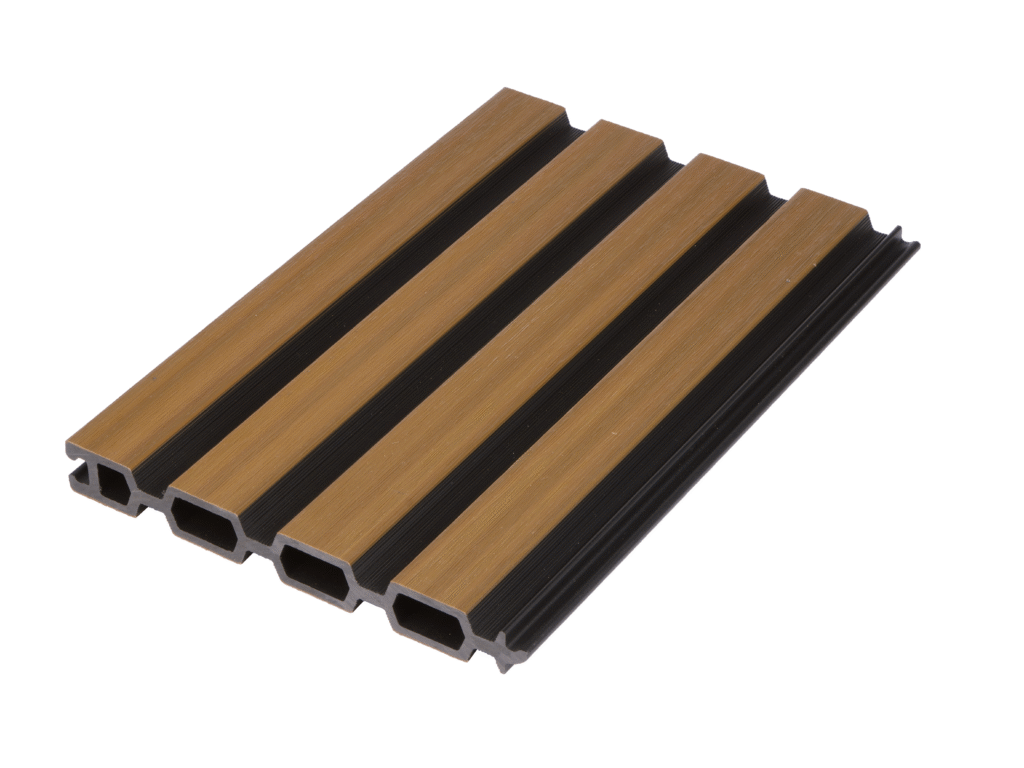
Wood-tone boards suit projects seeking a timber-like finish; dark boards and contrasting posts create a different visual effect. Compare samples outdoors, on both faces, and beside the proposed paving or building finish before ordering a full run.
MecoFence’s S-CF05 dual-tone fluted board is described on its product page as having the same brushed, dual-tone finish on both faces. “Dual-tone” refers to the contrasting colors in the design; it should not be read as two different colors or styles on opposite faces.
Approve the board, post finish, orientation and replacement strategy together. A consistent double-sided finish can simplify presentation to customers, but any inventory saving depends on the actual range you stock.
Read the sample in three layers
Look at the face, the cross-section and the connection. Each answers a different question about what you are buying. A small sample can help confirm the design, but it cannot establish the performance of a full installed bay.
- Face: compare texture, sheen and both sides of the board; confirm which surface the customer will see.
- Cross-section: identify the core, any visible cap, cavities and edges; request a drawing where the construction is unclear.
- Connection: ask how the board fits into the proposed rail or post channel and which finishing pieces complete the edge.
Record the sample’s model and color, then reference them in the order. This gives the buyer and supplier a common description to work from when discussing the delivered goods or a later replacement.
Installation: check the site before ordering
Existing posts, slopes and concrete bases can change the required system. Resolve these details before the quotation becomes a purchase order. Modular boards can simplify assembly, but they do not remove foundation or layout work.
- Soil installation: confirm the approved foundation and post detail for the site conditions.
- Concrete mounting: verify the base condition and mounting arrangement; use the concrete-wall project guide to identify questions for the site review.
- Existing concrete posts: measure the slot and clear span, then check the posts’ condition and the proposed panel’s compatibility.
- Slopes: agree the layout and resulting bottom gaps before ordering; the slopes and uneven-ground guide discusses these situations.
- Thermal movement: follow the selected profile’s instructions for clearances and fixing positions.
A nominal “6 ft” panel is not proof that it fits an existing fence bay. Do not assume a universal board thickness, foundation depth or expansion gap. Use the installation guide for orientation and obtain the current system drawings for the job.
A similar finish or width does not establish suitability for a fence. Use boards approved for the intended fence configuration, or obtain the manufacturer’s written approval for a different application and supporting detail. Do not assume decking and fencing profiles are interchangeable.
Order the gate as its own assembly
A matching gate needs more than matching infill boards. Specify the opening, frame, supporting posts, hinges, latch, swing direction and clearance. Gate weight and movement place different demands on the supports from a fixed panel.
An aluminum frame is one way to support composite infill, but it does not guarantee that a gate can never sag. Wider or automated driveway gates need their own approved design and compatible hardware.
Use the MecoFence gate range to identify the required opening type, then confirm dimensions and compatible infill with the supplier.
Composite fencing cost: compare the complete job
A board-only price cannot be compared with an installed fence price. First give each supplier the same height, total length, bay layout, gates and finish. Then separate the product, logistics and site costs.
For a contractor, removal work, access, foundations, corners and gates can alter the installed price. For an importer, packing, shipping terms and destination charges also matter. Use the wholesale cost guide to understand the cost layers, then obtain a current quotation for your configuration and destination.
What an ownership-cost comparison includes
Add cleaning, refinishing where required, inspections, repairs and expected replacements to each option’s initial installed cost. Keep the fence length, time period and labor assumptions identical. An assumed saving is only useful if you can explain the work and rates behind it.
If one column includes a whole fence’s maintenance and the other includes only one panel’s purchase price, the comparison cannot support a buying decision. Keep composite cleaning and gate servicing in the budget too.
The ten-year fence cost breakdown explores ownership costs in a worked scenario. Its assumptions need to be checked against your fence length, local labor rates and maintenance plan before you use it in a proposal.
Low maintenance still includes cleaning
Plan for periodic cleaning and checks of posts, fixings and gate operation. Follow the product’s care instructions for the cleaner, brush and method. Avoid sanding a protective cap or using aggressive pressure washing unless the manufacturer explicitly permits it.
For example, Trex’s fence-care guidance recommends periodic cleaning with suitable products or soap, water and a soft brush. Use the care requirements for the fence you actually supply when setting customer expectations.
What to check before you order
Ask for a sample, a complete bill of materials and the documents for the selected system. Those three items turn a general discussion about composite fencing into a specification that purchasing and installation teams can use.
- Define the project. State location, fence height and length, privacy needs, ground conditions, slopes, gates and timing.
- Confirm the product. Record the model, core and cap, finish, installed coverage, post type and replacement availability.
- Review the evidence. Match relevant test reports and warranty terms to the proposed product, configuration and use.
- Normalize the quotation. Confirm quantities, inclusions, shipping terms, packing and exclusions before comparing totals.
Noise and fire claims need a defined scope
For a noise-sensitive boundary, a laboratory result should not be presented as the same reduction a customer will experience outdoors. Height, length, openings and the source-to-receiver layout affect the outcome. FHWA’s noise-barrier guidance explains why the barrier’s geometry matters alongside its material.
If fire performance is part of the brief, obtain the relevant report and confirm its applicability to the proposed use. Neither an added cap nor the term WPC establishes a fire classification.
Match each document to the question it can answer
A product drawing explains the configuration; a bill of materials explains what is supplied; a test report describes results under stated conditions. The warranty sets contractual coverage, and the care guide explains the required maintenance. Keep these documents together so a broad sales description does not stand in for the specific information you need.
For factory evaluation after this first product review, see what a composite fence manufacturer controls. Ask about the selected model and order, including how the approved specification will be identified in production and delivery.
Composite fencing: common questions
In this guide, yes. WPC means wood-plastic composite: wood fibers, plastic and additives formed into fence boards. Confirm the core material when comparing products described only as “composite.”
No. The description usually identifies the WPC infill boards. The complete assembly can also contain metal posts, rails, fixings and other components.
It means a protective polymer layer covers some or all of the profile. Confirm the cap material and coverage for the selected board; the term alone is not a complete performance grade.
Not necessarily. A panel describes a section, while a kit describes a collection of supplied components. Check the bill of materials to confirm boards, posts, rails, fixings and exclusions.
Not always. Fluted boards can create a slat appearance while forming a closed panel. An open slat layout has gaps, so confirm the required screening and airflow before choosing the design.
Do not assume they are. A similar appearance or width does not establish suitability for a fence. Use an approved fence configuration or obtain the manufacturer’s written approval for the alternative application.
For additional care and product questions, visit the composite fence FAQ.
Move from a sample to a complete specification
Shortlist the finish your customer needs, check the supporting system and compare the complete cost. A useful sample review ends with a documented board, post, rail and gate specification that everyone on the project can follow.
Written by
Steven He
Co-Founder & Head of Product · MecoFence
Steven leads product development and B2B partnerships at MecoFence, a WPC composite fence manufacturer based in Guangdong, China. 10+ years in composite material manufacturing, covering formulation, extrusion process engineering, and export supply chain.
Table of Contents
Planning a Fence Range or Contractor Project?
Send your location, fence dimensions, gate requirements and expected quantity. We can discuss a suitable composite fencing configuration and the samples and quotation you need next.