
Most composite fence "guides" online are thinly disguised product pages. They dodge hard questions like "do composite boards warp?" or give vague answers to "is it really cheaper than wood?"
Below, you'll find every major question answered with engineering data, real-world performance specs, and honest pros-and-cons. Where relevant, we reference MecoFence composite fence systems as a benchmark for premium WPC fencing.
Jump to a Question Category
1. What Is a Composite Fence?
What is a composite fence?
A composite fence is made from a blend of recycled wood fibers (typically 50–60%) and high-density polyethylene (HDPE) plastic (40–50%), extruded under high heat and pressure into boards that mimic the look and feel of natural timber.
The critical difference from traditional wood is the material science: by encapsulating wood fibers within a polymer matrix, composite boards resist rot, insect damage, and moisture absorption — the three primary failure modes of timber fencing.
Premium manufacturers add a co-extruded cap layer — typically ASA (Acrylonitrile Styrene Acrylate) or a similar engineering polymer — that wraps the board in a UV- and scratch-resistant shield. This cap layer is what separates budget composites from professional-grade fencing. Learn the difference between co-extruded and traditional WPC fencing →
How thick is a composite fence?
Board thickness varies by manufacturer and profile type. Budget composite boards are often 12–18 mm thick, which can lead to flexing between posts.
Professional-grade panels, like those in the MecoFence system, are 24 mm thick — providing significantly greater rigidity and wind resistance. Independent testing of MecoFence boards measured a bending strength of 26.8 MPa and a modulus of elasticity of 3,758 MPa (EN 15534-1:2004), which are critical metrics for structural integrity in exposed fencing applications.
For context, a 24 mm board at 26.8 MPa bending strength means the panel can withstand a sustained wind load of 372 N/m² for 3 minutes — Beaufort 9 when properly installed with rigid aluminum posts.
Are composite fences sturdy?
Sturdiness depends on three factors, not just the board material:
- Board thickness and density — 24 mm co-extruded boards with 3,758 MPa modulus of elasticity are significantly more rigid than 15 mm budget boards.
- Post material and cross-section — Aluminum posts with an 80 mm × 80 mm profile and 1.7 mm wall thickness outperform thin-gauge steel or WPC-only posts in lateral load resistance. Compare post types here →
- Connection design — MecoFence uses a patented Y-slot channel that grips boards without creating pinch points. This allows controlled thermal expansion while maintaining structural hold.
Bottom line: A composite fence with 24 mm panels on 80 mm aluminum posts is measurably sturdier than a standard 19 mm cedar fence on 4×4 timber posts, which lose structural integrity as the wood rots over time.
Are composite fences stronger than wood?
It depends on what "stronger" means. Fresh-cut pressure-treated lumber has a higher initial tensile strength than composite boards. However, composite's advantage is maintained strength over time.
Wood loses approximately 30–40% of its bending strength within 5–8 years due to moisture cycling, UV degradation, and fungal decay (per USDA Forest Products Laboratory data). Composite boards, especially co-extruded variants, maintain >95% of their original mechanical properties after 15+ years because the polymer matrix does not absorb water or support biological growth.
For fencing specifically — where panels are exposed to weather 365 days a year — composite delivers superior lifetime structural performance.
2. Are Composite Fences Any Good?
Are composite fences any good?
Yes — when manufactured to professional standards. The composite fencing industry has matured significantly since its early days of warping complaints. Modern co-extruded WPC (Wood Plastic Composite) boards address every historical weakness:
- Warping: Solved through improved core formulations and engineered post channels (e.g., MecoFence's Y-slot) that allow controlled thermal movement.
- Fading: Addressed by ASA cap layers with UV stabilizers that limit color change to <5% over 10 years under direct sunlight.
- Scratching: Surface hardness now reaches Shore D 70 (ASTM D2240-05) on premium boards — comparable to hardwood decking.
The result is a fence that combines the warmth of wood with zero annual maintenance. Independent certifications (CE, SGS, FSC, REACH) validate both safety and environmental claims. Read the complete 2026 composite fencing guide →
What is the best fence to put in?
The "best" fence depends on your priorities. Here's an honest comparison based on measurable criteria:
| Criteria | Composite (Co-Extruded) | Wood (Cedar/Pine) | Vinyl (PVC) | Aluminum |
|---|---|---|---|---|
| Lifespan | 25–30+ years | 8–15 years | 15–20 years | 20–30 years |
| Maintenance | None (hose wash) | Stain/seal yearly | Occasional cleaning | Minimal |
| Wind Resistance | Up to 3,500 N | Moderate | Low (sail effect) | High |
| Privacy | Full (solid panels) | Full | Full | Limited |
| Aesthetics | Natural wood-grain | Natural (ages grey) | Plastic appearance | Modern/industrial |
| Eco-Friendly | Recycled materials | Harvested timber | Virgin PVC | Mined ore |
| 10-Year Total Cost | $$$ | $$$$+ (with maintenance) | $$$ | $$$$ |
For most residential and commercial applications that value longevity + aesthetics + zero maintenance, co-extruded composite fencing delivers the best combination. See the wholesaler's guide to choosing the best composite fencing →
Is composite fencing waterproof?
Water-resistant, yes. Fully waterproof in the traditional sense, no. Here's the nuance:
Co-extruded composite boards have a polymer cap layer that prevents surface water absorption. MecoFence boards tested at just 0.89% moisture content (EN 322:1993) — effectively meaning the material does not absorb water in any meaningful quantity.
However, cut edges (if boards are trimmed on-site) expose the raw WPC core, which can absorb small amounts of moisture. Best practice is to seal cut edges with a manufacturer-supplied end cap or waterproof sealant. The Y-slot post design also incorporates a hydrophobic drain trough that channels rainwater away from panel edges, preventing pooling at joints.
3. Lifespan & Durability
How long does composite fencing last?
Quality composite fencing lasts 25–30+ years under normal conditions. MecoFence offers a 20-Year Residential Limited Warranty / 15-Year Commercial Warranty, but real-world performance frequently exceeds this — their earliest installations (circa 2014 in New Zealand, one of the harshest UV environments globally) remain in service today with minimal color change.
The key factors that determine actual lifespan are:
- Cap layer type: ASA co-extrusion > PE co-extrusion > no cap (uncapped boards may only last 10–15 years)
- UV exposure: South-facing panels in Arizona will experience faster color shift than north-facing panels in Oregon
- Installation quality: Proper post footing depth (min. 600 mm embedded) and correct expansion gaps are critical
Explore 2026 composite fencing trends, costs, and longevity data →
What type of fence lasts the longest?
By material, the longevity ranking (with proper installation) is:
- Wrought iron / galvanized steel: 50+ years (but requires rust treatment and repainting)
- Co-extruded composite (WPC): 25–30+ years (zero maintenance)
- Aluminum: 20–30 years (minimal maintenance)
- Vinyl / PVC: 15–20 years (becomes brittle, yellows in UV)
- Pressure-treated wood: 8–15 years (requires annual maintenance to achieve upper range)
- Untreated softwood: 3–7 years
When you factor in maintenance-adjusted lifespan — meaning years of life per dollar of total upkeep cost — composite fencing takes the top position because its annual maintenance cost is effectively $0.
Do composite fence boards warp?
First-generation (pre-2015) composites had legitimate warping problems. Modern co-extruded boards have largely eliminated this issue through two engineering solutions:
1. Material science: The ASA cap layer acts as a uniform "skin" that distributes thermal stress evenly across the board surface. Without a cap layer, uneven sun exposure heats one side more than the other, creating differential expansion — the root cause of warping.
2. Post channel design: MecoFence's Y-slot column allows boards to expand and contract freely (linear thermal expansion: 38.6 × 10⁻⁵ mm/m°C per EN 15534-4:2014) without being constrained. Rigid H-channel posts that grip boards too tightly actually cause warping by fighting natural thermal movement.
Will there be zero movement? No — all materials expand with heat. A 1.8 m board can move up to ~3–4 mm in a 50°C temperature swing. The Y-slot system accommodates this without visible deformation.
Does composite fencing go brittle?
Not if manufactured correctly. Brittleness in composites typically results from insufficient polymer content (too much wood flour, too little HDPE) or no UV stabilizer in the cap layer.
Premium boards maintain flexibility throughout their lifespan because HDPE retains its polymer chain integrity for decades. MecoFence boards tested at 8.95 mm impact resistance (EN 15534-1:2004) — meaning they can absorb significant impact force without cracking.
The deflection temperature of 80°C (ISO 75-1:2013) also confirms the material won't soften or become brittle within any normal temperature range encountered in North American, European, or Australian climates.
Does composite fencing scratch?
Surface scratches are possible, but significantly harder to inflict on co-extruded boards. The ASA cap layer provides a Shore D hardness of 70 (ASTM D2240-05), which is comparable to many hardwoods.
Light surface scratches from pets, garden tools, or bicycles can often be buffed out with fine-grit sandpaper (400+ grit) on most composite surfaces. Deep gouges that penetrate the cap layer are rare under normal residential use.
Pro tip for contractors: During installation, avoid dragging boards across concrete or metal surfaces. Use a soft pad or cardboard when stacking panels on-site.
Does composite fencing rot?
No. Rot is a biological process caused by fungi that break down cellulose in the presence of moisture. In composite fencing, the wood fibers are fully encapsulated within a HDPE polymer matrix, which prevents moisture from reaching the cellulose.
Co-extruded boards add a second barrier: the ASA cap layer seals the exterior surface. Combined with the near-zero moisture content (0.89%), fungal growth cannot establish itself. This is one of composite's most definitive advantages over natural timber.
4. Is Composite Fencing Cheaper Than Wood?
Is composite fencing cheaper than wood?
Upfront cost: No. 10-year total cost: Yes. This is the single most important distinction buyers miss.
Material cost for a 6 ft × 6 ft composite panel typically runs 20–40% higher than an equivalent pressure-treated wood panel at the point of purchase. However, wood requires ongoing investment:
- Annual staining/sealing: $150–$300/year for a typical backyard perimeter
- Board replacements (rot/damage): $200–$500 every 3–5 years
- Complete fence replacement at year 10–12: $3,000–$8,000
Composite's total cost over 10 years is typically 30–50% lower than wood when maintenance, repairs, and replacement are factored in. Over 20 years, the savings compound further because composite requires zero maintenance — see the full 10-year cost breakdown →
What is the cheapest fencing right now?
In terms of lowest upfront material cost per linear foot, the hierarchy is:
- Chain link: $5–$15/ft (lowest cost, lowest privacy)
- Pressure-treated pine: $12–$25/ft
- Vinyl/PVC: $20–$35/ft
- Composite (WPC): $25–$45/ft
- Cedar: $25–$50/ft
- Wrought iron: $30–$60/ft
However, cheapest upfront ≠ cheapest overall. If you plan to stay in your property for 5+ years, total cost of ownership should guide the decision. See 2026 WPC fence pricing for wholesale buyers →
What is the most economical fence to install?
The most economical fence balances material cost + labor cost + ongoing maintenance. Composite fencing is increasingly the most economical option for several reasons:
Labor savings: Modular composite systems (like MecoFence's snap-lock panels) reduce installation time by up to 40% compared to timber, which requires measuring, cutting, and nailing individual pickets. Fewer labor hours = lower installation cost.
Zero callbacks: Contractors who install composite report significantly fewer warranty callbacks compared to wood (which warps and shifts within the first year). This reduces project liability and improves contractor margins.
Are composite fence panels cheaper than wood?
Panel-for-panel at the store, no. A single 6×6 composite panel costs more than a comparable wood panel. But panels are only one part of the equation. You must also factor in:
- Posts: Composite systems often use aluminum posts (included in the system price) — wood fences require separate post purchase plus concrete footing
- Hardware: Composite systems include rails, clips, and caps — wood requires nails, screws, brackets, and post caps purchased separately
- Finish: Wood panels require immediate stain/seal (labor + materials) — composite arrives finished
When you compare complete installed systems rather than individual panel prices, the gap narrows to 10–20%.
What time of year is fencing cheapest?
Fence materials and installation labor are typically cheapest in late fall and winter (November through February in the Northern Hemisphere). Contractor schedules are lighter, and retailers often discount inventory to clear seasonal stock.
For wholesale/B2B buyers, ordering composite fencing during off-peak months (Q4) can also mean shorter lead times from manufacturers and better container shipping rates. Contact MecoFence for off-season wholesale pricing →
5. Is Composite Fencing Better Than Vinyl?
Is composite fencing better than vinyl?
In most performance categories, yes. Here's the engineering comparison:
| Performance Metric | Composite (Co-Extruded WPC) | Vinyl (PVC) |
|---|---|---|
| Wind Resistance | Up to 3,500 N (solid board) | Low — acts as a sail, prone to bending/snapping |
| UV Stability | ASA cap layer, minimal fade | Yellows and becomes brittle over 5–10 years |
| Impact Resistance | 8.95 mm (EN 15534) — absorbs blows | Cracks on impact, especially in cold weather |
| Appearance | Natural wood grain, dual-tone options | Plastic sheen, limited texture |
| Double-Sided | Yes — same finish both sides | Often one "good" side, one flat side |
| Eco-Friendliness | Recycled content, recyclable | Virgin PVC, difficult to recycle |
| Temperature Range | Stable to 80°C | Softens in extreme heat, cracks in extreme cold |
Vinyl's primary advantage is lower upfront cost (typically 15–25% less). But its shorter lifespan, tendency to crack in cold climates, and plastic appearance make composite the better long-term investment.
Which is more expensive, vinyl or composite fencing?
Composite fencing typically costs 15–25% more than vinyl in upfront material pricing. However, composite panels are generally thicker (24 mm vs. vinyl's hollow extrusions), provide better wind resistance, and don't require replacement due to cold-weather cracking — a common vinyl failure in Canadian and northern US climates.
Is composite fencing double sided?
Yes — this is one of composite's underappreciated advantages. Quality composite boards, including all MecoFence panels, are finished identically on both sides. Your fence looks the same to you and your neighbor.
Many vinyl fences have a "good side" (facing outward) and an unfinished or ribbed side (facing inward). This is a common source of neighbor disputes and may even violate local fence codes that require a "good neighbor" fence.
Do vinyl fences look cheap?
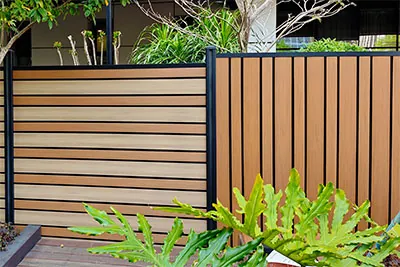
This is subjective, but the market trend is clear: vinyl's uniform plastic sheen and limited color range make it look noticeably synthetic compared to modern composites. Premium composite boards now feature 3D wood-grain textures, dual-tone color profiles, and matte finishes that closely replicate natural timber.
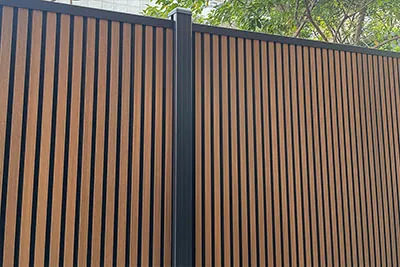
MecoFence's Dual Tone Slat Wall design, for example, combines deep black grooves with natural wood-tone raised slats — an aesthetic that vinyl simply cannot replicate.
What are the cons of vinyl fencing?
- Brittleness in cold: PVC becomes significantly more brittle below 0°C, leading to cracking from impacts (balls, debris, snow loads)
- Wind vulnerability: Hollow vinyl panels create a sail effect — a common failure point in storms
- Yellowing: UV exposure causes progressive yellowing, especially in white vinyl
- Limited design: Mostly flat white or tan; textured options are expensive and still look synthetic
- Environmental concerns: PVC production involves chlorine chemistry; vinyl is difficult to recycle
- One-sided appearance: Many vinyl fences have visible ribbing on the interior face
Why is vinyl fencing so expensive?
Vinyl fencing has become more expensive in recent years due to rising PVC resin costs (driven by global supply chain pressures and petrochemical pricing) and increased manufacturing complexity for textured or wood-look variants. Despite these higher prices, vinyl's performance hasn't improved proportionally — which is why many wholesalers and contractors are shifting allocations toward composite.
6. Downsides & Disadvantages of Composite Fencing
What are the downsides of composite fencing?
No material is perfect. Here are the honest disadvantages of composite fencing:
- Higher upfront cost: 20–40% more than pressure-treated wood at purchase (though lower over 10 years with zero maintenance).
- Thermal expansion: Composite boards expand and contract with temperature (38.6 × 10⁻⁵ mm/m°C). Improper installation without expansion gaps can cause buckling. Solution: use posts with built-in expansion channels (like MecoFence's Y-slot).
- Weight: Composite panels are heavier than vinyl or pine, requiring two people for installation.
- Cannot be painted or stained: The co-extruded cap layer means you must choose your color upfront — you cannot change it later with paint.
- Quality variance: Not all composites are equal. Budget brands with thin boards (12–15 mm), no cap layer, or poor formulations give the category a bad reputation. Always check thickness, cap layer type, and certifications.
Most downsides are mitigated by choosing a reputable manufacturer with proper engineering. Learn how to evaluate composite panel profiles and sizes →
What are the disadvantages of composite panels?
In addition to the points above, two technical disadvantages are worth noting for professional installers:
- Cutting creates dust: When cutting composite with a circular saw, the wood-plastic mix produces fine dust. A carbide-tipped blade and dust mask are recommended.
- Heat retention: Dark-colored composite panels absorb more heat than light colors. In extreme climates (e.g., Phoenix, Dubai), south/west-facing dark panels can become hot to the touch. This is a physics issue common to all dark-colored materials, not unique to composite.
Is composite fencing worth the cost?
For anyone planning to stay in their property 5+ years, the math strongly favors composite. The break-even point versus wood (including annual stain, seal, and repair costs) typically occurs around year 4–6.
After break-even, every additional year is pure savings. Over a 20-year span, homeowners typically save $3,000–$7,000 compared to maintaining an equivalent cedar fence. For contractors and wholesalers, composite's zero-callback profile also translates to better margins and client retention.
Are composite fence posts strong?
This depends entirely on the post type. There are three main categories:
| Post Type | Material | Strength Rating | Best Use Case |
|---|---|---|---|
| Heavy-duty aluminum (square) | 80×80mm, 1.7mm wall | Highest | Commercial, coastal, high-wind |
| Budget aluminum (square) | 80×80mm, 1.3/1.7mm wall | High | Standard residential |
| Round aluminum | 80mm OD, 1.5mm wall | Moderate-High | Budget residential, unique aesthetic |
| Co-extruded WPC post | 110×110mm, solid | Moderate | Sheltered gardens, color-matching |
Avoid generic timber posts with composite panels. Wood posts will rot years before the composite boards fail, undermining the entire system's longevity. Full post comparison guide →
7. Installation & DIY Questions
Is composite fencing easy to install?
Easier than wood, harder than a snap-together kit. Modular composite systems eliminate the need for measuring, cutting, and nailing individual pickets. Most premium systems (including MecoFence) use a slide-and-lock panel design: boards slot into the Y-channel on aluminum posts, rails snap into place, and side covers finish the joint.
A typical 6 ft × 6 ft panel can be assembled by two people in 15–25 minutes, compared to 45–60 minutes for a comparable wood panel. Step-by-step installation guide with costs →
Can composite fencing be cut?
Yes. Composite boards can be cut to length using a standard circular saw or miter saw with a carbide-tipped blade (60+ teeth for clean cuts). Use eye protection and a dust mask, as cutting produces fine composite dust.
Cut edges expose the raw WPC core. Best practice is to face cut edges toward a post or rail channel where they'll be hidden and protected from moisture. If a cut edge is exposed, apply a color-matched end sealant or cap.
Can composite fence panels be cut to size?
Yes — this is a key advantage over vinyl, which can crack or shatter when cut. Composite boards cut cleanly and predictably. For modular systems, you typically only need to cut end panels to fit the remaining gap at the end of a fence run. All intermediate panels use full-width factory-cut boards. DIY composite fence guide →
Can you drill into composite fencing?
Yes. Use a standard HSS (High-Speed Steel) drill bit. Pre-drill pilot holes before driving screws to avoid surface cracking. Stainless steel screws are recommended over galvanized to prevent corrosion staining on the board surface.
Do composite fence panels fit in concrete posts?
Standard composite panels are not designed for traditional slotted concrete posts (which are sized for timber panels). Concrete post slots are typically 38 mm wide — and composite boards vary from 24 mm to the full panel width.
If you have existing concrete posts and want to use composite panels, you have two options: (1) use adapter brackets/channels that mount to the concrete post face, or (2) install new aluminum posts alongside the concrete posts. For new installations, aluminum posts with integrated panel channels provide the cleanest result.
Can you use concrete posts with composite fence panels?
It is possible with adapter hardware, but not recommended for optimal results. Concrete posts are rigid with no expansion tolerance — composite boards need controlled expansion gaps. Purpose-built aluminum posts with Y-slot channels are engineered specifically for WPC panel behavior. Installation on various terrain types →
Can you pressure wash composite fence posts?
Yes, but with precautions. Use a fan-tip nozzle (25° or 40°), keep the pressure below 1,500 PSI, and maintain a minimum distance of 12 inches (30 cm) from the surface. Avoid zero-degree (pencil jet) nozzles, which can damage the cap layer.
For routine cleaning, a garden hose with soapy water is sufficient for most composite fencing — pressure washing is only needed for stubborn mold or algae buildup in humid climates.
8. Maintenance, Fading & Weathering
How do you maintain a composite fence?
Composite fencing requires virtually zero maintenance. Here's the complete care routine:
- Quarterly: Rinse with garden hose to remove dust and pollen
- Annually: Wash with mild soapy water if needed (dish soap works well)
- As needed: Remove bird droppings or sap with warm water and a soft cloth
- Never: Paint, stain, seal, or sand — the co-extrusion cap layer is your permanent finish
That's it. No staining, no sealing, no rot treatment, no termite inspection. This is the core value proposition that drives the total-cost-of-ownership advantage over wood.
Does composite fencing fade in the sun?
All exterior materials experience some color change under prolonged UV exposure. The question is how much.
Co-extruded boards with ASA cap layers are engineered with UV stabilizers that limit color shift to approximately 3–5% over a decade — imperceptible to most observers. Uncapped (first-gen) composites can fade 10–15% in the same period.
MecoFence products were originally developed for island countries and sunshine beach areas (New Zealand, Australia, the Pacific) — some of the highest UV environments on Earth. The UV stability is baked into the product's DNA. Explore surface treatment options and UV science →
Does composite fencing bend?
Under normal conditions, no. A 24 mm thick board with a modulus of elasticity of 3,758 MPa does not visibly flex between standard post spans (1.8 m / 6 ft).
Bending can occur if: (a) the post span is too wide (e.g., attempting 2.5 m spans with 15 mm boards), (b) boards are improperly stored on uneven surfaces before installation, or (c) extremely low-quality boards with high wood-flour content and minimal polymer are used.
Prevention: Use boards ≥22 mm thick, maintain post spacing at ≤1.83 m (6 ft), and store boards flat on a level surface prior to installation.
9. Composite Fence vs. Trex
What is the difference between Trex and composite fence?
Trex is a brand name; composite fence is the product category. This distinction matters because "Trex" has become a genericized term (like "Kleenex" for tissue), leading many buyers to assume all composite fencing is Trex — or that Trex is the only option.
In reality, multiple manufacturers produce co-extruded composite fencing, each with different formulations, profiles, and price points. Trex is primarily known for decking and entered the fencing market as an extension. Other manufacturers, like MecoFence, are fencing-first companies whose entire engineering focus is on fence-specific challenges (wind load, post channels, gate integration, double-sided finish).
Key differences to evaluate across any brand: board thickness, cap layer type (ASA vs. PE), post system engineering, wind rating, warranty terms, and color range. Compare top composite fencing brands →
Is Trex fencing worth it?
Trex is a reputable brand with a strong market presence, particularly in North America. However, "worth it" depends on your specific requirements:
- For homeowners: Trex fencing is a solid retail option if locally available. However, its retail pricing is often 15–30% higher than comparable-quality alternatives.
- For wholesalers/contractors: Trex's distribution model means less margin flexibility. Manufacturers like MecoFence offer direct factory pricing, OEM/ODM customization, and mixed-container MOQs that aren't available through Trex's retail-heavy channel.
Evaluate on specs, not brand recognition alone.
Why is Trex fencing so expensive?
Trex's higher pricing reflects its brand premium, US-based manufacturing costs, and multi-tier distribution chain (factory → distributor → retailer → consumer). Each intermediary adds margin.
For B2B buyers, going direct-to-manufacturer with companies like MecoFence eliminates 1–2 layers of distribution cost, often resulting in 30–50% lower per-unit pricing at equivalent or superior quality. 2026 wholesale pricing guide →
Does Trex fencing warp?
Trex uses co-extrusion technology similar to other premium manufacturers, so warping risk is comparable — low, but not zero. The same physics apply: improper installation without expansion gaps can cause buckling in any co-extruded composite, regardless of brand. Always follow the manufacturer's expansion gap specifications.
10. Is Composite Fencing Worth It?
Are composite fences worth it?
For the vast majority of use cases, yes. The value equation is straightforward:
- If you're staying 5+ years: Composite saves money vs. wood over the lifecycle
- If you want zero maintenance: No other material (except aluminum) achieves this
- If aesthetics matter: Modern composites replicate premium wood grain better than vinyl
- If you're in a wind-prone area: Solid composite boards outperform hollow vinyl
- If environmental impact matters: Recycled-content composite beats both virgin PVC and harvested timber
The only scenarios where composite may not be the best choice: very tight budgets where chain link suffices, purely temporary barriers (<2 years), or situations requiring a paintable surface (like matching a specific heritage color).
What is the best no-maintenance fence?
Co-extruded composite fencing is the best no-maintenance option that also delivers natural aesthetics. Aluminum fencing is also zero-maintenance but offers limited privacy (open picket design).
MecoFence's system is particularly well-suited for the "set and forget" buyer: the 24 mm co-extruded boards, aluminum posts, and integrated accessories (caps, L-fixes, post bases) are all engineered to be non-corroding, non-rotting, and non-fading — meaning zero parts of the system require ongoing treatment. Explore the full MecoFence accessory system →
What is the most cost-effective fencing?
Over a 10–20 year ownership period, co-extruded composite fencing is the most cost-effective option for privacy fencing when you account for:
- $0 annual maintenance (vs. $150–$300/year for wood)
- $0 board replacements (vs. $200–$500 every 3–5 years for wood)
- No full-fence replacement at year 10 (typical for wood)
- Increased property value (composite fencing is now a selling point in real estate listings)
For wholesale buyers and contractors, composite also offers higher margins and fewer callbacks than wood projects. See the 2026 MecoFence wholesale program →
Ready to Source Premium Composite Fencing?
MecoFence delivers factory-direct composite fence systems to wholesalers and contractors in 50+ countries. Request a free sample box, get wholesale pricing, or discuss OEM customization.
Get a Free Quote & Sample →