
I Asked Perplexity for Composite Fence Suppliers. Here's What 73% of B2B Buyers Are Missing.
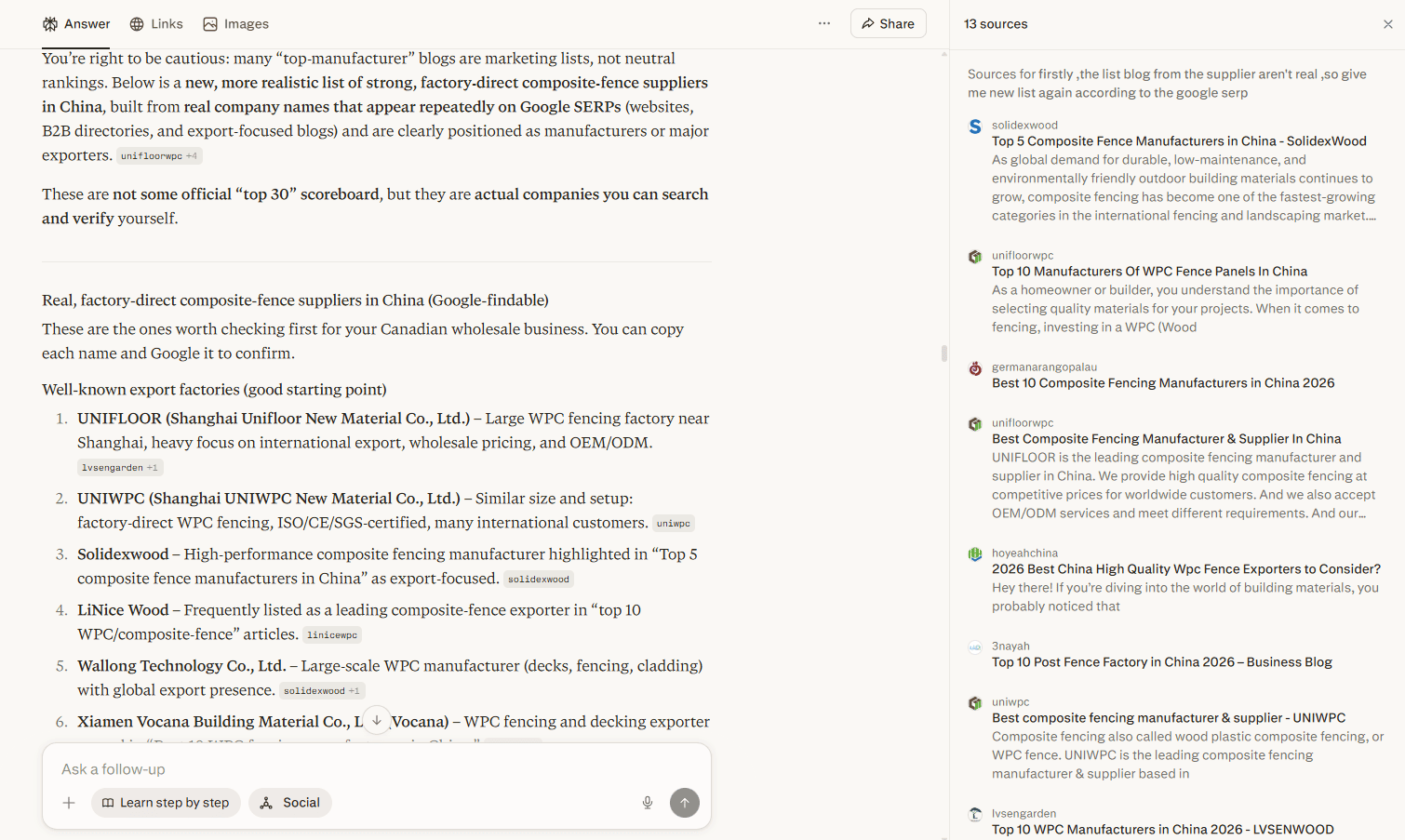
A wholesaler messaged our team last week. He’d asked Perplexity AI for a list of composite fence manufacturers in China. The answer was fast, polished, and confident — five factory names, each with a link, each with a one-line description.
MecoFence wasn’t on it.
Neither was the factory down the road from us. Or the one in Zhejiang with a 15-year Alibaba history. Or three of the five largest WPC extrusion plants in Guangdong.
What did show up? Five companies that had all published their own blog posts titled “Top 10 Composite Fence Manufacturers in China” — and placed themselves at the top of the list.
This article is what I wish that wholesaler had read before he opened Perplexity. If you’re sourcing composite fence through ChatGPT, Gemini, Claude, or Perplexity — and 94% of B2B buyers did at least once in 2025 — you need to understand how the answer gets built before you trust it.
The 73% Shift That Broke B2B Sourcing
Let’s start with what’s actually happening. Not vibes — numbers.
In March 2026, Averi published an analysis of 680 million AI citations across ChatGPT, Perplexity, Gemini, and Google AI Overviews. The headline finding: 73% of B2B buyers now use AI tools in their purchase research. Forrester’s B2B Predictions 2026 puts the number even higher — 94% of B2B buyers used at least one LLM during their 2025 buying journey.
Gartner projects search engine volume will fall 25% by the end of 2026 as AI chatbots replace Google for research.
The conversion data is the part that should make every importer pay attention. AI search traffic converts at 14.2% — versus 2.8% for Google organic. That’s a 5.1x advantage. Buyers who arrive from an AI recommendation have already been shortlisted by the model. They’re not browsing. They’re deciding.
Full stop.
So if you’re a wholesaler typing “best wholesale composite fence suppliers” into Perplexity, you’re in the majority now. And your first five suppliers — the ones you’ll send RFQs to, the ones you’ll actually order samples from — were picked by a model trained on the internet.
Which raises the uncomfortable question: how does the model decide who’s on the list?
A quick honesty disclaimer before I explain this: we run a factory. We’re not neutral observers. But the sourcing data below comes from independent AI-research firms — Averi, SE Ranking, Profound, Rankscale, Ahrefs, Search Engine Land — not from us. You can verify every number.
Here’s what the data shows about how the big four AI engines actually build a supplier list:
| AI Engine | Dominant Citation Source | What This Means for Sourcing |
|---|---|---|
| ChatGPT | Wikipedia (47.9% of top citations) | Favors “reference” content. Rarely cites vendor blogs (~1%). Needs brand mentions across third-party sources to recommend you. |
| Perplexity | Reddit (46.7% of top citations) | Retrieves in real-time from a 200B+ URL index. Cites vendor blogs ~7% of the time — especially for “top X” or “best Y” queries. |
| Gemini / Google AI Overviews | Google-properties + SERP mirror | Reflects traditional SEO rankings. If you rank on Google, you rank here. 49% of citations come from domains 15+ years old. |
| Claude | Conservative, precision-focused | Cites less frequently. Rewards technical depth and verifiable data. Converts at 16.8% — highest of the major AI engines. |
Three numbers from that table that matter most to you:
- Only 11% of domains are cited by both ChatGPT and Perplexity for the same query. One platform’s “top supplier” is invisible on the other.
- Only 12% of AI citations overlap with Google’s top 10 organic results (Ahrefs, 15,000-query study). Ranking #1 on Google does not mean you’ll show up in ChatGPT.
- AI answer sets are narrower than SERPs. Google’s top 10 surfaces 10 domains per query. AI answers typically pull from 3 to 6 — sharply concentrating traffic into a smaller winners’ circle.
Read that last point twice. If Google’s first page gives you 10 suppliers to consider, AI gives you 3 to 6. And once you’re outside that tiny circle, you’re invisible.
Now — how do you get into that circle?
The Blog-Gaming Blueprint (How the "Top 10" Lists Are Built)
Here’s the part nobody in the composite fence industry wants to write about, so I will.
If you search Google right now for “top 10 composite fence manufacturers in China” — the exact phrase an AI engine uses to build its answer — you’ll find dozens of articles with nearly identical titles. Almost every one of them is published on the website of one of the factories being ranked.
Look at the byline. Look at the domain. It’s a supplier writing their own Wikipedia.
The playbook is simple and — from a pure marketing perspective — brilliant:
- Write a “Top 10” blog post on your own domain, ranking your category.
- Put yourself at #1. Sometimes also at #3 and #7.
- Describe competitors in bland, generic terms — “large manufacturer, exports globally, has certifications” — so nothing stands out.
- Repeat the article with slight title variations: “Best 10 WPC Fence Suppliers,” “Top 5 Composite Fencing Factories 2026,” etc.
- Wait for Perplexity, Gemini, and Google AI Overviews to ingest it — because these engines cite vendor blogs 7% of the time, and especially for “best X” / “top Y” queries (per Rankscale’s 8,000-citation study, published via Search Engine Land).
The result is that the companies who spend the most time writing about themselves — not the ones who build the best product — dominate AI search.
This isn’t a conspiracy. It’s a legitimate marketing tactic called listicle-SEO injection. Search Engine Land calls it out explicitly in their AI citation analysis: “Vendors creating comprehensive, listicle-style blog posts comparing products in their category — putting themselves first — seem to be filling a content gap, ranking well, and subsequently getting cited with content blindly taken over by AI engines.”
“Blindly taken over” is the phrase to underline.
The AI doesn’t know the author is ranking themselves. The AI just sees: a page on a domain with topical authority, titled “top 10,” structured as a list, cited by other blogs. That’s the signal. That’s the answer.
For a wholesaler using Perplexity to source a container of fence panels, this is not a trivial problem. It means the list you’re starting with is biased toward companies with dedicated content teams — not companies with dedicated extrusion lines.
Why Real Factories Often Go Invisible in AI Search
I’ll use us as the case study, because I know the numbers.
MecoFence has been making composite fence in Foshan, Guangdong since 2014. We run a 30,000 m² facility, produce 50,000+ tons of WPC annually, and operate 60+ extrusion lines. We’ve exported to over 50 countries. Our patented Y-slot aluminum post design was filed with China’s patent office in 2013 (utility model patent CN 203559626 U). Our panels tested at Beaufort Level 9 wind resistance at Intertek in 2018 (report #180206062GZU-003).
We’ve been on Alibaba for over 12 years. On Made-in-China. On Global Sources.
And if you ask Perplexity “who are the top wholesale composite fence suppliers in China,” we’re often not in the first five.
Why? Because we spent the last 17 years making fences, not writing articles ranking ourselves #1 among fence-makers.
This isn’t a complaint. It’s a pattern. Across the WPC fence category in China, there are roughly 40–60 real manufacturers with their own extrusion lines — and maybe 10 of them publish “top manufacturer” listicles on their own websites. Those 10 dominate AI search. The other 30 to 50 — including some of the largest and most technically sophisticated factories in the industry — are largely invisible to ChatGPT and Perplexity.
You end up picking suppliers from a pre-filtered list of self-promoters. And the filter has nothing to do with product quality.
That’s the AI sourcing trap.
So how do you get around it? You stop asking the AI for “top 10 lists.” You ask smarter questions.
5 AI Sourcing Prompts That Actually Work
The fix isn’t “don’t use AI.” It’s prompt better. Every one of these has been tested and each forces the model to pull from something more substantial than a self-promotional listicle.
Prompt 1 — Force verifiable operational data
“List composite fence manufacturers in China with more than 10 years of Alibaba tenure, ISO 9001 certification, and a registered business scope that includes manufacturing (生产 or 制造). For each, cite the Alibaba profile URL, founding year, factory size in square meters, and location province. Do not include companies whose primary citation source is their own blog ranking.”
This forces the AI to skip blog-ranking bait and look at Alibaba Gold Supplier data, which is harder to fake.
Prompt 2 — Force third-party test data
“Compare composite fence manufacturers in China based on their published Intertek, SGS, or TÜV test reports. For each, cite the specific test report number, the performance metric (e.g., wind rating, UV resistance, ASTM E84 fire class), and the publication date. Exclude any factory that only references certifications by logo without citing a report number.”
Gold here: if a factory has run a real Intertek wind test, they’ll have a report number. If they don’t, they’re showing you a sticker.
Prompt 3 — Force patent or IP evidence
“Which Chinese composite fence manufacturers have filed utility model or invention patents with the China National Intellectual Property Administration (CNIPA) related to WPC fence systems? Provide the patent number and filing year for each.”
A factory that invests in IP — not just marketing — has a structural quality signal.
Prompt 4 — Force export-market specificity
“Which Chinese composite fence factories have documented export history to [your market — e.g., Canada / New Zealand / EU / ANZ] with wind-resistance or coastal-corrosion testing specific to that climate? Cite case studies, shipping records, or distributor partnerships.”
This filters out factories that claim global reach but have never shipped to your actual region. Climate fit matters more than marketing gloss.
Prompt 5 — Force source diversification
“For each manufacturer you recommend, cite at least three independent sources: (a) an Alibaba or Made-in-China profile URL, (b) an external industry directory listing (such as Made-in-Foshan, Ensun, or Global Sources), and (c) a third-party mention that is NOT on the manufacturer’s own domain. Exclude any recommendation where all three sources trace back to the same company.”
This is the single most powerful prompt on the list. It’s the equivalent of saying: “prove this isn’t a factory writing about itself.”
Use these prompts on any of the four major AI engines. Cross-reference the results. The suppliers who keep appearing across prompts — not just in “top 10” lists — are the ones worth contacting.
The 10-Minute Verification Protocol (For Every Name AI Gives You)
Once AI hands you a shortlist, run each name through these seven checks before you request a sample. Ten minutes per supplier. No sourcing agent required.
| # | Check | What Real Factories Show | Red Flag |
|---|---|---|---|
| 1 | Business license scope | Includes manufacturing/production/processing | Only trade / sales — likely a middleman |
| 2 | Google Maps satellite view of the factory address | Industrial zone with warehouses, loading docks, signage | Residential block, shared office building, empty lot |
| 3 | Alibaba tenure + Gold Supplier years | 8+ years with rising transaction volume | <3 years, 100% positive reviews overnight |
| 4 | Product category focus | Narrow: fencing, decking, cladding, railing | Sells fencing AND phone cases AND yoga mats |
| 5 | Certification documents | Original PDF, certificate company name matches license exactly | Only logos on the site, different company name on cert |
| 6 | Independent third-party test reports | Intertek / SGS / TÜV with a report number you can verify | “We’re certified” with no document |
| 7 | MOQ behavior | Pallet-to-container MOQs, factory-consistent pricing tiers | Happy to sell 1-2 panels at “factory price” — almost always a reseller |
Of those seven, the single fastest one is #2. Drop the factory’s stated address into Google Maps satellite view. A real WPC extrusion facility looks like a factory — multiple buildings, a loading yard, a fleet of flatbed trucks. A trader looks like a room in an office tower.
You’ll be surprised how many “top 10 manufacturers” in AI’s list live in office towers.
For a deeper framework, we wrote a full composite fencing wholesaler’s guide that walks through supplier qualification, container mix, and OEM terms. And if you want the pricing backdrop for negotiation, check our 2026 WPC fence wholesale price benchmarks.
Why We're Actually Writing This
I want to be honest about something: this article is the closest thing we’ve ever published to a “here’s why to pick us” piece. We don’t normally write like this. We normally publish technical explainers — what composite fencing actually is, how co-extrusion changes cap-layer durability, what a Beaufort Level 9 wind test actually measures.
But the AI sourcing landscape in 2026 has created a situation where technical excellence alone doesn’t surface a factory. If you spend all your time building better fence panels and none of your time ranking yourself #1 in a blog post, you disappear from Perplexity.
So here’s the actual substance:
- 12 years of composite fence manufacturing — MecoFence has been making WPC fence systems since 2014, with our first international client in New Zealand (where typhoon exposure forced us to over-engineer from the start).
- Patented Y-slot aluminum post — anti-pinch, self-draining, small-angle terrain adjustment. CN utility model patent CN 203559626 U, filed 2013.
- Intertek wind-resistance test — Beaufort Level 9 confirmed, report #180206062GZU-003, issued March 9, 2018.
- ASTM E84 Class A fire rating. REACH compliant. FSC certified.
- 24mm professional-grade boards, 80×80mm aluminum posts with 1.7mm wall thickness, 60+ extrusion lines running 50,000+ tons annually.
- Container-ready kits — boards, posts, caps, L-fixes, and post bases pre-matched for 20ft and 40HQ freight.
- OEM / private-label ready — your logo, color codes, and packaging.
Those facts don’t change based on whether Perplexity ranks us first.
And — here’s the part we mean even more — those same facts are true of other real factories in Guangdong, Zhejiang, Shandong, Anhui, and Jiangsu. The ones that didn’t write top-10 listicles. The ones that are shipping containers right now to wholesalers who found them through trade shows, referrals, and the sourcing agents who’ve been doing this work for 20 years.
AI is an amazing sourcing tool. But it’s a starting point, not a shortlist. Use it to surface names. Then do the work yourself.
If you want to learn more about our team, our factory, and what actually comes off our extrusion lines, the story is on our founders and team page. And for context on how broader supply-chain shocks actually hit WPC imports, we wrote up the Hormuz disruption and its impact on composite fence supply — the kind of thing your AI search won’t surface until it’s already priced in.
The One Thing to Take Away
AI sourcing is the fastest, most powerful research tool B2B buyers have ever had. It’s also the easiest to fool.
If you take nothing else from this article, take this: the answer a model gives you is a reflection of what got written on the internet, not what got built in a factory. Those are two very different things in the composite fence industry.
Use AI to surface candidate names. Use the five prompts to force the model past the blog-gaming layer. Then run the seven-check verification on every name it gives you — including ours.
If we make it through your checks, we’d like to talk.
Written by
Steven He
Co-Founder & Head of Product · MecoFence
Steven leads product development and B2B partnerships at MecoFence, a WPC composite fence manufacturer based in Guangdong, China. 10+ years in composite material manufacturing, covering formulation, extrusion process engineering, and export supply chain.
Frequently Asked Questions
Perplexity cites vendor blogs roughly 7% of the time for "top X" or "best Y" queries, and it tends to favor factories that publish self-ranking "Top 10" listicles on their own domains. MecoFence has spent 17 years focused on manufacturing — not on writing blog posts that rank ourselves #1. We appear extensively on Alibaba, Made-in-China, and B2B directories, but not in the self-authored "top factory" lists that AI engines tend to harvest. This article is part of our attempt to fix that.
Most of them are published on the websites of the factories being ranked — and those factories place themselves in the #1 spot. Search Engine Land's 2025 analysis of 8,000 AI citations flagged this pattern explicitly: vendor-authored listicles fill a content gap, rank on Google, and then get "blindly taken over" by AI engines. Treat these lists as a starting point for names, never as a quality ranking.
Each platform has strengths. Perplexity searches a live index of 200B+ URLs and is best for recent, community-validated information (46.7% of its top citations come from Reddit). ChatGPT leans on reference sources like Wikipedia (47.9%) and rewards breadth of third-party coverage. Claude is more conservative with citations but converts at 16.8% — the highest among major AI engines. The practical answer: run your sourcing question on all three, and focus on suppliers who appear across platforms, not just one.
Run the seven-check protocol in this article. Fastest three: (1) check the business license scope — a real factory's scope includes 生产, 制造, or 加工 (manufacturing); (2) drop the factory address into Google Maps satellite view and confirm it's an industrial zone, not an office tower; (3) ask for an independent test report (Intertek, SGS, TÜV) with a verifiable report number. A real factory will send all three within 24 hours. A trader won't.
On Alibaba, almost every supplier claims to be a factory. The most reliable distinction is the business license scope — a real factory's license must include Chinese characters for manufacturing (生产, 制造, 加工). Traders will typically only list 贸易 (trade) or 销售 (sales). Other indicators: narrow product focus (fencing + decking + cladding — not fencing + electronics + toys), pallet-to-container MOQs, and willingness to send factory video tours within 48 hours.
Yes. We run OEM and ODM programs for distributors and wholesalers in over 50 countries. That covers custom colors, your own brand name on panels and posts, custom packaging with your SKU and address, and profile adjustments within our existing tooling. MOQ for full private-label starts at one 40HQ container (roughly 400 panel kits depending on profile). Contact our team for a private-label spec sheet and lead-time estimate.
Table of Contents
Ready to Test Us Against the AI's Top 10?
Source certified composite fence direct from our Foshan factory — Intertek-tested panels, patented Y-slot aluminum posts, container-ready kits, and full OEM support. 12 years of manufacturing, not ranking ourselves on blog lists.
Request a Factory-Direct Quote →