
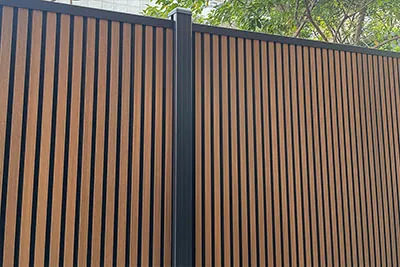
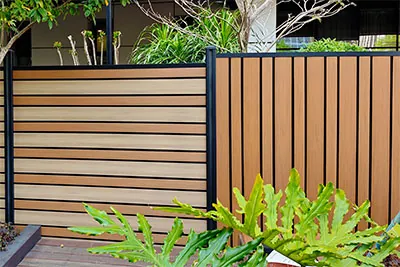
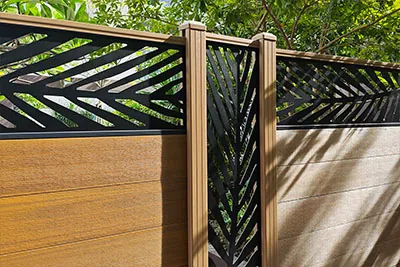
Every composite fence installation guide online assumes you’re digging post holes in dirt. But what happens when the job is on top of a concrete retaining wall?
Different forces. Different anchoring. Different failure modes. If you quote a wall-mount job using ground-install logic, you’re either undercharging or setting yourself up for a callback.
We’re MecoFence — we’ve manufactured composite fence systems since 2014 and shipped to 50+ countries. This guide covers what we’ve learned from real wall-mount projects across Europe, New Zealand, and the Middle East. No fluff. Just the technical details your quoting sheet needs.
Check the Wall Before You Measure the Fence
The wall is your foundation now. Not the ground. Three things to confirm on site before you count panels.
Concrete Cap Width
The post base plate needs flat surface on both sides of the anchor points. If the cap is too narrow — common on older garden walls — you may need a wider cap poured first.
MecoFence base plates use an 80mm × 80mm post footprint. Allow at least 30mm clearance beyond the anchor bolt holes on each side. Narrower than that, and you risk edge blowout.
Concrete Condition
Tap the wall cap with a hammer. Solid concrete rings clean. Hollow-core block gives a dull thud. Spalling surfaces crumble under anchor pressure.
These walls can still work — but they need chemical anchors instead of expansion wedges. Know what you’re drilling into before you commit to a method.
Total Height = Wall + Fence
A 1m retaining wall plus a 1.8m privacy panel = 2.8m total barrier height. Many European municipalities cap combined boundary heights. Check local codes before you lock a height into the quote.
Easier to adjust now than after the container arrives.
On the ground, soil provides passive lateral resistance. On a wall, the base plate and anchors are doing 100% of the work.
Spacing
Standard 1.8m center-to-center works for most wall-mount runs. But on elevated walls fully exposed to crosswind? Consider tightening to 1.5m–1.6m in high-wind zones. Shorter spans = less sail area per section = less force on each base plate.
Anchor Selection
| Anchor Type | Best For | Avoid When |
|---|---|---|
| Wedge anchors | Solid poured concrete | Hollow block, old mortar |
| Chemical anchors | Hollow-core block, aged concrete | Wet conditions during cure |
| Through-bolts + backing plate | Narrow walls with underside access | No underside access |
The Base Plate Difference
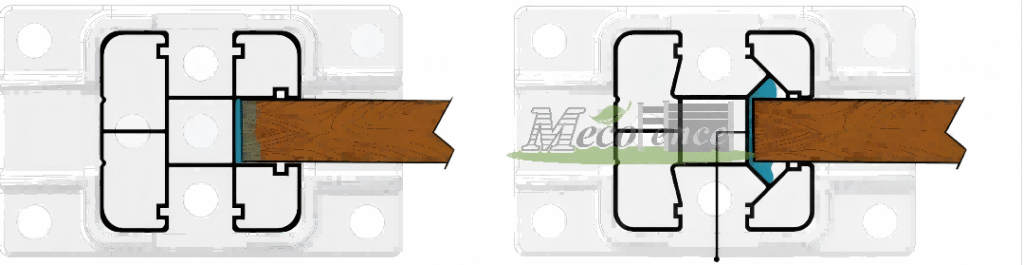
Not all post systems handle wall mounting equally. The MecoFence aluminum post uses a hidden inset base plate with anti-wobble plastic inserts inside the post column. The insert locks the post to the plate — no rocking, no progressive loosening.
On a wall where there’s no surrounding soil to dampen movement, this rigidity is the difference between a fence that stays tight and one that develops a click-click-click in the wind after six months.
Thermal Expansion — the Problem That Shows Up 6 Months Later
Here’s where wall-mounted fences behave differently. And where a lot of cheaper systems fail.
A fence on top of a wall gets direct sunlight on both sides. A ground-level fence usually has shade on one side — from the house, from vegetation, from the wall itself. Wall-mounted panels heat more evenly and reach higher peak temperatures.
More heat = more expansion. In a European climate, the swing between a January night and a July afternoon can exceed 50°C. Over a 1.8m panel, that translates to several millimeters of movement per cycle.
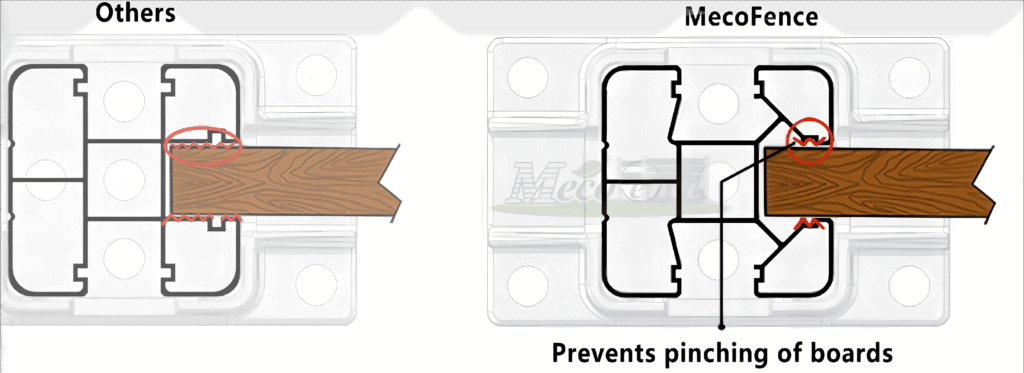
If your post system clamps the panel edge — like an H-channel or rigid U-channel — the panel can’t move. The edges crush. After a season or two, you see cracking and warping at every post joint.
How the Y-Column Solves This
The MecoFence Y-column uses a spatial notch that holds the panel in position without clamping it. There’s a 2–3mm gap between the panel edge and the column wall on each side.
Panel expands in heat? Pushes outward freely inside the channel. Contracts in cold? Pulls back. No pinching, no crushing, no edge damage.
It’s invisible on install day. It becomes very visible 12 months later — either as clean joints, or as cracked edges at every post. That’s the difference between a well-engineered composite fence system and a cheap one.
Water Drainage at Post Joints — the Hidden Issue on Walls
Ground-level fences have one advantage wall-mounted fences don’t: the ground absorbs water.
On a concrete wall, rain reaches the panel-to-post junction and sits there. If the post channel doesn’t evacuate it, water pools at the panel edges. Over time:
- UV degradation accelerates at the wet joint
- Algae and mildew grow in the standing water
- In freezing climates, ice expansion cracks panel edges from below
The MecoFence Y-column includes a hydrophobic drain trough inside the channel. Water enters the joint, runs down the Y-channel interior, exits at the base. No pooling. No edge contact. No freeze damage.
You can’t see it in a product photo. You’ll see it 18 months later when competitors’ panels have water stains at every post and yours don’t.
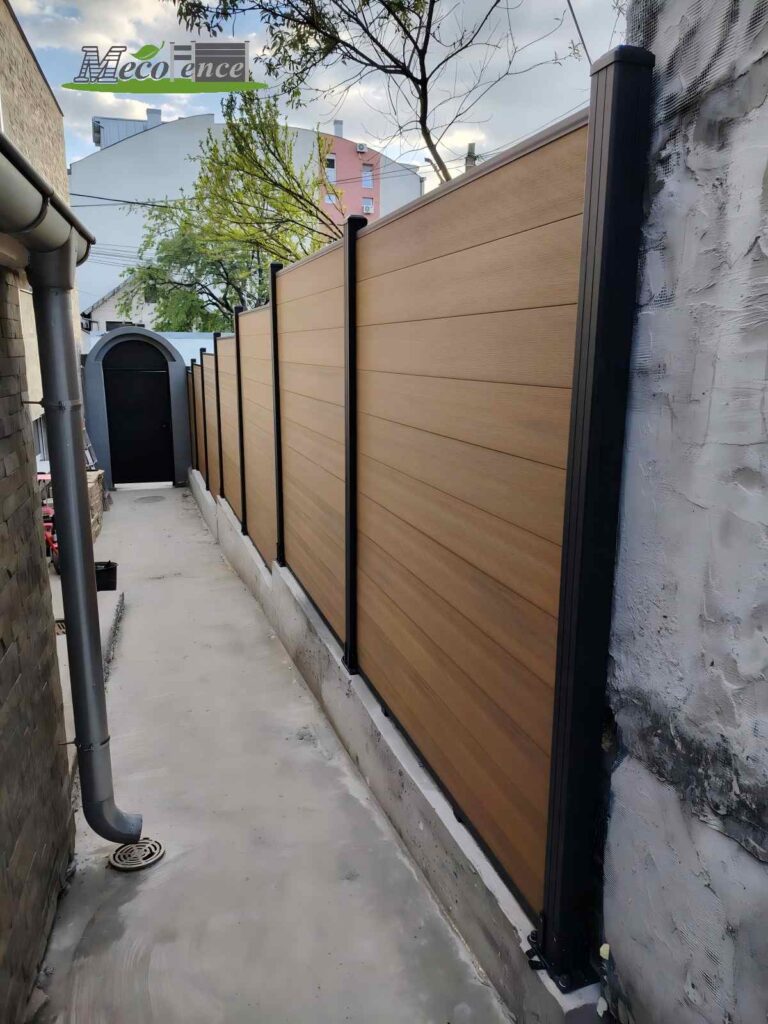
What It Looks Like Installed: EU Contractor Project in Teak
One of our European construction partners recently completed a teak privacy fence installation on a concrete retaining wall in an urban setting. Here’s the result.
| Detail | Spec |
|---|---|
| Product | MecoFence Privacy Fence |
| Panel Size | 1.8m × 1.8m |
| Board Profile | 180mm wide × 24mm thick, co-extruded |
| Color | Teak |
| Post System | 80mm × 80mm aluminum Y-column, 1.7mm wall |
| Post Features | Anti-pinch Y-slot, drain trough, small-angle adjustment |
| Mounting | Surface base plate on concrete retaining wall |
| Fire Rating | ASTM E84 Class A |
| Wind Rating | Beaufort Level 9 (Intertek tested) |
Notice the color consistency across five+ consecutive bays. That’s the co-extrusion line working — 360-degree outer cap, continuous color calibration. For a wholesaler fulfilling a 200-meter commercial project, this consistency is non-negotiable. Learn more about what makes composite fencing perform at this level.
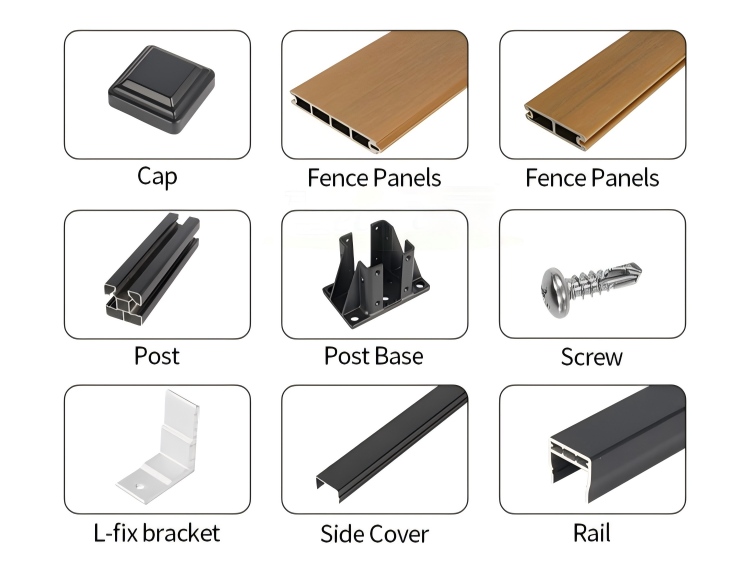
Components Checklist for Wall-Mount Projects
Same system as ground-level, one key difference: the base plate type.
| Component | Wall-Mount Note |
|---|---|
| Aluminum Y-column post | Same as ground — may cut shorter if wall provides height |
| Surface-mount base plate | Use wall-mount plate with mechanical anchors — not ground-embed type |
| Anti-wobble insert | Critical on wall installs — eliminates lateral play |
| Top rail | Same as ground install |
| Privacy fence panels (24mm) | Same panels, same dimensions |
| Side cover, L-fix, post cap | Same as ground install |
Quoting tip: on wall-mount jobs, posts are often cut shorter since the wall provides the first 0.5–1.0m of height. Confirm the desired total height (wall + fence) with the client before ordering post lengths.
For complex terrain — slopes, corners, stepped walls — see our installation guide for slopes and uneven ground.
Frequently Asked Questions
Yes. Use surface-mount base plates with mechanical anchors (wedge or chemical) secured into the concrete cap. The concrete must be solid and at least wide enough to provide clearance around the anchor bolts. MecoFence aluminum posts with anti-wobble inserts are engineered for this exact application.
Wedge anchors are best for solid poured concrete. Chemical anchors are recommended for hollow-core block or older concrete where expansion pressure may crumble hole edges. Through-bolts with backing plates offer maximum strength if you have access to the wall’s underside.
Yes — and more than ground-level fences because wall-mounted panels are exposed to sun on both sides. The MecoFence Y-column provides a 2–3mm expansion gap on each side of the panel, allowing free movement without pinching or crushing. Rigid H-channel or U-channel systems don’t allow this and often show cracked edges within 1–2 seasons.
Water pools at post joints on concrete because there’s no soil to absorb it. The MecoFence Y-column includes a built-in hydrophobic drain trough that channels water downward and out through the base — preventing standing water, algae growth, and freeze damage at panel edges.
Standard 1.8m center-to-center for most applications. In high-wind zones or on fully exposed elevated walls, tighten to 1.5–1.6m to reduce sail area and wind load per post. MecoFence panels are 1.8m × 1.8m standard and fit the standard spacing without cutting.
The bottom line
Mounting composite fence on concrete isn’t harder than a ground install. It’s different. Different anchoring, different thermal behavior, different drainage requirements.
Get the wall check right. Get the anchor type right. Use a post system that handles expansion and water. That’s it.
We built MecoFence for exactly these conditions. Our first clients were in New Zealand — island climate, extreme UV, typhoon-grade wind loads (Beaufort Level 9, Intertek tested). The same engineering is in every panel and post we ship to Europe today.
Written by
Steven He
Co-Founder & Head of Product · MecoFence
Steven leads product development and B2B partnerships at MecoFence, a WPC composite fence manufacturer based in Guangdong, China. 10+ years in composite material manufacturing, covering formulation, extrusion process engineering, and export supply chain.
Table of Contents
Planning a Wall-Mount Fence Project?
MecoFence composite fence systems are engineered for concrete, soil, slopes, and everything in between — with factory-direct pricing for contractors and wholesalers worldwide.
Request Wholesale Pricing →