
Start with the product you need to sell or install. Then build a supplier shortlist that can deliver it.
A contractor’s drawing lands in your inbox: white privacy panels, a matching gate and a decorative aluminum insert. At the showroom, a dealer wants a dual-tone option to put beside the standard gray range. Each request needs a supplier who can turn that idea into an order.
The search starts with “composite fence manufacturers.” A top-ten list leads to a top-twenty list, with familiar promises beside each name: quality, innovation, competitive prices and global experience.
Three tabs later, the shortlist is longer. The practical questions are still open: whether white is a standard color, what comes with the quoted panel, and whether the supplier can deliver the design and quantity required.
A useful shortlist shows which suppliers can meet your design, quantity and delivery requirements. For wholesalers, distributors and fence contractors, those details determine whether a product can be stocked, sold or installed as planned.
Go straight to: standard, custom and new product options | China supplier directory and quotation guide
A place on a top list tells you very little about your order
Supplier lists can introduce useful names. Their value for a purchase depends on whether they explain what those businesses supply and how the recommendations were made.
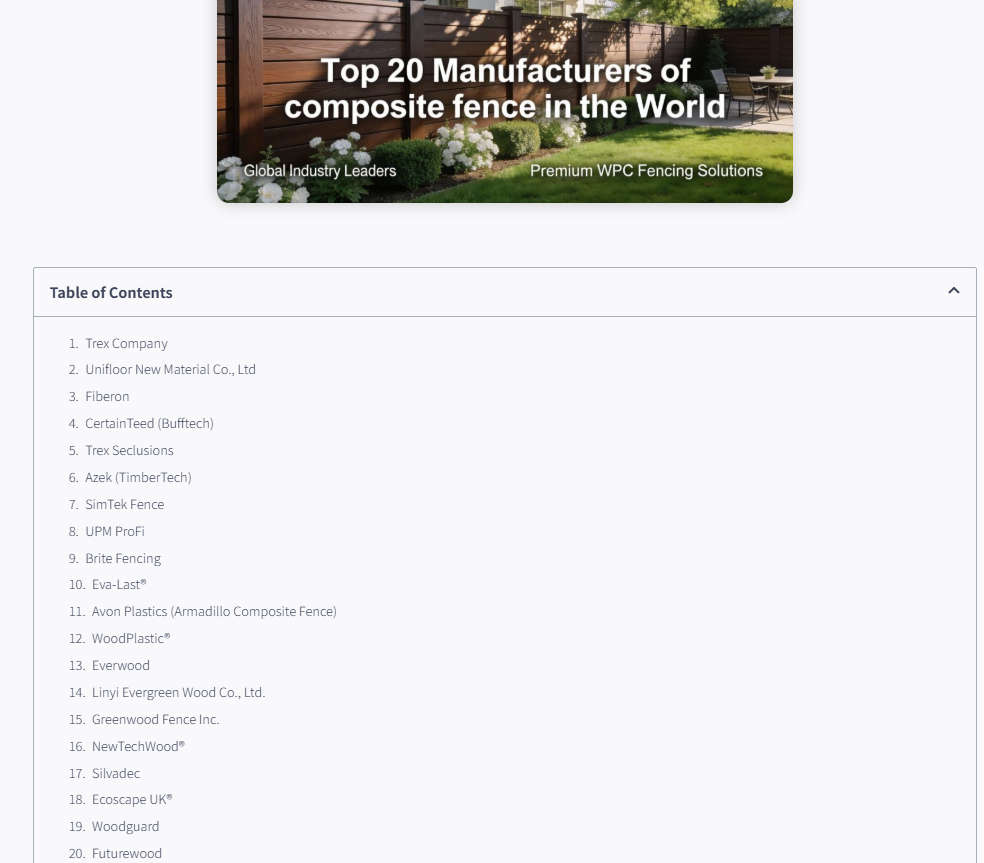
One ranking reviewed for this guide lists Trex Company and Trex Seclusions separately. Trex presents Seclusions as a fencing collection on its own website, so those entries do not represent two independent manufacturers.
That distinction matters when you are counting potential sources. A company, a product line and a local distributor can each be useful contacts, but they play different roles in an order.
Use a list to find names, then narrow it with three order questions:
- Does the supplier offer the fence design you need?
- Does its supply model fit your quantity and delivery schedule?
- Does the quotation cover the complete system you intend to sell or install?
Decide what you are buying before deciding whom to buy from
A standard privacy fence, a custom white panel and a new ventilated design create different purchasing tasks. One order can include all three: an existing privacy system, a specified white finish and a new decorative aluminum insert.
Start with what an existing system can already do. Then identify the parts that need to change, so the supplier can separate standard production from custom work.
| Buying route | Typical products | The decision to make |
|---|---|---|
| An established product | Privacy fence, trellis fence, existing colors and panel sizes | Can the current system meet your sales or project requirements? |
| A custom specification | A particular white, decorative aluminum panels, nonstandard dimensions | What must change, and is the change worth its cost and lead time? |
| A product-line addition | ASA-capped systems, dual-tone finishes, privacy designs with airflow | Which customer need does it address, and how will you test demand? |
Buying standard products: start with the complete fence system
If you already know your customers want a conventional privacy fence, a supplier’s existing range may be the most practical place to start. You can compare a defined product without first commissioning a new design.
For privacy fencing, look beyond the face of the board. The specification needs to identify the panel dimensions, posts, rails, fixing method and any matching gate. A panel photograph rarely tells you what the quoted set includes.
Trellis fencing serves a different visual purpose. A full trellis panel, a solid panel with a trellis top and a mid-trellis design offer different degrees of openness; they should not be treated as interchangeable versions of the same privacy fence.
- For repeat stock: the stock plan needs sizes, colors and replacement parts that can be replenished.
- For a named project: the standard system needs to fit the drawing and installation conditions.
- For a mixed range: shared components reduce the number of separate stock lines.
“Standard” also needs a definition. It can mean an existing mold and established specification, with production starting after an order. It does not automatically mean finished goods are sitting in a warehouse.
Buying custom products: define the change before requesting a price
A request for a white fence can be simple or quite involved. If the supplier already produces an acceptable white in the right system, you are buying an existing product. If you need a specific shade, finish or matching set of components, you are discussing a custom specification.
“We can make white” leaves several details open: the boards, posts, gate frame and decorative insert may use different materials and finishes. A physical sample or agreed color reference gives the supplier a target; the approval should identify any visible differences accepted between materials.
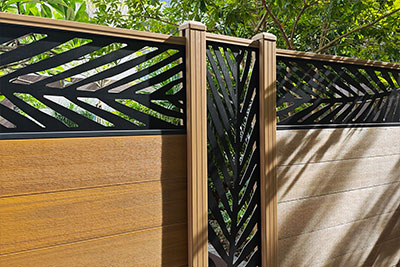
Decorative aluminum fencing panels need a similarly clear brief. You might mean a full aluminum screen, a laser-cut insert above composite boards or a decorative panel within a framed fence section. Those are different assemblies, with different drawing and fabrication requirements.
It helps to separate three levels of customization:
- Configure an existing system. Choose from available colors, lengths and decorative options.
- Modify an existing product. Request a new color match, a different insert pattern or a changed dimension that the production process can accommodate.
- Develop a new product. Change the profile or assembly enough to require design work, tooling or additional testing.
For the second and third routes, discuss sample approval, minimum quantities by color or design, development charges and production timing. A custom mold may also need a written agreement about ownership and future use.
Before paying for custom tooling, compare the development cost with your expected order volume. For a one-off project, an available profile with a custom insert may meet the design brief without developing an entirely new board.
Buying new products: connect the design to a customer need
A dealer may be asking for an option beyond flat gray panels, or a project designer may want a screened terrace that still feels open. These are useful reasons to explore a new range because they identify a customer need before adding another product to stock.
Material construction, contrasting finishes and ventilated profiles address different needs. Use the following examples to decide what to evaluate; they are product directions, not a claim that every market is already buying them.
ASA: ask what the whole board is made of
If customers are asking about a particular color or exposed outdoor application, compare how candidate boards are constructed. ASA can be used as an outer layer, so ask the supplier to identify both the cap and the core material.
An ASA-capped polyvinyl chloride (PVC) profile has a different core from a WPC board. Request the product specification and relevant weathering or color-retention information for the actual option being proposed, rather than treating the material name as a performance result.
The report should identify the proposed cap, core and finish, so its results can be related to the product being offered.
Dual-tone designs: decide what the contrast contributes
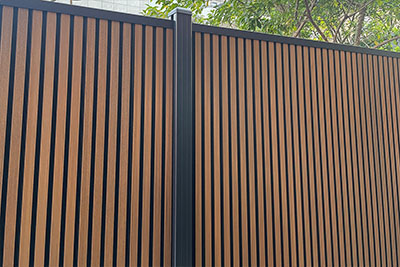
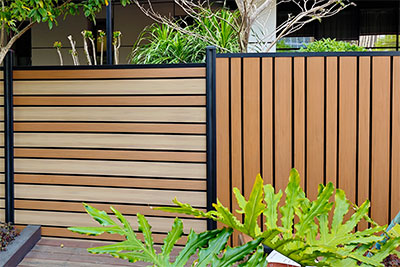
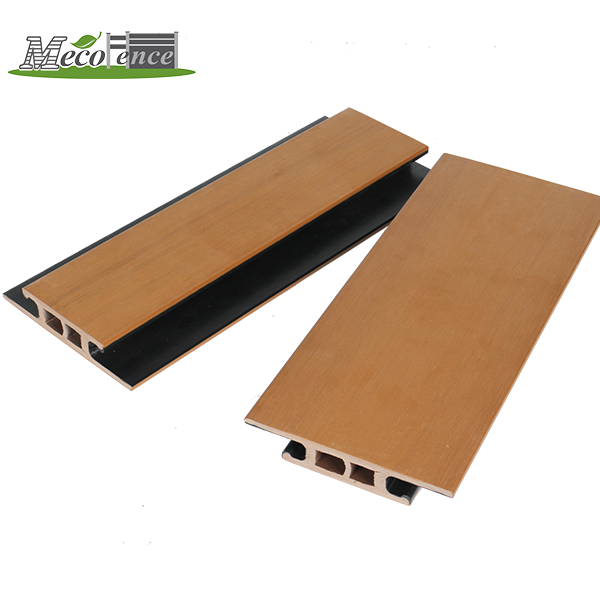
A wood-tone face with dark grooves can give a fence more visual depth. For a distributor, that may create an alternative to a flat, single-color range; for a contractor, the darker grooves may coordinate with dark posts and gate frames.
An assembled section shows how both faces look beside the posts and gate. Compare vertical and horizontal installation, including how the groove pattern ends at the rails and frame.
Add a color combination when customer demand justifies keeping it in stock. Confirm whether it shares posts and rails with your existing range, and whether a later order can replenish that color without buying the full assortment again.
Privacy with airflow: understand the viewing angles
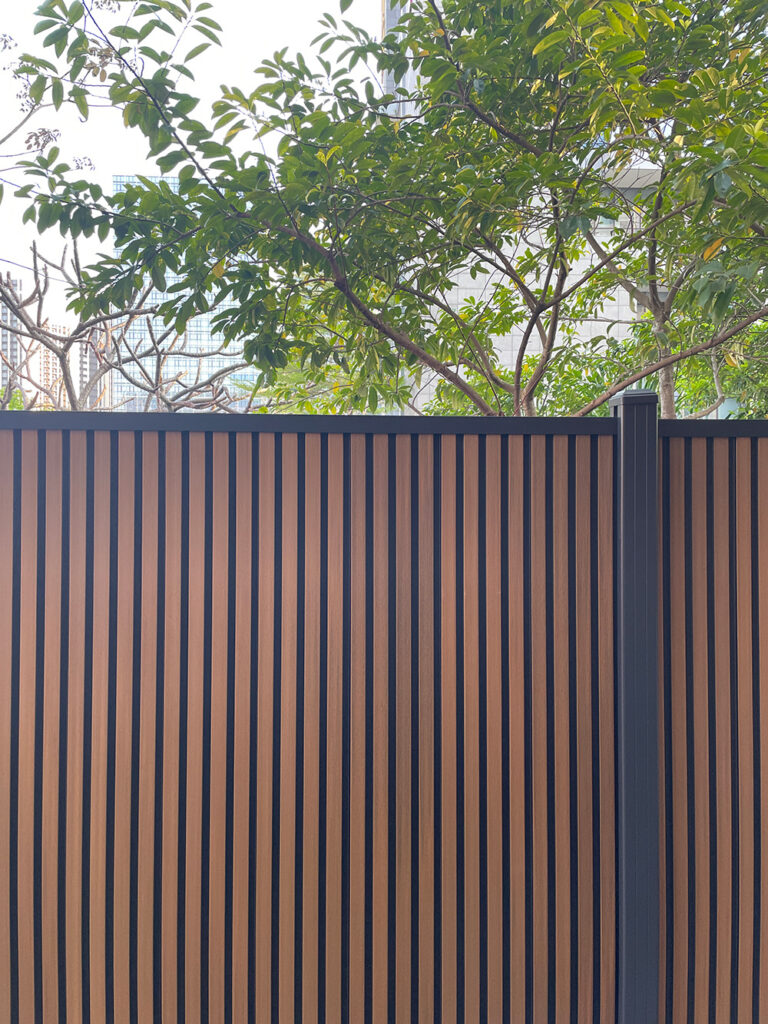
A client may want to screen a terrace from a neighboring property while allowing air to pass through the boundary. Offset or shaped profiles can address that brief by creating air passages and obscuring direct sightlines.
Review an assembled section from the positions that matter on the site: straight on, from an angle and from an upper floor where relevant. Privacy depends on that geometry, and any wind-load requirement still needs evidence for the complete fence assembly.
Put a sample or display section in front of the dealers, installers or project customers you expect to buy it. Record which finish they prefer, the price level they would consider and what they need to know about installation; use that feedback to choose the opening assortment.
If a supplier offers a limited opening order, agree what a successful trial would lead to: the colors to retain, the quantity to replenish and the supporting materials needed for a wider launch.

Match the supplier’s capabilities to the order you intend to place
A company can be a legitimate manufacturer and still be a poor fit for your order. Your preferred design may fall outside its normal production, your opening quantity may be too small, or your project may need support it does not offer.
Send the same product brief to the suppliers under consideration. Their responses should identify the proposed system, the parts that require custom work and any quantity or delivery conditions that affect the order.
| Your order | Capability to prioritize | A useful response from the supplier |
|---|---|---|
| Repeat orders of standard privacy or trellis fencing | Established systems, compatible accessories and replenishment planning | A defined kit, available variants and an order-specific production schedule |
| White panels or custom decorative aluminum inserts | Color communication, fabrication, drawing review and sampling | A clear split between standard options and custom work, with sample and production terms |
| A new material or design range | Product explanation, application evidence and launch support | Samples, relevant technical documents and a workable opening-order proposal |
| An installation project with gates and changes of direction | System detailing and complete component supply | A drawing-based component list that includes gates, corner and end conditions |
Ask who is responsible for each part of the system. A composite-board producer may source its aluminum work elsewhere, while a specialist fence supplier may coordinate several production processes. What matters to your order is that the responsibilities and supply scope are clear.
If the job needs a small quantity on a short schedule, compare local stock or a distributor route alongside direct factory supply. A factory price is only useful if production and international delivery fit the date the materials are needed.
Once the product fit is clear, check the business and supporting evidence. Our guide to vetting a WPC fence manufacturer in China covers that process separately, including the questions to ask before committing to an order.
Documents to agree before the order
A test report is useful when it identifies the product being offered and the conditions under which it was tested. For a new range, the specification should connect each report to the board profile, material, finish and assembly it covers.
| Document or test | What the buyer needs to know |
|---|---|
| Quality-management certificate | ISO 9001 concerns the organization’s quality-management system. Check the certified company, site, scope, edition and validity; it does not establish a fence panel’s wind or fire performance. |
| WPC product specification | EN 15534-6 addresses WPC fencing profiles and elements. ASTM D7032 addresses deck boards, stair treads, guards and handrails; a report to that standard should not automatically be treated as approval for a privacy fence. |
| Fire classification, where required | For an EN 13501-1 classification, identify the tested construction, mounting conditions and declared class. The required classification depends on the intended market and application. |
| Weathering or color-retention report | Record the test method, UV exposure and moisture cycle, exposure hours and measured result for the proposed finish. A QUV exposure duration alone does not translate into a guaranteed number of outdoor years. |
| Wind or structural report | Match the tested panel size, posts, rails, fixings and anchorage to the proposed assembly. A board-only result cannot establish the performance of the complete installed fence. |
For the scope of these documents, see ISO’s quality-management standard, EN 15534-6 for fencing profiles, ASTM D7032’s product scope and EN 13501-1 fire classification. Q-Lab explains why accelerated-weathering hours cannot be converted into outdoor years using a universal multiplier.
If a supplier claims CE marking, identify the applicable regulatory and technical basis for the product and its intended use, together with the relevant declaration. A test standard on a report is not, by itself, a complete CE-marking basis; the European Commission’s construction-product assessment guidance explains the assessment route for products outside harmonised standards.
Pre-shipment inspection checks the manufactured order against the agreed specification before dispatch. The brief can cover dimensions, finish, assembly fit, quantities, packaging and markings, with separate arrangements for container-loading supervision if required.
An independent inspector can work to that brief; the inspection company’s name does not define the checks. The acceptance criteria, inspection date, report and handling of nonconforming goods belong in the order agreement.
Wholesalers need a range they can sell. Contractors need a system they can deliver
For a wholesaler, a successful purchase has to work beyond the first shipment. For a contractor, it has to arrive as a complete package that the crew can install on schedule.
Order quantities and lead times: a published example
MecoFence’s WPC fence bulk-order page provides a starting point for planning an order. These are supplier-published references checked on September 14, 2026, rather than industry averages or a quotation for a particular shipment.
| Planning item | Published reference | What the figure covers |
|---|---|---|
| Standard opening order | 100 sets | Listed starting minimum order quantity (MOQ) for standard 6ft × 6ft panels; the partner-program section separately lists 200 sets per order. |
| Custom colors | 200+ sets | Published threshold for custom-color orders. The page does not state that every color may be split within that quantity. |
| Production | 15–25 days | Published production range after order confirmation. A new mold or unapproved sample needs its own development schedule. |
| Ocean transit | US West Coast: 22–28 days; US East Coast: 28–35 days; Europe: 28–36 days | Ranges in the page’s shipping FAQ. These are transit references, separate from production and destination handling. |
| Container planning | About 400 sets per 40ft container | Listed for the page’s standard systems; its FAQ specifies approximately 400 sets in a 40HQ (40-foot high-cube container). The actual parts mix and packing plan control the shipment. |
| Sample pack | 35cm board samples | The page lists these alongside a mini fence set and catalog. Sample-production and courier dates need a separate schedule. |
The 100-set standard offer and 200-set partner-program minimum describe different purchasing arrangements. The quotation should identify the applicable minimum and the accepted split by color and profile; a custom-color threshold does not automatically establish a per-color MOQ.
For a rough length calculation, 400 nominal 1.83m-wide bays represent about 732 linear meters before allowing for gates, corners and the precise installed bay width. That calculation describes nominal fence length, not a guaranteed container load; the packing list still needs to account for posts, hardware, gates, pallets and shipment weight.
Sampling, production, sea transit and destination delivery belong on separate lines of the schedule. A supplier’s transit range cannot establish the date the goods will reach your warehouse.
Wholesalers: choose a range you can stock, sell and support
A new WPC range has to earn its place alongside the products you already sell. Before committing to the opening order, consider how it will fit your customers, your stock and the support you provide after a sale.
Will the range fit the business you already have?
A dealer who already buys timber or aluminum fencing from you may welcome a WPC option. The panel sizes, gate options and installation method still need to suit the work that dealer handles.
Within the same supplier’s fence system, different colors or surface finishes will often use the same posts and rails. That can let you add another look without stocking a separate frame system, provided the board thickness and fitting details remain compatible.
If you plan to use existing stock from another system or supplier, ask for compatibility to be confirmed. A similar appearance does not establish that boards, post channels and fixings will fit together.
Prepare the sales counter as well as the warehouse. Agree what display samples, installation documents, approved product images and packaging information are available, and what your dealers and installers need to learn before offering the range.
Build the opening order around complete fence systems
A low minimum order sounds useful until it turns out to apply separately to every color. The MOQ needs a unit: the whole order, each profile, each color or each custom design.
Mixed loading determines which of those items can travel together. Being able to combine privacy panels, trellis options and matching gates may help build a practical assortment, but the supplier must confirm which combinations it accepts and how each is priced.
Boards alone do not make a saleable order. Gray boards may still be on the shelf when the matching end-post fittings or gate hardware run out, leaving you unable to supply the next customer’s complete fence.
Give the supplier your expected mix of straight runs, corners and gates, and ask it to map the required components to that mix. Separate shared posts, rails and fixings from parts that belong to a particular design, then identify the display samples and service spares needed alongside saleable stock.
There is no single accessory ratio for every opening order. The supplier can explain the component requirements; your expected customer orders should determine the quantities.
Make sure repeat orders remain compatible
Ask about the second order before placing the first. If white sells faster than gray, can you replenish white alone, and at what quantity and lead time?
A sample approval also needs a connection to future supply. Agree how the selected finish will be referenced on repeat orders, what batch-to-batch color variation is acceptable and whether a later replacement board is expected to match an already weathered installation.
For routine replenishment within the same system, confirm that the order follows the agreed model, board thickness and fitting details. A new color or surface finish does not, by itself, mean the frame needs to change.
A different board thickness or an upgrade to the frame system needs a separate compatibility check. If a proposed change affects appearance, installation or fit, agree how the supplier will notify you and obtain approval before supplying the revised product.
Ask what happens to remaining stock and service parts if a model is revised or discontinued. That may involve a final replenishment order, continued availability of particular components or an agreed replacement option; the arrangement needs to be clear before you promise support to your own customers.
Know what support sits behind the warranty
A customer reports a problem after the fence has been installed. You need to know how the supplier will assess it and what support follows if it is accepted as a product defect.
An agreed claim process identifies the photographs, batch references and installation records required, the person handling the claim and the response timing. The warranty period alone does not explain how a customer complaint will be resolved.
Clarify whether an accepted claim leads to replacement components, a credit or another agreed remedy. International freight, local delivery and removal or reinstallation labor need separate inclusion or exclusion terms.
The service you promise locally should reflect the support you have agreed with the supplier and the responsibilities your own business will retain. Resolve that difference before the range reaches your dealers.
- Make the margin calculation complete. Compare costs on the same delivery basis, including the transport and handling needed to reach your warehouse.
- Clarify private-label terms. If packaging, branding or territory arrangements matter, agree them in writing rather than inferring them from an OEM claim.
These details help separate an affordable opening shipment from a range the business can support through repeat sales.
Contractors: quote every change in the fence run
A catalog panel describes one section of fencing. A project can include corners, end posts, changes in height, sloping ground and a gate opening that needs a different fixing detail.
Send the layout with the quotation request and ask for a component schedule. It should show what is supplied for the whole run, including gates and hardware, and identify anything the crew must source locally.
- Separate production from arrival. The agreed start date needs to account for the deposit and any outstanding drawing or sample approvals.
- Work back from the site date. Allow separately for production, transport, clearance and delivery to site; “ready to ship” does not mean ready for installation.
- Plan for missing or damaged parts. Agree what spares belong in the original shipment, how a shortage is reported and who pays for replacement parts and transport.
- Confirm the installation scope. Identify cutting, drilling, fixing and site work that the selected system requires, together with the instructions and project documents available.
A few missing brackets can leave the final section unfinished even when every board has arrived. Resolve the replacement route before the crew has to wait for it.
For project-specific structural or regulatory requirements, confirm who supplies the relevant system documentation and who reviews the site design. Keep that responsibility separate from a general product description.
Compare the same delivered scope. A lower price for panels alone does not establish a saving against a package that also includes the gate, posts, fixings and spare components.
China composite fence suppliers: websites, platform details and pricing
MecoFence publishes this guide and appears in this directory. Suppliers are listed alphabetically; inclusion and order imply no ranking or quality endorsement.
The table uses the same broad fencing category for every supplier, including MecoFence. It is a starting point for product inquiries, not a comparison of every design or service each business offers.
Copy an address into your browser to open it. “Supplier profile” identifies a platform introduction; “Store address” identifies a storefront. A dash means no direct address is included in this directory.
| Supplier | Company contact location | Fencing category | Website address | Alibaba | Made-in-China |
|---|---|---|---|---|---|
| Anhui Sentai WPC | Guangde, Anhui | WPC fencing | www.sentaiwpc.net | Store addressahstspc.en.alibaba.com | Store addresssentai2007.en.made-in-china.com |
| AVID WPC | Xuancheng, Anhui | WPC fencing | www.chinawpcdecking.com | Supplier profilesuppliers.alibaba.com/anhui-avid-new-materials-co-ltd_2427082203 | Store addressavidwpc.en.made-in-china.com |
| COOWIN | Qingdao, Shandong | WPC fencing | www.coowingroup.com | Store addresscoowinwpc.m.en.alibaba.com | Store addressbarefootwpc.en.made-in-china.com |
| EVEROK | Haining, Zhejiang | WPC fencing | www.ekwpc.com | — | Store addresswpcfloor.en.made-in-china.com |
| Greenzone | Foshan, Guangdong | WPC fencing | www.greenzone-wpc.com | Store addresswpcgreenzone.en.alibaba.com | — |
| JFWPC / Nanjing Jufeng | Nanjing, Jiangsu | WPC fencing | www.jfwpc.com | — | Store addressnjjufeng.en.made-in-china.com |
| MACRO TECH | Chengde, Hebei | WPC fencing | macrotechwood.com | Store addressmacrotechwpc.en.alibaba.com | Store addresshebeimacrotech.en.made-in-china.com |
| MecoFence | Foshan, Guangdong | WPC fencing | mecofence.com | Store addressmexytechwpc.en.alibaba.com | Store addressmexytech.en.made-in-china.com |
| Senyu WPC | Yangzhou, Jiangsu | WPC fencing | www.senyu-wpc.com | — | Store addressyzsenyuwpc.en.made-in-china.com |
| Supereco | Linyi, Shandong | WPC fencing | www.ecowpc.com | Store addresssupereco.en.alibaba.com | Store addresssupereco.en.made-in-china.com |
| UNIFLOOR | Shanghai (municipality) | WPC fencing | www.unifloorwpc.com | Supplier profilesuppliers.alibaba.com/shanghai-unifloor-new-material-coltd_2209731064930 | — |
How we compiled this directory
Compiled and desk-reviewed: September 14, 2026. The starting list came from the sourcing records supplied for this article. Company websites, About and Contact pages, and publicly accessible marketplace profiles were used to review business locations and fencing categories.
Entries were retained where public material identified a China-based business, a fencing offering and a company contact location. Where the record combined different company identities without a supported connection, that combined entry was excluded.
Locations use city and province, or the municipality for Shanghai, and describe the company contact location published by the source. They do not establish that the office and production site are the same; this convention also applies to MecoFence.
Marketplace addresses come from the supplied sourcing records and public profiles where accessible. Login-only reports and transactions were not audited; the directory does not verify factory ownership, current capacity, product compliance or performance.
Sign in to see additional Alibaba supplier information
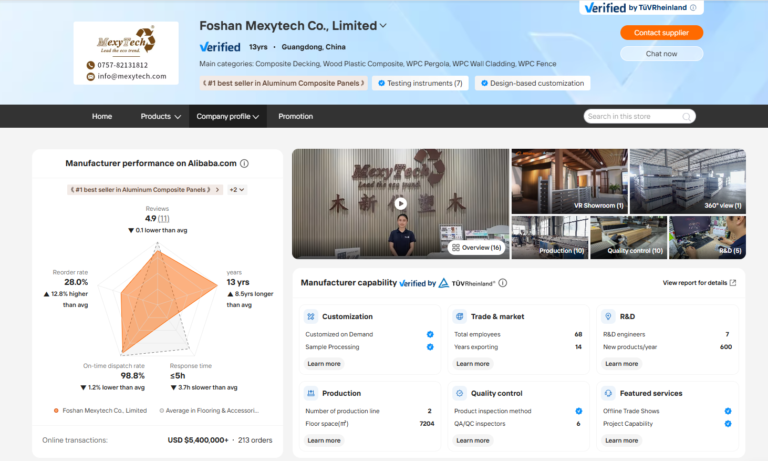
Some Alibaba company-profile details require a buyer-account login. Depending on the store, these can include supplier performance data, production and quality-control information, and assessment-report access.
The useful context is the period and scope behind each figure. An on-time-dispatch percentage describes platform-recorded dispatch performance for its reporting period; a response-time metric does not establish production capacity or technical support.
For an assessment report, read the company identity, assessment date, site and activities covered. A store badge and a product-specific test report answer different questions.
A platform listing price is not a quotation for your order
A price beside a fence photograph only becomes useful when the unit and package are clear. One piece may mean a board, a post or a complete section; one set may include a different parts list from the next supplier’s set.
Posts, rails, decorative inserts, hardware and packaging can be included or quoted separately. Check those items before comparing the headline figures.
Use a listing price as a reference until its specification, quantity and supply terms match your order. A fixed, ready-to-ship SKU may have a valid stated price; custom configurations need an order-specific quotation.
| What you see | What to establish before comparing |
|---|---|
| Price per piece | Is the piece one board, one post, one screen or an entire fence section? |
| Price per meter or square meter | Which dimensions and components are included in the measurement? |
| Price per set | What is the complete parts list, including posts and fixings? |
| A quantity-based price range | Which tier applies to your actual mix of designs, sizes and colors? |
| A factory or FOB price | Which transport and destination costs remain outside that figure? |
Know whether you are receiving an estimate or a formal quotation
An initial estimate helps establish whether the proposed design is close to your budget. A supplier can work from a reference image and approximate quantity, provided it states the assumptions behind the figure.
A formal quotation should identify the agreed product configuration, quantity and supply terms. If drawings, dimensions or component choices remain open, ask which changes would require the quotation to be revised.
You do not need a finished engineering package to begin. Send the information you have, and make the unknowns explicit:
- Design: a product reference, sketch or photograph showing the intended fence style.
- Dimensions: panel height and width, or a layout showing the total run and gate openings.
- Material and finish: the requested construction, color and any decorative aluminum detail.
- Quantity: panels or linear length, with the intended split by size, color and design.
- Supply scope: boards only or a complete system, including the parts you expect.
- Delivery: destination, required timing and the pricing basis you want compared.
Check what comes back with the price
A quotation is easier to compare when the configuration, exclusions and delivery terms arrive in one document:
- Product configuration: model, dimensions, material construction, finish and the drawing or sample reference where applicable.
- Quantity and unit: price per board, section, set, meter or square meter, with the variant breakdown.
- Included components and exclusions: posts, rails, gates, hardware, packaging and any locally sourced items.
- Custom charges: sampling, setup or tooling, separated from the recurring product price.
- Timing and delivery basis: production and dispatch dates, plus the Incoterms® 2020 rule and named place or port.
- Commercial terms: currency, payment schedule, quotation validity and the handling of replacement parts.
If one supplier prices standard gray infill and another prices white panels with decorative aluminum inserts, ask for the differences to be resolved before comparing totals. The same applies when one offer is ex-factory and another includes transport to a destination.
Need a budget before approaching suppliers? Use the WPC fence wholesale pricing and landed-cost guide for the separate cost discussion. It separates product, freight and destination costs so you can build a budget before requesting the current price for your configuration.
Put delivery and payment terms on the same order
The quotation should name the Incoterms® 2020 rule and the precise place or port. EXW (Ex Works), FOB (Free On Board), CIF (Cost, Insurance and Freight) and DDP (Delivered Duty Paid) allocate different delivery responsibilities; they are not interchangeable labels for the same landed cost.
FOB and CIF are sea or inland-waterway rules, and CIF payment of freight to a destination does not mean risk transfers there. FCA (Free Carrier) may fit a container handoff to a carrier before vessel loading; the ICC’s Incoterms guidance explains the boundaries to agree with the supplier and forwarder.
Payment terms are a separate agreement. MecoFence’s published first-order terms are 30% by T/T bank transfer as a deposit and 70% before shipment; payment against a bill-of-lading copy would be a different arrangement and should not be assumed.
Before paying, the order should connect each payment milestone to the agreed specification, approvals and inspection arrangements. For an eligible Alibaba Trade Assurance order, keep the agreed requirements in the platform order and follow its payment instructions and claim conditions; a supplier’s participation alone does not define protection for an off-platform transaction.
Download a fence supplier RFQ template
Send the same request for quotation (RFQ) to each shortlisted supplier. Fill in the product, quantity and delivery details, then attach the relevant drawing or reference photos. The same brief makes the suppliers’ proposals easier to compare.
View and copy the RFQ email
Subject: RFQ - composite fence system for [market / project]

We are a [wholesaler / distributor / contractor] sourcing fencing for [market].
Please propose a system against the following brief and identify any open assumptions.

BUYER BRIEF
Product route: standard range / custom option / new product trial
Reference model, photo or drawing:
Core and cap materials; finish and approved sample reference:
Panel height and installed bay width:
Post, rail, fixing and gate requirements:
Opening quantity, broken down by profile and color:
Estimated repeat-order quantity and frequency:
Destination and required warehouse or site date:
Branding, packaging and display-sample requirements:
Applicable project or market documentation requested:

PLEASE RETURN
1. Proposed model, drawing and complete component list, with exclusions.
2. Minimum order quantity per profile/color and accepted mixed-order combinations.
3. Product quotation; sampling and tooling quoted separately if applicable.
4. Sample approval, production and dispatch schedule, with start conditions.
5. Packing dimensions, gross weights and proposed container-loading plan.
6. Incoterms 2020 rule with the named place or port; destination exclusions.
7. Payment milestones, quotation validity and inspection arrangements.
8. Repeat-order compatibility, change-notification and spare-parts arrangements.
9. Warranty claim process, remedy and freight/labor inclusions or exclusions.
10. Relevant reports identifying the product and test scope.

Please label assumptions and alternatives so we can compare proposals on the same basis.
Questions buyers ask before making contact
Can a 100-set minimum be split across several colors?
A 100-set order minimum does not establish an accepted color split. Request a written breakdown by color and profile; MecoFence’s published 200+ set threshold for custom colors is a separate condition from its standard-panel starting MOQ.
How should I use a 400-set container estimate?
Treat it as a reference for the stated panel configuration. The supplier’s loading plan should show posts, rails, fixings, gates, pallets and gross weight; a mixed shipment may carry a different number of complete sets.
Does a new color require a different fence frame?
Within the same supplier’s system, a different color or surface finish will often use the existing frame. Board thickness, fitting details and any frame-system upgrade still need to remain compatible with the approved specification.
What should a contractor send for a complete quotation?
Send the fence layout, heights, corners, gate openings, finish and delivery date. The returned component schedule should identify both supplied parts and items the installer must source locally; the RFQ template above provides an editable starting point.
Does an ISO 9001 certificate prove a fence meets wind or fire requirements?
No. It concerns the organization’s quality-management system; product performance needs relevant reports for the proposed material or complete assembly, with the test configuration and application scope identified.
Does a warranty include replacement freight and installation labor?
Only if the agreed terms include them. Separate the product remedy from international freight, local delivery and removal or reinstallation labor before making a service promise to your customers.
Give your shortlist a job to do
Start with the product, then define the opening quantity and the date the material is needed. Ask shortlisted suppliers to separate standard items from custom work and return a quotation with the same component and delivery scope.
For a stocking order, confirm that the opening mix can supply complete systems, repeat orders will remain compatible and after-sales responsibilities are clear. For a project, make sure the package and replacement plan can support the installation through to completion.
Sources and scope
This guide is published by a fencing supplier. Directory records describe published business locations and offerings; product-page figures are supplier references, and project examples describe individual orders.
- Ranking example, accessed September 14, 2026www.unifloorwpc.com/fencing/top-20-manufacturers-of-composite-fence-in-the-world.html
- Trex product-collection reference, accessed September 14, 2026www.trex.com/products/fencing/
- MecoFence manufacturer-list articlemecofence.com/blog/sourcing-best-composite-fencing-manufacturers/
- Directory company and contact sources, reviewed September 14, 2026www.sentaiwpc.net/about-us/www.chinawpcdecking.com/about.htmlwww.coowingroup.com/contact-us/www.ekwpc.com/contactus.htmlwww.greenzone-wpc.com/company-profilewww.jfwpc.commacrotechwood.commecofence.com/contact-us/www.senyu-wpc.com/contact/www.ecowpc.comwww.unifloorwpc.com/contact
Technical and platform references are linked beside the relevant statements. The two project records are linked where their configurations are discussed; they do not establish a general minimum order or a performance guarantee.
Written by
Steven He
Co-Founder & Head of Product · MecoFence
Steven leads product development and B2B partnerships at MecoFence, a WPC composite fence manufacturer based in Guangdong, China. 10+ years in composite material manufacturing, covering formulation, extrusion process engineering, and export supply chain.
Considering a MecoFence system?
Review the composite fence range, then send your design and quantity for a product discussion.