
× Send

GaLaBau 2026 Fence Trends: What European Brands Launched—and What Buyers Should Verify

FIELD REPORT November 05 2026

A trade show booth can tell you where a brand is investing. It cannot, on its own, tell you what will sell in your market.

That distinction matters when you are planning a fencing range.

In September, our team visited GaLaBau 2026 in Nuremberg and reviewed the composite fencing and privacy systems presented by six established brands: NATURinFORM, elephant, TraumGarten, megawood, VIDUAL and GroJa. Around the show, we also held 23 meetings with distributors, wholesalers and contractors.

Three directions appeared repeatedly: more specific material claims, more design-led privacy fencing, and greater emphasis on installation efficiency.

For buyers, the opportunity is not simply to copy these directions. It is to understand which ones fit your customers—and what evidence you need before adding a new system to your inventory.

NATURinFORM booth at GaLaBau 2026 presenting its WPC material story and outdoor systems.

What This Report Covers—and What It Does Not

This is a field report focused on composite fencing and privacy systems, not a review of the entire outdoor-living market.

The six brands we reviewed are based in Germany or strongly positioned around German-speaking and nearby European markets. Their stands provide a useful view of that channel, but they do not represent every European country, price point or project type.

Likewise, our 23 buyer meetings were practical commercial conversations, not a statistically representative market survey.

Competitor specifications below are claims presented in the brands’ own materials. We have not independently tested their products. A trade show launch should therefore be read as a supplier-side signal—not proof of retail demand, installed performance or long-term reliability.

1. Material Claims Are Becoming More Specific

“Composite” once functioned as a complete sales pitch. At GaLaBau 2026, the stronger presentations went much further.

megawood presented its GCC composite with up to 75% wood fiber, Cradle to Cradle certification and a take-back program. NATURinFORM emphasized approximately 70% PEFC-certified local wood fiber, production offcuts returned to manufacturing, and a material it claims can be recycled multiple times. Its range also includes a 26 dB acoustic fence. elephant used its CoBAM bamboo-composite products to present a different renewable-material story.

These are not interchangeable claims. A high wood-fiber percentage describes a formulation; it does not automatically establish weathering performance. A certification may cover a material, a product or a company program. “Recyclable” also needs a practical collection and reprocessing route to become meaningful for an end customer.
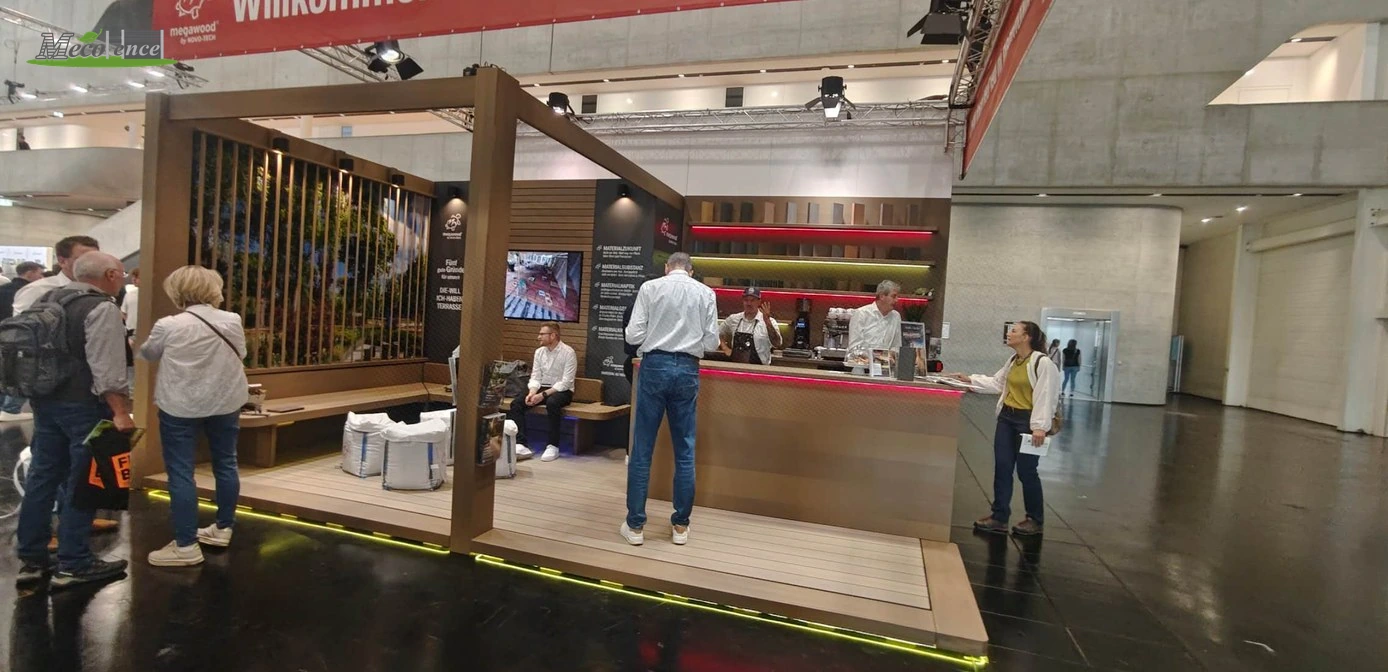
megawood booth at GaLaBau 2026 presenting GCC composite products and material claims.

What to verify before following this trend

Ask any supplier—including us—to separate the material story into four questions:

  • Which exact product does the claim cover? The core, cap and complete assembled fence are different subjects.
  • What does the certification actually measure? Chain-of-custody documentation, material-health certification and product-performance tests serve different purposes.
  • How does recycling work in practice? Ask whether collection, transport and reprocessing are available in the market where the fence will be sold.
  • What does the warranty exclude? Fading, staining, deformation and installation-related issues may be treated differently.

A useful material narrative should survive these questions. If it cannot, it is a booth story rather than a specification.

2. Privacy Fencing Is Becoming a Design System

The second direction was visible before we read a single specification.

TraumGarten presented modular fencing with decorative inserts, adjustable height increments and its SYSTEM LICHT range with integrated LED lighting. VIDUAL offered combinations across models, colors, heights and decorative panels, including aluminum frames with WPC infill. GroJa’s Mix-It approach used a shared connection standard across several series, allowing different designs to be combined.

The common idea is bigger than decorative panels. These brands are selling a coordinated design system rather than an isolated fence board.

That can support a higher-value sale. It can also create a more complicated inventory.

More finishes and components may mean more samples to maintain, more SKU decisions, more installation variations and more replacement parts to manage. A design range is only commercially useful if your team can explain it, your installers can assemble it and your customers can obtain compatible parts on a repeat order.

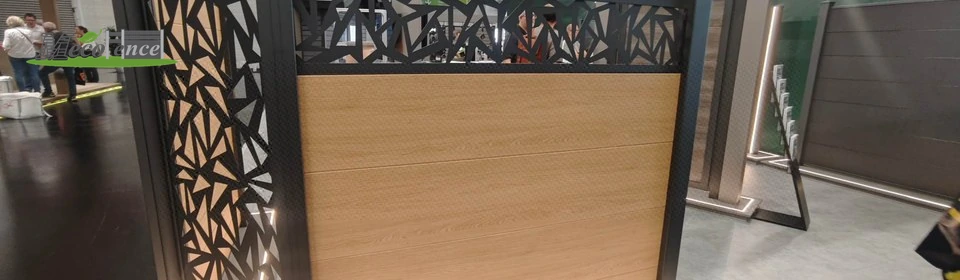
TraumGarten booth at GaLaBau 2026 with full-size privacy fence displays and sample panels.
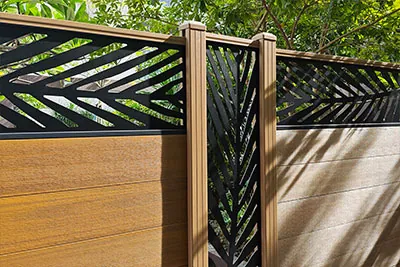
GroJa decorative fence panel with an openwork pattern displayed at GaLaBau 2026.

What to verify before following this trend

Before expanding a design-led range, ask:

  • Can repeat orders remain compatible with the first installation?
  • How are replacement boards, posts, caps and decorative parts supplied?
  • What is the policy on color variation between production batches?
  • Are corner, slope, end and gate details available for the same system?
  • What display samples, installation documents and sales materials support the range?

A smaller, coherent assortment is often easier to sell and support than a catalog full of combinations that your channel cannot realistically stock.

3. Installation Efficiency Is Part of the Product Now

Tool-free or reduced-tool assembly appeared across the brands we reviewed.

elephant previewed its Steckzaun Wave plug-in fence for the 2027 season. VIDUAL’s Stecksystem uses aluminum components that plug together without welding or visible screws. Across the show, clips, plugs and concealed fixings were presented as standard system features rather than optional upgrades.

The reason is straightforward: in many European markets, installation labor can represent a substantial part of the project cost. A lower board price does not necessarily produce a lower installed price.

But installation efficiency should not be judged by component count alone.

Fewer, wider boards may reduce the number of pieces to fit. At the same time, longer boards can be harder to transport, carry and align. Wider post spacing may reduce foundation work, but it can also require greater setting-out accuracy. The result depends on the complete design and the site.

VIDUAL modular fence systems and privacy panels displayed at GaLaBau 2026.

What to verify before following this trend

Compare systems using the whole installation, not just the panel:

  • Crew size and tools required
  • Post spacing, foundation and fixing requirements
  • Board length, weight and manual-handling needs
  • Cutting waste and replacement allowances
  • Corner, slope, gate and end conditions
  • Thermal-movement and clearance requirements
  • Actual assembly time during a trial installation

A timed trial on a representative run will tell you more than a showroom demonstration.

Four Requests We Heard from Buyers

The meetings around the show added a useful counterpoint to the exhibitor presentations. Four requests came up repeatedly.

1. A surface that does not look mass-produced

Buyers were interested in varied, tactile grain patterns rather than flat, uniform boards. In separate conversations, an Irish distributor and a Benelux wholesaler specifically commented on our Wanxiang grain.

That is encouraging feedback, but it remains anecdotal. A texture still needs to be evaluated as a physical sample, in daylight and at the viewing distance of a real project.

2. Documentation for project requirements

Fire documentation came up repeatedly in larger-account conversations. The practical lesson is simple: if a tender requires a particular classification, make it a gating question before discussing colors or pricing.

Do not infer a fire rating from a material family, a co-extruded cap or a general quality certificate. The documentation must apply to the required product or assembly and its intended use.

3. Environmental claims that can be explained

Buyers were interested in recyclability and responsible material sourcing, but they also needed claims they could pass on accurately. A certificate logo without its scope, validity and product coverage is not enough.

4. A complete, supportable system

Customers wanted coordinated boards, posts, rails, fixings, gates and documentation—not a collection of parts that leaves the installer to resolve compatibility on site.

They also wanted clarity on what happens after the first order: repeat compatibility, replacement parts, warranty handling and responsibility for freight or labor.

Where Wide-Plank Privacy Fencing Fits—and Where It Does Not

Wide-plank fencing is one way to respond to the demand for more architectural outdoor surfaces. Broader faces can create longer visual lines and a less repetitive appearance than narrow slats. A wider module can also reduce the number of boards and posts in a suitable layout.

It is not automatically the right choice for every project.

Wide-plank systems are worth considering when:

  • The project calls for a modern, cladding-like privacy surface.
  • The layout includes suitable straight runs where wider modules can be used efficiently.
  • The installer can transport and handle longer boards.
  • The distributor wants a differentiated range with a manageable number of finishes and components.
  • The complete system has been checked against the site’s exposure and fixing requirements.

They need closer evaluation when:

  • The site is highly exposed or subject to a specific wind-performance requirement.
  • The layout contains many short runs, corners, slopes or gate openings.
  • Access or manual handling makes longer boards impractical.
  • The tender requires a particular fire, acoustic or other performance classification.
  • Rapid local replacement of individual components is important but has not been planned into the supply arrangement.

These are not reasons to reject the concept. They are reasons to specify it properly.

Product Example: MecoFence ASA WidePlank Privacy Fence

One example of this approach is the MecoFence ASA WidePlank Privacy Fence. It is included here not as a universal answer to every trend above, but as an illustration of how a wide-plank concept translates into an orderable system.
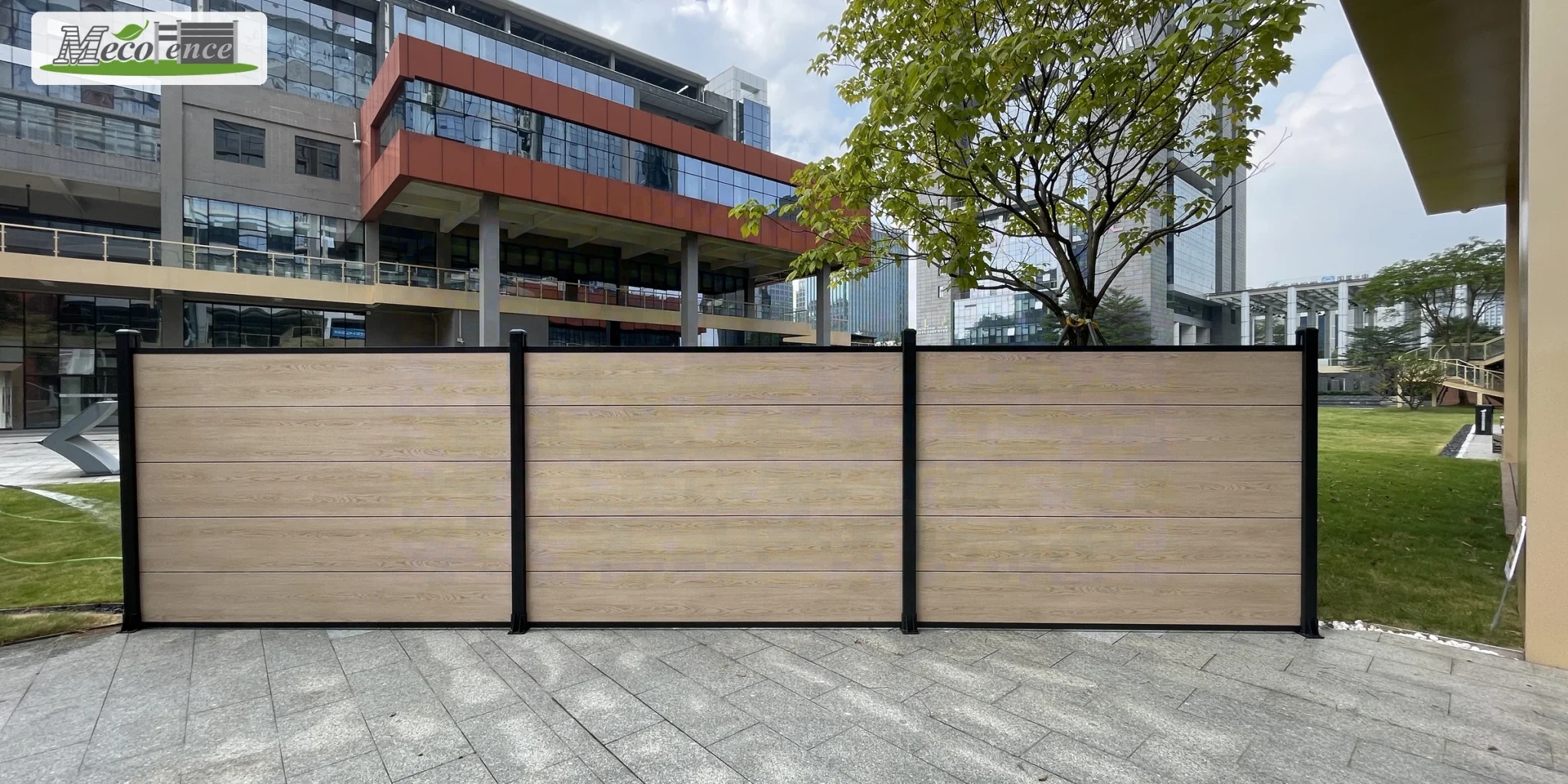
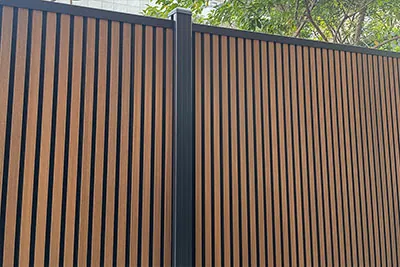
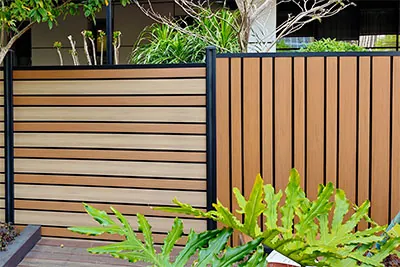
Installed ASA WidePlank privacy fence run with broad wood-grain boards separated by black joint lines.

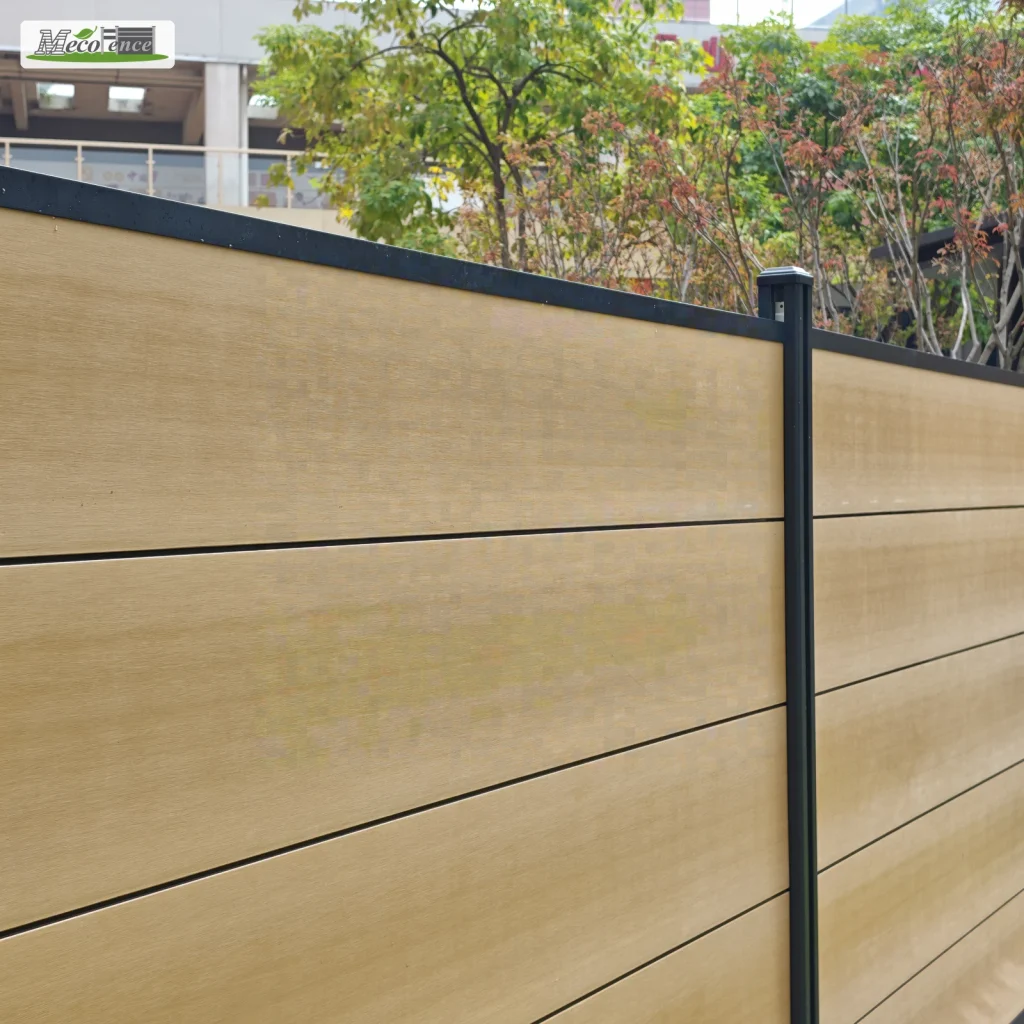
Each standard module measures 1,800 mm high × 2,400 mm wide and uses five AS-F04 boards. Each board is 2.36 m long, with a 335 mm visible face. The wider face is separated by defined black joint lines, creating a surface that reads more like architectural cladding than a conventional narrow-board fence.

Two surface options are available: Brushed grain, with a finer linear pattern, and Wanxiang grain, with a more varied wood-grain pattern. Wood tones and grey are offered, with color confirmed against a physical sample.
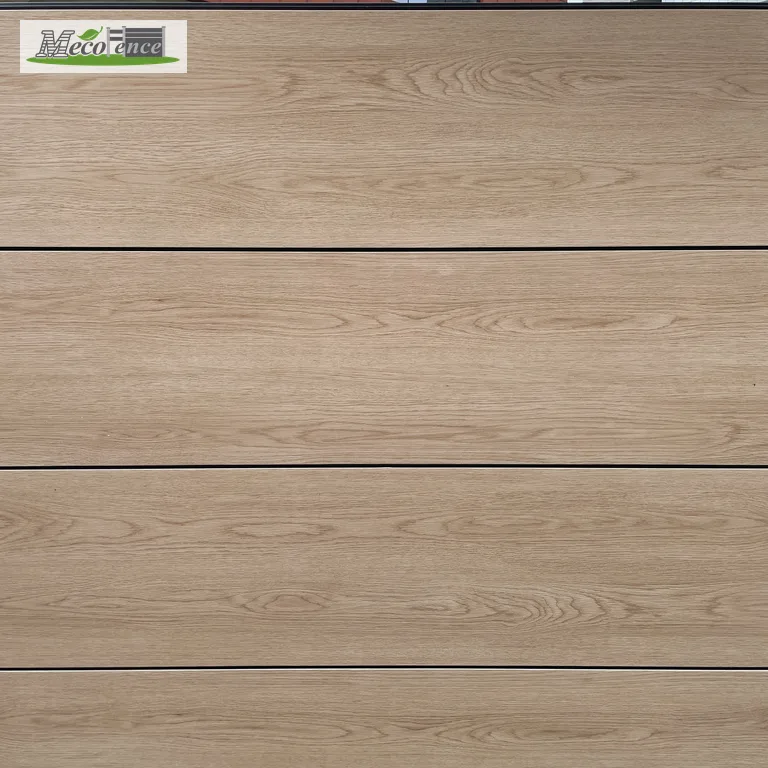
Close-up of the Wanxiang grain texture on an ASA WidePlank composite fence board.
Black joint line detail between two wide ASA composite fence boards.

The AS-F04 board is described as ASA co-extruded. ASA is a weatherable polymer family used in exterior applications, including automotive trim. That material background is relevant, but the material name alone should not be treated as proof of the finished product’s performance. Product-specific documentation and the applicable warranty terms remain part of the specification.

What the module comparison shows—and what it does not

The following comparison uses the WidePlank module and the specified MecoFence 1.8 m, ten-board standard privacy module.

 WidePlank moduleStandard privacy module
Module height × width1.8 × 2.4 m1.8 × 1.8 m
Boards per module510
Weight per board6.6 kg5 kg
Total board weight33 kg50 kg

Across a nominal 7.2 m straight run, the module layout changes to:

  • 3 WidePlank modules instead of 4 standard modules
  • 15 boards instead of 40
  • 4 posts instead of 5, with shared posts and the same end conditions
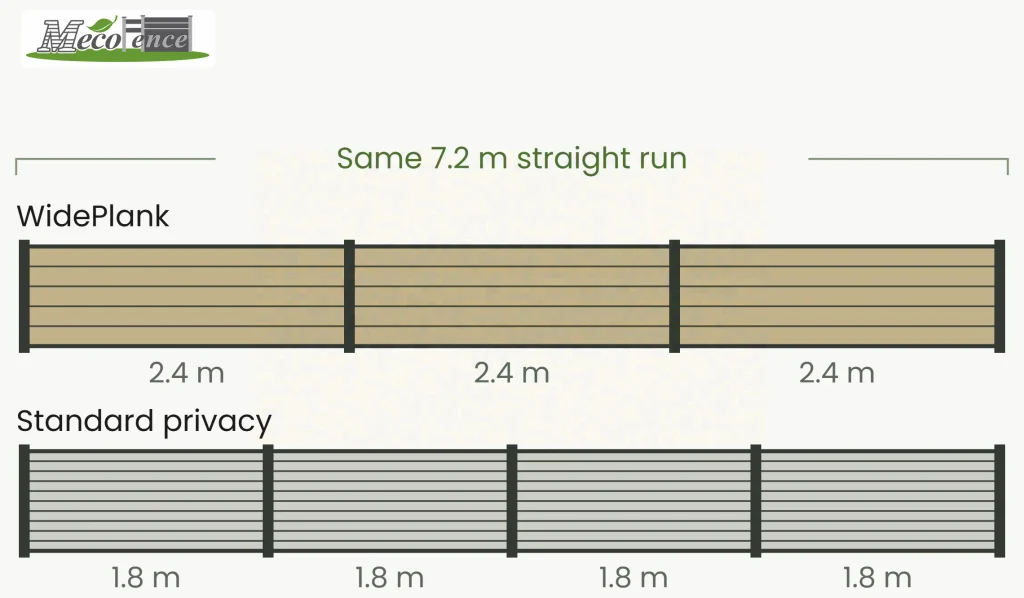
Diagram comparing three 2.4 m WidePlank modules covering a 7.2 m fence run against four 1.8 m standard modules.

The comparison shows a reduction in component count and board weight for the specified layouts. It does not, by itself, establish a measured installation-time saving or a total installed-cost saving.

Board weights above exclude posts, rails, fixings and packaging. Module dimensions are nominal. Corners, gates and site conditions change quantities, and the longer, heavier individual boards still need appropriate handling.

The next step is a trial installation: set out the posts, record crew size and time, and check the alignment, cutting and fixing process under real conditions.

Components and commercial terms

The coordinated layout includes five AS-F04 boards, a Post-N post, two JH-FR rails, a post side cover, an aluminum post cap and four L-fix brackets. Matching gates are part of the wider system discussion.
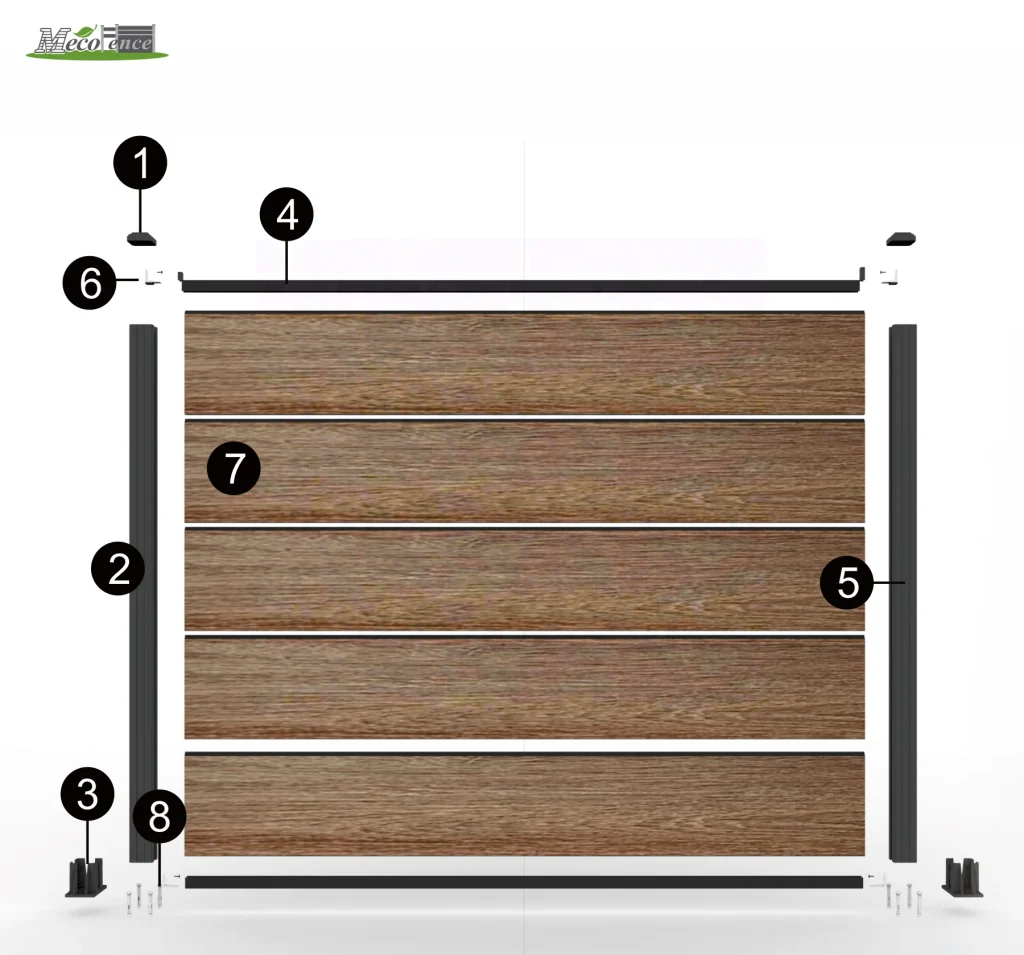
Exploded assembly diagram of one ASA WidePlank fence module showing boards, post, rails, brackets and cap.

The published minimum order is 100 sets, with OEM enquiries welcome. The stated warranty is 20 years for residential use and 15 years for commercial use; the full warranty terms and exclusions should be reviewed before making promises to downstream customers.

Before specifying or ordering, request the current package relevant to your project:

  • Installation drawing, post spacing and fixing method
  • Complete component schedule and stated exclusions
  • Applicable warranty terms
  • Available product-specific test documentation
  • Packing details and a container-loading plan
  • Replacement-part and repeat-order arrangements
  • Any fire, acoustic or other project-specific classification required by the tender

If a required document is not available for the proposed configuration, that should be resolved before the order—not discovered after installation.

How to Apply These Trends to Your 2027 Buying Plan

GaLaBau 2026 showed where several established European suppliers are investing. Turning that into a purchasing decision requires a more local test.

  1. Follow the design direction selectively. Choose a range your sales team can demonstrate and your channel can support, rather than adding every available finish or component.
  2. Compare the installed system, not only the board price. Include labor, foundations, waste, transport, spare parts and after-sales responsibilities.
  3. Check every claim at the correct level. Material, product, assembled system and company-program claims are not interchangeable.
  4. Run a sample and trial-installation stage before a larger order. Confirm appearance, handling, assembly time and documentation under your actual conditions.
  5. Plan the repeat order before the first one. Compatibility, replacement parts and consistent supply matter long after the initial launch.

Wide-plank privacy fencing can be a strong option for design-led projects. The right choice is still the system you can verify, install and support repeatedly in your own market.

Frequently Asked Questions

Does a GaLaBau product launch prove that a fence will sell?

No. A launch shows that a supplier is investing in a direction. Sell-through still depends on local demand, price, presentation, installer acceptance and after-sales support. Use a limited range, samples or a trial order to test the concept in your market.

Is a wide-plank fence always faster to install?

Not necessarily. Fewer boards and posts can reduce some installation steps, but longer and heavier boards may require more careful handling and alignment. Measure the complete installation on a representative site before making a labor-saving claim.

Does ASA co-extrusion establish a product’s fire or weathering rating?

No. ASA describes a material family used in the co-extruded surface. Performance claims should be supported by documentation for the relevant product or assembly. A fire classification, in particular, should never be inferred from the cap material alone.

What should buyers request before placing a system order?

Request the complete component schedule, installation drawings, applicable test documentation, warranty terms, packing and loading information, and replacement-part arrangements. Confirm how corners, gates, slopes and repeat orders will be handled.

Who should consider the MecoFence ASA WidePlank Privacy Fence?

It is intended for buyers evaluating a design-led privacy system with wide board faces and a coordinated module schedule. Send the intended layout, quantities, site conditions and any mandatory project classifications so the system and available documentation can be checked against the requirement before sampling or ordering.

Written by

Steven He

Co-Founder & Head of Product · MecoFence

Steven leads product development and B2B partnerships at MecoFence, a WPC composite fence manufacturer based in Guangdong, China. 10+ years in composite material manufacturing, covering formulation, extrusion process engineering, and export supply chain.

Table of Contents

Evaluating a Wide-Plank Fence System?

Explore the ASA WidePlank Privacy Fence within our composite fence range, then send your layout, quantity and project requirements for a configuration check.