
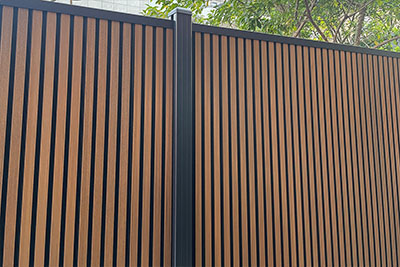
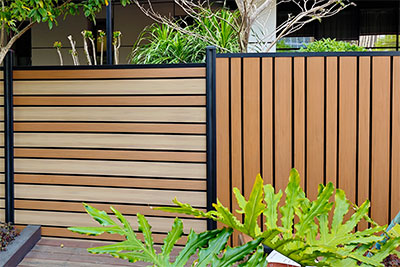
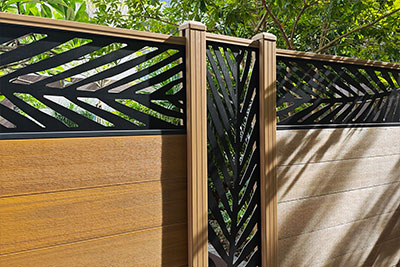
A California GC walked into a backyard pool-house remodel last quarter with a fence count that didn’t fit a single composite supplier’s playbook. He needed 40 teak fluted panels and 6 matching gates — about a quarter of a 40HQ container. Local distributors quoted him 2–3× factory price. Most China factories said “hit the MOQ first.”
One didn’t.
Full disclosure: we’re MecoFence. He’s our customer. Every photo in this post is from his actual job — dirt piles, brick walls, side-yard chaos and all. Here’s exactly how the order moved from RFQ to a finished pool-house gate, and what other contractors and small developers can take from it when their next project doesn’t round up to a full container.
The Project: One Backyard, Three Fence Conditions, One Driveway Gate
The job was a full residential remodel in Los Angeles County. New pool-house construction. Pool re-tile. Hardscape rebuild. Front driveway re-paved with concrete pavers.
Three fence conditions sat inside that one project:
- A sloped side yard running tight against the existing home, with grade falling roughly 4 inches over each panel run.
- A back-property line tying into existing brick masonry columns — the columns stay, the wood fence between them goes, the new composite drops in.
- A front driveway with a double-swing gate — the architectural showpiece of the whole property.
Total bill of materials: 40 sets of single-tone teak fluted panels (1.8m × 1.8m, 24mm boards), 6 matching gates in mixed widths, full aluminum hardware kit, plus rails and post caps.
That’s roughly 24 cubic meters of cargo. About 25% of a 40HQ container.
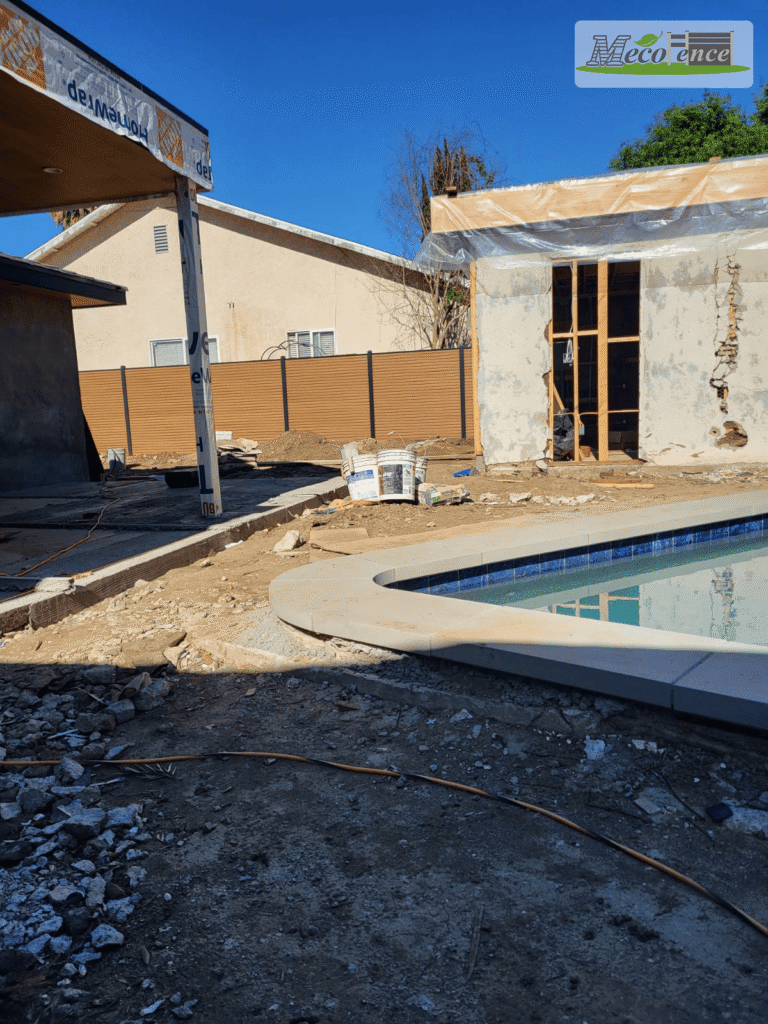
Pool re-tile in progress. Composite fence already installed in the background — a teak fluted single-tone privacy run that became the visual anchor of the rebuild.
This contractor wasn’t learning how to import. He’d already brought tile, plumbing fixtures, and paver edging in from China for the same project. He had his own forwarder running a CFS warehouse in the Pearl River Delta, ready to consolidate his cargo and ship it to his Los Angeles bonded warehouse.
The wall wasn’t logistics.
The wall was factory MOQ rigidity.
Most composite fence factories he reached out to said the same four things, in four different ways:
- “Sorry, our minimum is 1×40HQ container.”
- “We can do partial volume, but you pay full container freight.”
- “We don’t deliver to third-party forwarder warehouses.”
- “Export customs is your problem, not ours.”
Why factories say no to small orders is reasonable from their side: a single SKU run takes setup, color batching, packaging tooling, and a clean production slot. Spinning that up for 40 sets is genuinely uneconomic for most factories that quote at 100–200 set MOQs.
Here’s why we said yes.
Teak is one of our stock colors. The single-tone fluted profile is one of our running SKUs. We have 60+ extrusion lines and 50,000+ tons of annual capacity, which means a 40-set order doesn’t require a dedicated production slot — it slips into the queue alongside larger orders running the same color and profile.
If you’re still mapping factory MOQ logic, our WPC fence wholesale pricing guide walks through how per-SKU and per-order minimums actually work in 2026.
That’s the difference. The “no” isn’t about volume — it’s about whether your stock SKUs match the factory’s running production.
How the LCL Order Actually Moved: From PO to Pickup
Here’s the full sequence, from the day his PO landed in our inbox to the day his forwarder collected the cargo.
1. Order Confirmation & Spec Lock (Day 1–3)
He sent his takeoff in fence sets, not linear feet — which matched our SKU language exactly. Forty sets of single-tone teak fluted, 1.8m × 1.8m, with our standard 80×80mm aluminum Y-slot posts. Six gates: two double-swing driveway, four single pedestrian, all with matching teak fluted infill in aluminum frames.
Hardware kit confirmed. Color confirmed (teak, stock). Lead time quoted at 25 days production.
2. Production Slot & Quality Control (Day 4–25)
Because teak fluted is a stock SKU, his order joined the production queue without a custom color batch. We ran his 40 sets alongside two larger orders going to Australia and the UK — same profile, same color, same line. He paid stock-SKU pricing, not custom-run pricing.
Quality check before packing: board thickness verified at 24mm, powder coat thickness on aluminum measured (factory standard 60µm+, his batch tested at 71.3µm), wind-load test data on file (Beaufort Level 9, Intertek-tested).
3. LCL Packing & Palletizing (Day 26–27)
LCL cargo isn’t loose-packed cargo. We palletized everything for CFS warehouse handling — meaning his forwarder’s warehouse staff could move it with a forklift in one piece, drop it into a mixed container alongside his tile and fixtures, and re-handle it minimally.
- Panels banded in stacks of 10, edge-protected with foam corner guards
- Aluminum posts bundled separately, stretch-wrapped
- Gate hardware boxed and labeled with his PO number
- Each pallet labeled with shipping marks, weight, and CBM dimensions on the outside
4. Export Customs Clearance (Day 28)
We filed the export side on our customs license. Three documents matter, and we owned all three:
- Commercial invoice with HS code 3925.90 for composite fence panels (so the duty class on the import side matches what we declared on the export side — mismatch here is the #1 reason small shipments get held)
- Packing list with CBM, gross weight, and pallet count
- Export customs declaration filed in our name as the manufacturer of record
His forwarder got clean cargo with paperwork that already cleared the China side. No re-filing, no scrambling for FORM E or origin certificates after the fact.
5. Handoff to Forwarder’s CFS Warehouse (Day 29)
We trucked the palletized cargo to his nominated Foshan CFS warehouse, where his forwarder consolidated it with the rest of his project cargo for the trans-Pacific leg. Total time on our side: about 4 weeks from PO to pickup.
That’s the entire LCL flow when the contractor brings his own forwarder. Three services on our side — LCL packing, export customs clearance, delivery to forwarder’s warehouse — and the rest sits in his existing logistics chain.
On the Jobsite: Sloped Grade, Brick Tie-Ins, and a Tight Side Yard
The cargo landed in California. Now the install story starts — and this is the part most catalog-style content skips, even though it’s the part contractors actually read.
The Sloped Side-Yard Run
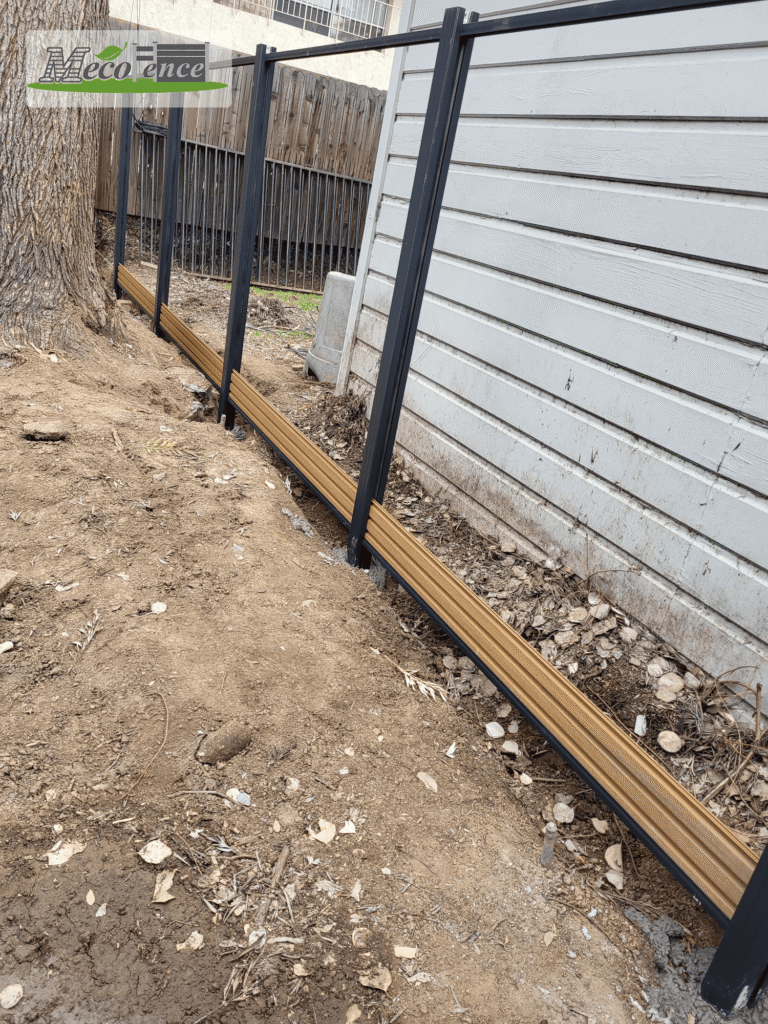
This is the side yard between the existing home and the back property line. Grade falls roughly 4 inches across each panel run.
On a wood-fence install, that’s where the framing gets sloppy — you either step the rails or rip-cut the bottom of every picket. On this job, the Y-slot post design absorbed the slope inside the column itself.
The Y-shaped notch lets each panel rotate up to ~5° off horizontal without cutting the boards. That’s how you get a continuous bottom rail running along uneven grade in the photo — no step-downs, no scribed cuts, no exposed end-grain. Our installation guide for slopes and uneven ground covers the slope math in detail.
Tying Into Existing Brick Columns
The back property line ran past two existing brick masonry columns the homeowner wanted to keep. That meant the new fence couldn’t use a clean 1.8m post-spacing rhythm — it had to land cleanly against the brick on each side.
The contractor used the L-fix side cover (one of our standard hardware components) to terminate the panel against masonry without surface-mounting a post into the brick. Adjusted post spacing on either side so the visible rhythm stayed clean.
String-line in the photo is doing what every fence string-line does — checking that the new aluminum posts run dead parallel to the existing column face.
The Tight Side Yard
Mid-install behind the existing shed. PVC plumbing, drainage, and the chain-link replacement scrap all on the ground simultaneously — this is what real California residential remodels look like 4 weeks before walk-through.
The aluminum frame goes up first, the boards slide in second. That sequence matters when you’re working a 4-foot side-yard corridor — you can stage the boards inside the house and slide them into the posts one at a time, instead of trying to maneuver pre-assembled panels through a gate that doesn’t exist yet.
Contractor Notes Worth Stealing
- 1.8m × 1.8m panels (6ft × 6ft equivalent) drop into standard residential layouts without custom cuts.
- 24mm board thickness survived being stacked on bare dirt for 9 days during the pool re-tile — zero warping, zero deformation. Thinner 18–20mm boards from generic suppliers don’t.
- 80×80mm aluminum post, 1.7mm wall: heavy enough that the framers couldn’t bend it during pour, and the rebar tied off it cleanly.
- Y-slot drain trough on the post: rain water exits the column instead of pooling against the board ends. Critical detail for irrigation-zone installs in Southern California, where overhead spray hits the fence twice a day.
If you want the full step-by-step, our composite fence installation guide covers costs, materials, and standard sequencing.
The Reveal: Why Composite Beat the Cedar Quote on This Job
Walkthrough day. Here’s what the homeowner saw.
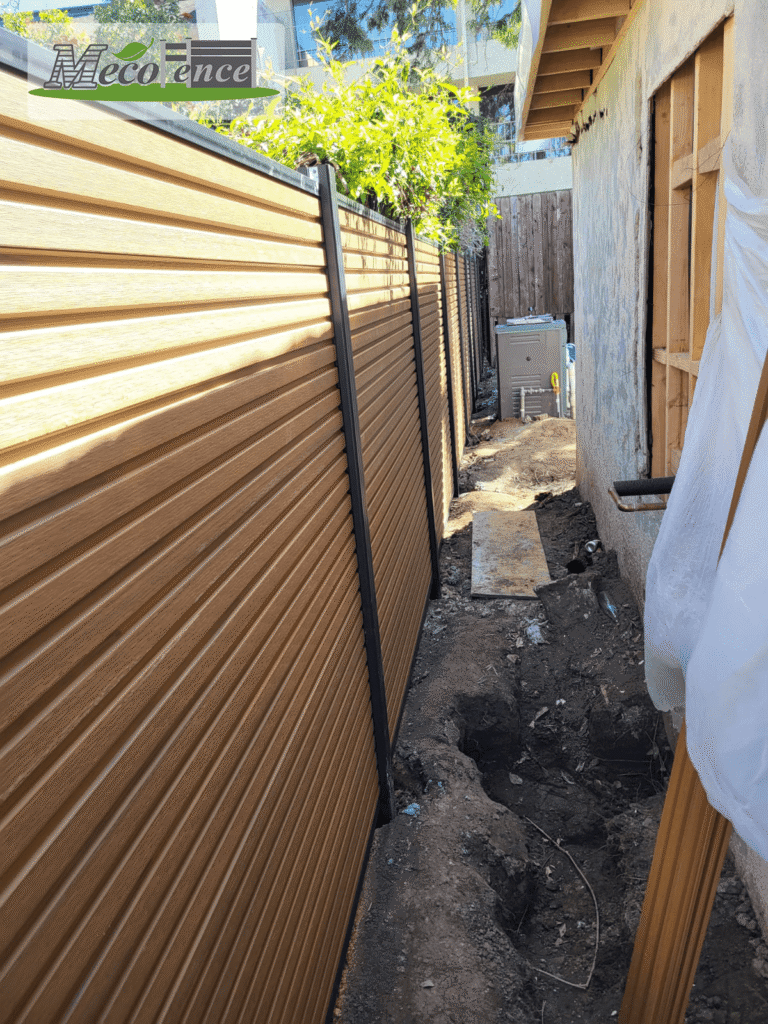
Side yard finished — horizontal teak fluted boards turn a 4-foot utility corridor into a designed surface.
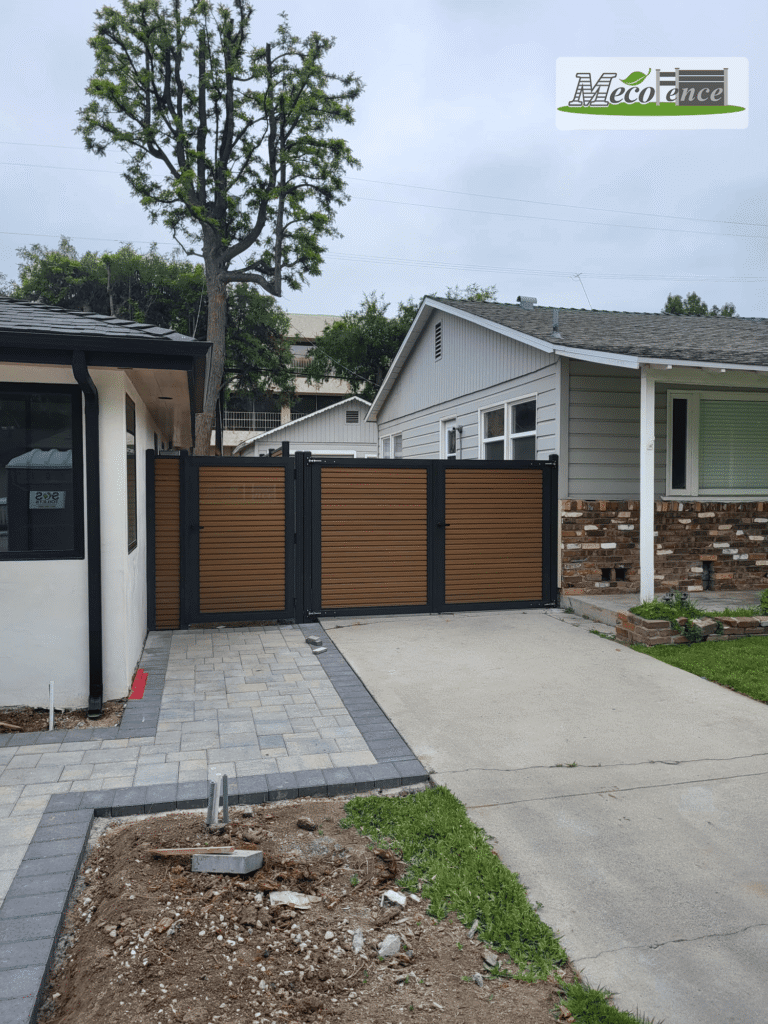
Front driveway double-swing gate — teak fluted infill in a black aluminum frame. The visual centerpiece of the property.
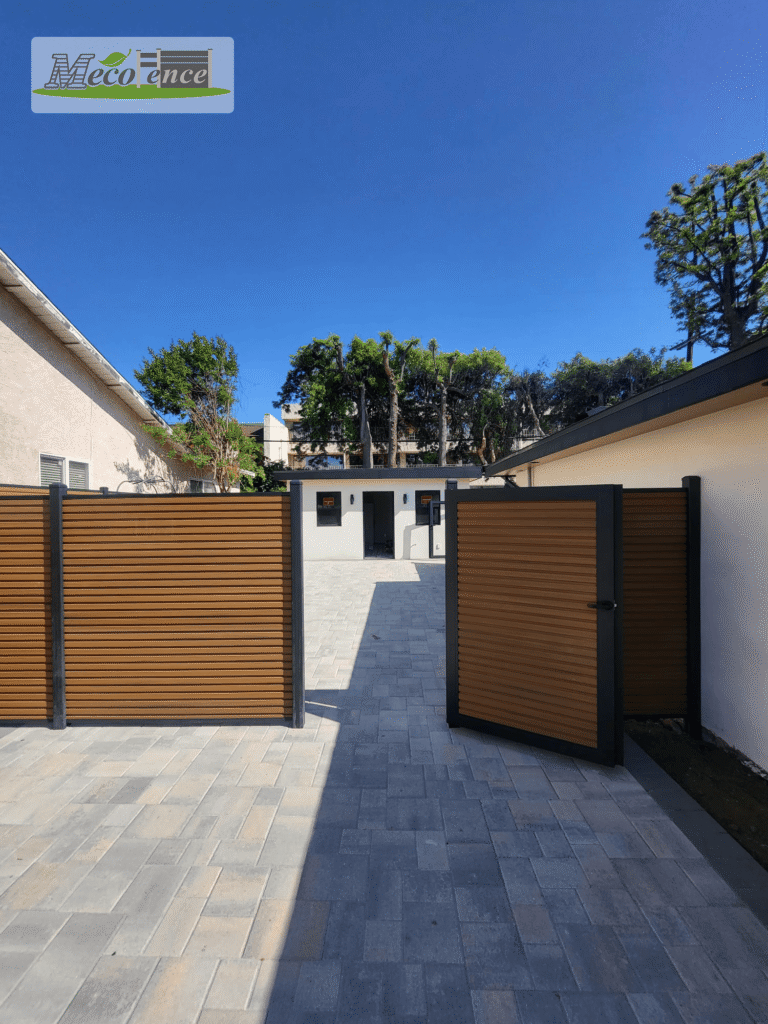
Full property exterior. Driveway gate, fence run, hardscape, and home read as one continuous design.
The contractor signed off on this job for four reasons that matter for any contractor pricing the same scope:
- Maintenance-free finish. No annual stain, no sealing, no warping callbacks 18 months later. The 360° co-extrusion outer layer locks the color in.
- 15–20 year warranty. Materially longer than the cedar quote he was competing against, which assumed re-staining every 2–3 years just to hold the warranty.
- ASTM E84 Class A fire rating. Relevant on every job in California — and a quiet selling point in fire-zone counties where wood fence approvals get scrutinized.
- Color continuity from fence to gate. Every panel and every gate came from one factory, one production batch, one teak color run. Zero color drift — which is what he couldn’t guarantee when he priced a mixed cedar-fence-plus-steel-gate option.
That last point is the underrated one. When the fence and the gate come from two different vendors — one US fence supplier, one local welder doing the gate frame — the “teak” on each side never matches. Contractors live with that mismatch because the alternative is a logistics headache. This contractor didn’t have to.
For projects in similar climates, our coverage of composite fence performance in coastal and California climates covers the UV, salt-air, and wind-load specs in detail.
The Playbook: 5 Steps for Contractors With Their Own China Forwarder
If you already have a forwarder in China — pulling tile, fixtures, paver edging, lighting, anything — here’s the playbook for adding composite fence to that same shipment without inflating your MOQ exposure.
Step 1: Quote the project in fence sets, not linear feet
Factories sell in sets. A “set” is one panel + one post + the hardware that mounts it. Translate your linear-foot takeoff into sets before you send the RFQ — it’s the language we quote in, and it eliminates back-and-forth.
Math: total linear feet ÷ 6 (panel width) = number of sets. Add 5–10% for end posts, gate posts, and corner conditions.
Step 2: Confirm stock colors before requesting custom
Stock colors run on the production line continuously. Custom colors trigger an MOQ jump — usually 200–500 sets — because the factory has to set up a new color batch.
Our running stock colors for fluted profile: Teak, Dark Grey, Ashwood, IPE, Antique, Walnut. If your design call lands on any of those, your MOQ exposure drops dramatically.
Step 3: Ask three MOQ questions, not one
Most contractors ask “What’s your MOQ?” and accept the first number. Ask three:
- “What’s the MOQ per SKU?” (per panel profile/color combination)
- “What’s the MOQ per order?” (total minimum across all SKUs)
- “Can you do LCL packing for delivery to a third-party CFS warehouse?”
Three answers tell you everything. If the factory can’t separate per-SKU from per-order, they’re probably running every order as a custom batch — which means their cost structure is wrong for small projects.
Step 4: Coordinate the warehouse handoff before the cargo ships
Get your forwarder’s CFS warehouse address, the warehouse manager’s contact, and the CBM dimensions they need on the pallet labels. Send all three to the factory before production finishes.
Pallets that arrive at a CFS warehouse without proper marks get sidelined. We’ve seen 3-day delays from a missing PO number on a stretch-wrap label. Don’t.
Step 5: Verify export documents match what your forwarder declares
HS code, declared value, country of origin — all three need to match between the export declaration (filed in China) and the import declaration (filed by your customs broker on the US side). The HS code for composite fence panels is 3925.90 under most US customs rulings.
Mismatches here are the #1 reason small shipments get held at port. We file the export side cleanly so your forwarder — and your US broker — have nothing to fix on arrival.
That’s the playbook. Five steps. The whole thing fits on one project sheet.
If you’re newer to the sourcing side, our composite fencing pillar guide covers the foundational product knowledge before you start spec’ing the order.
Final Takeaway: A Better Fence Project Is a Better System
40 panels. 6 gates. One forwarder. One factory. One pool-house remodel finished on schedule.
The contractor’s next order is already in pre-production — same teak fluted profile, different California job, similar set count. That’s how this story ends.
If you’ve got a fence count that doesn’t round up to a full container — and a forwarder waiting in China — it’s the same story with your name on it. The factory side of the equation is the easy part. We’ve already solved it.
ects.Written by
Steven He
Co-Founder & Head of Product · MecoFence
Steven leads product development and B2B partnerships at MecoFence, a WPC composite fence manufacturer based in Guangdong, China. 10+ years in composite material manufacturing, covering formulation, extrusion process engineering, and export supply chain.
Frequently Asked Questions
Our standard MOQ is 100 sets for stock-color SKUs in our running profiles. For trial orders, repeat customers, or contractors using their own China-based forwarder for LCL consolidation, we evaluate orders down to 40–50 sets on a per-project basis — provided the SKU is one of our stock colors and standard profiles. Custom colors and profile modifications trigger higher MOQs (typically 200–500 sets) because they require a dedicated production batch.
Yes — this is one of our most common arrangements for small-order contractors and developers. We palletize and label cargo for direct CFS warehouse handling, and we deliver to your forwarder’s nominated warehouse in Foshan, Shenzhen, Ningbo, or any major Chinese consolidation hub. We work on EXW-plus or FOB terms depending on your forwarder’s preference. Just provide the warehouse address and any specific pallet-label requirements your forwarder needs.
LCL packing covers everything that turns loose factory cargo into forwarder-ready freight: banded panel stacks with foam edge protection, stretch-wrapped post bundles, labeled hardware boxes, palletization, and shipping marks with PO number, CBM dimensions, gross weight, and warehouse-side label format. The goal is one-time handling at the CFS warehouse — your forwarder’s staff moves the pallets in, scans them, and consolidates them with the rest of your cargo without re-handling individual panels.
Yes. We file the China-side export customs declaration on our own customs license as the manufacturer of record. We provide the commercial invoice with HS code 3925.90 (the standard classification for composite fence panels), packing list with CBM and gross weight, and the export declaration itself. Your forwarder — and your US customs broker on the import side — receive a clean documentation package that matches what was physically shipped. This is what eliminates the most common port-hold issue: HS code or declared-value mismatches between origin and destination paperwork.
For a stock-color, stock-profile order in the 40–100 set range: ~25 days production + 3–4 days for packing, customs filing, and warehouse delivery. The California case study in this article ran 29 days total from PO to forwarder pickup. Custom colors, custom profiles, or private-label packaging add 1–2 weeks. Lead time is confirmed in writing at the order-confirmation stage, not estimated.
Yes — mixed orders are how most contractor projects ship. The California case study mixed 40 fence sets, 6 gates (mixed widths and types), and a complete hardware kit in a single order. Available gate types include single swing, double swing, sliding, and electrical-operated systems, all in widths from 2m to 6m. Color and profile match across panels and gates because everything ships from one factory in one production batch — which is the part you can’t replicate when you source the fence and the gate from two different vendors.
Table of Contents
Got a Project Sized Below a Full Container?
MecoFence runs LCL-ready orders for contractors and developers with their own China forwarder. Our stock-color composite fence SKUs ship without MOQ jumps, and our team handles export customs clearance so your forwarder picks up clean cargo. Spec sheets, FOB pricing, and lead-time confirmation in 24 hours.
Request a Small-Order Quote →


