
Everything you’ve read about co-extrusion vs traditional WPC? It was probably written about decking.
And decking is a completely different animal.
A deck sits flat. It carries dead weight. It drains freely. A fence stands vertical, catches full wind load, spans 6–8 feet between posts, and bakes in direct sun on one side while staying shaded on the other.
Browse any fence contractor forum and you’ll see the same pain on repeat.
A recent post on Reddit’s r/FenceBuilding racked up 287 upvotes and 148 comments. The story? A homeowner’s pressure-treated 4×4 posts had warped dramatically — just five months after installation.
The contractor’s response? “That’s normal wood warping.”
The community’s verdict? Sun drying one side faster than the other, causing the post to bow. One commenter’s post had twisted a full 90 degrees. Another said simply: “We switched to steel forever posts last year.”
Posts warping. Boards fading unevenly. Bottom panels swelling near the ground line.
These aren’t freak failures. They’re predictable outcomes of fence-specific stresses that most material guides ignore — because they were written for horizontal decking applications.
The co-extrusion cap layer matters for both products. But how it matters — and where it fails — is entirely different for fencing.
If you’re a wholesaler or distributor sourcing composite fence panels, you’re making a bet every time you place a container order. This guide is about making that bet with the right information — the fence-specific kind that decking guides never cover.
This isn’t gospel. But it’s the most useful framework we’ve found for evaluating co-extruded vs uncapped fence panels at the sourcing level.
The Decking Assumption That Gets Fence Buyers in Trouble
Most co-extrusion marketing talks about stain resistance, barefoot comfort, and poolside spills.
Those are decking problems.
Here’s what fence panels actually face:
- Single-side UV exposure. One face bakes in full sun while the other stays cool. This creates asymmetric thermal stress that decking boards never experience. Over years, the sun-facing side expands and contracts differently from the shaded side — and the board wants to cup.
- Vertical wind load. A 6ft privacy fence section acts like a sail. Wind doesn’t push down on it (like foot traffic on a deck). It pushes sideways, and that lateral force transfers through the board-to-rail connection point. If the cap layer has any weakness at the tongue-and-groove interface, wind cycling will find it.
- Full-height water run. Rain doesn’t pool on a fence — it sheets down vertically across the entire face. That water collects at the bottom rail junction, where the board’s end grain (even in WPC) is most exposed. On uncapped boards, this is where moisture ingress starts.
- Ground-level splash zone. The bottom 12 inches of any fence live in a constant cycle of mud splash, irrigation mist, and lawn moisture. Decking is elevated on joists. Fencing sits right in the line of fire.
So when someone tells you “co-extrusion is better,” the right question isn’t is it better? It’s: better at handling which of these fence-specific stresses?
1. Asymmetric Weathering (The "Two-Face" Problem)
This is the one nobody talks about — but it should sound familiar.
Remember that Reddit post? Wood posts warping because the sun dries one side faster than the other? The exact same physics applies to uncapped WPC fence boards — just with UV degradation instead of moisture loss.
Install an uncapped WPC fence panel facing south. Come back in 18 months.
The sun-facing side will be noticeably lighter than the shaded side. Not subtly. Visibly.
The wood fiber in that 4×4 post twisted because it dried asymmetrically. The pigment in your uncapped WPC board fades asymmetrically for the same structural reason.
One side takes the hit. The other doesn’t.
With a co-extruded cap, the UV-stabilized shell absorbs the hit on both sides equally. The color differential after 3 years? Minimal to undetectable on properly manufactured co-extrusion panels.
For wholesalers, this matters because the “two-face” complaint is one of the top reasons end users reject traditional WPC fences.
How big is this problem?
Based on after-sales data from our distribution partners, color-mismatch complaints account for roughly 30–40% of all first-gen WPC fence warranty claims. Nearly all come from south- or west-facing installations.
Co-extruded panels in the same markets? Under 5%.
That’s not a marginal improvement. That’s a different product category.
The difference doesn’t show up on a product sample. It only shows up in the field — when it’s too late.
2. Board-to-Rail Interface Durability
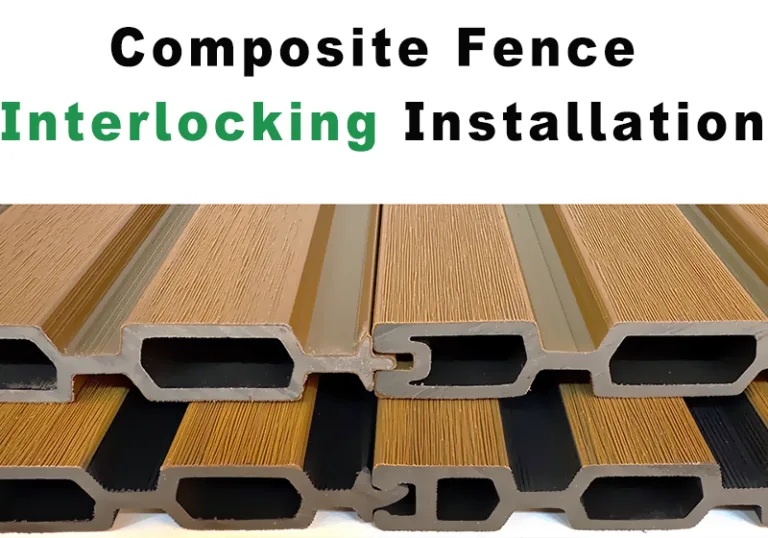
Here’s where fencing diverges from decking most dramatically.
A deck board sits passively in a clip. Gravity holds it down. The clip barely works.
A fence board is locked into an aluminum or WPC rail and must resist lateral push-pull from wind, thermal cycling, and physical impact — all through that tongue-and-groove or channel interface.
On uncapped boards, the exposed WPC at the tongue edge is the weakest point. It’s where micro-cracks initiate from repeated wind flex. It’s where moisture migrates inward.
Over 3–5 years in exposed locations, you start seeing boards loosen in the channel — not because the rail failed, but because the board edge degraded.
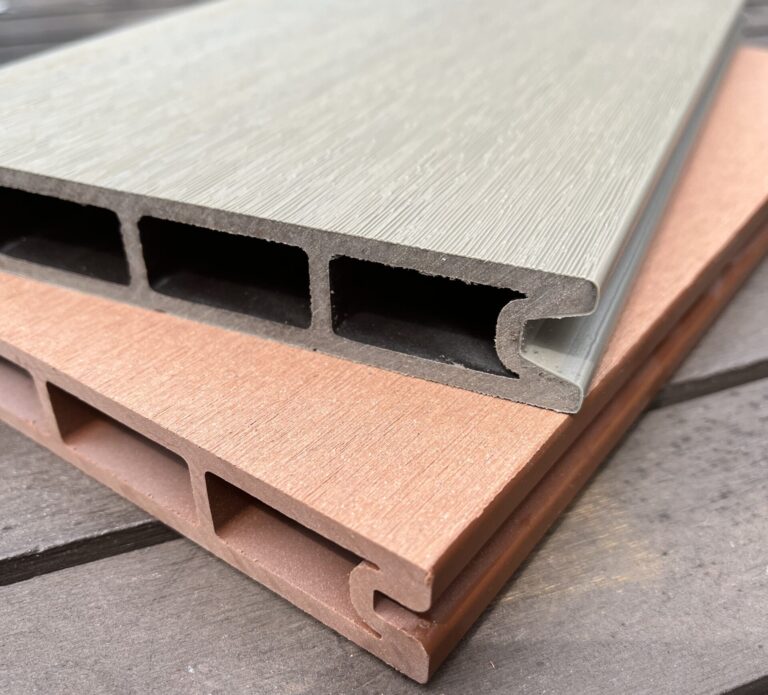
The co-extrusion cap wraps all four sides of the board, including the tongue edge. That continuous shell turns the weakest point into a sealed surface.
The polymer cap resists micro-abrasion from board movement in the channel far better than raw WPC. That’s the difference between a fence that’s still tight at year 5 and one that rattles in the wind.
This is why wind-rating test results look so different between capped and uncapped panels — and why coastal or high-wind projects are essentially co-extrusion-mandatory territory.
3. Bottom-Board Moisture Exposure
The bottom board of any fence section lives the hardest life.
It’s closest to the ground. It takes the most splash-back from rain, irrigation, and lawn care. It sits nearest to soil moisture.
And if the installation doesn’t leave an adequate gap, it can wick moisture directly from wet earth.
On traditional WPC, the bottom board is the first to show swelling, mold growth, and surface discoloration. The exposed wood fiber component absorbs moisture from the bottom edge up.
You won’t see it at install. You’ll see it at month 8.
Sound familiar?
It’s the same ground-level moisture problem that causes wood fence posts to rot and lean within months. Wood posts fail at the soil line because moisture and oxygen meet there.
Uncapped WPC boards don’t rot the same way. But they do absorb and swell at the bottom edge through the same mechanism. The failure is slower and less dramatic — but the warranty claim hits your desk just the same.
Co-extruded panels with a 360° cap create a sealed envelope. Moisture hits the surface and sheets off. Even the cut end — where the cap is broken — performs better because the dense polymer cap redirects water flow away from the core.
Practical takeaway: If you’re sourcing for humid climates (Southeast US, Gulf region, tropical Asia, Northern Europe), the bottom-board failure rate on uncapped panels is your biggest warranty risk.
The numbers back this up. Moisture-related claims on traditional WPC fence panels run 3–5× higher than on co-extruded panels in these regions. The bottom board is the culprit in the majority of cases.
Co-extrusion doesn’t reduce this problem. It largely eliminates it.
4. Thermal Expansion in Long Fence Runs
A single fence panel is manageable. Thermal expansion across 50 or 100 linear feet of fencing is a different engineering problem.
Both co-extruded and uncapped boards expand and contract with temperature changes. But here’s the difference: uncapped WPC boards have a higher and more variable expansion rate because the surface properties are identical to the core. There’s no stabilizing shell constraining the outer fiber.
Co-extruded boards don’t eliminate thermal movement. But the rigid cap layer constrains surface expansion, reducing the net dimensional change per board. Over a long run, this means:
- Smaller cumulative gaps in winter
- Less board buckling risk in summer
- More predictable spacing requirements for installers
For contractors doing commercial perimeter fencing — think HOA communities, multi-family projects, school boundaries — the thermal behavior over long runs is a spec issue, not just a preference.
Is there a universal building code mandating co-extrusion for long runs? Not yet.
But we’re seeing it show up increasingly in project specs from architects and property managers who’ve dealt with buckling callbacks on first-gen panels. Several of our distributor partners in the US Southwest and Australia now default to co-extrusion for any residential run exceeding 30 linear feet — and for commercial projects regardless of length.
Not because a code requires it. Because the callback math demands it.
When Traditional WPC Still Wins for Fencing
Co-extrusion isn’t the right answer for every fence project. Here’s where uncapped traditional WPC holds a genuine advantage.
Deep 3D embossing. First-gen WPC accepts heavy-roller embossing better than co-extruded boards. The softer, capless surface deforms more deeply under heat and pressure, creating tactile wood grain you can feel with your fingers.
Co-extrusion caps are too hard and thin for this. If the natural wood feel is the primary selling point — and the climate is mild — traditional WPC delivers something co-extrusion simply can’t.
(We cover the full finish breakdown in our surface treatments guide.)
Price-sensitive, mild-climate markets. If your customers are in temperate regions with moderate UV and low humidity, the performance gap narrows significantly. A well-made first-gen board from a quality manufacturer can deliver 15+ years of solid performance at 30–40% lower cost than co-extruded panels. (See our 2026 wholesale pricing guide for current FOB figures.)
Short-run decorative installations. Garden accents, planter surrounds, and short privacy screens under 3 meters. The engineering demands are low. The aesthetic demands are high.
Traditional WPC with premium embossing often looks better here than a brushed co-extrusion panel.
Surface repairability. Scratched a traditional WPC board? Sand it out. Scratched a co-extruded board? You can’t — you’ll destroy the cap.
For projects where the fence takes frequent physical contact (next to a driveway, loading dock, or equipment storage), the ability to repair surface damage is a real operational advantage.
The Inventory Decision: A Framework for Distributors
If you’re stocking both tiers, here’s how the market segments:
Co-extrusion pipeline — commercial projects, coastal/tropical markets, HOA-grade residential, high-wind zones. Any contractor who sells on warranty and lifetime value.
These buyers accept the price premium because their customers accept it. Margin per unit is higher. Return rate is lower.
Traditional WPC pipeline — budget residential, mild-climate markets, decorative/garden applications, price-driven contractors bidding against wood and vinyl. Volume is higher. Margin per unit is thinner.
But the acquisition cost per container is significantly lower.
The distributors getting squeezed in 2026? The ones stocking only first-gen panels and trying to compete on price with every factory-direct Alibaba listing.
The ones thriving? Two-tier inventory — co-extrusion as the flagship, traditional as the value line.
Different product. Different customer. Different margin structure. Same supplier relationship.
But wait — do I need two full containers?
Nope. Most quality manufacturers — including us — allow mixed containers with both co-extruded and traditional panels in a single 40HQ. Typical MOQ is 100 sets total, and you can split 60/40 or 70/30 between tiers.
Test market response. Don’t double your inventory risk. Ask your supplier about mixed-container pricing before you assume separate orders are the only option.
One more thing. If you’re bundling co-extruded panels with WPC composite posts, you’re only solving half the problem.
Wind cycling, ground-level moisture, asymmetric UV — these hit posts even harder than panels. The professional market is migrating to aluminum for exactly this reason. No warping. No rot at the soil line. No flex under wind load.
Co-extruded panels on WPC posts is a half-upgraded system. Don’t be that distributor. (We cover post material selection in our fence post types guide.)
What to Verify on Your Next Sample Order
You’ve read the theory. Here’s how to pressure-test it with physical samples.
The scratch test. Run a key or coin across both samples with moderate pressure. On traditional WPC, you’ll see a visible white scratch line immediately.
On co-extruded? The cap should resist without marking — or leave only a faint scuff that buffs out with a cloth.
The water bead test. Drop water on both samples.
On co-extrusion, water should bead and sit on the surface. On traditional WPC, it absorbs within 30–60 seconds, leaving a dark wet spot.
Pay special attention to the board edges and tongue profile — that’s where cap coverage matters most for fencing.
The UV comparison. Ask your supplier for accelerated weathering data (QUV or Xenon arc). Look for co-extruded panels with Delta E < 3.0 after 2,000 hours — that’s the threshold where color change becomes invisible to the naked eye.
Traditional WPC typically hits Delta E 5–8+ in the same test window. Big gap.
The flex test. Hold a 1-meter sample at both ends and apply moderate downward pressure in the center. Co-extruded panels should feel noticeably more rigid — the cap adds a structural skin effect.
That stiffness translates directly to wind resistance in the installed fence.
What if a sample fails?
Good. That’s not a problem — that’s free intelligence about your supplier’s manufacturing.
Each failure tells you something specific:
- Water absorbs at the edges? The cap probably doesn’t wrap all four sides. Some factories only cap the two flat faces, leaving tongue and groove exposed. That’s not co-extrusion — that’s two-sided lamination with better marketing.
- Scratches too easily? Thin or low-grade cap polymer. A proper co-extrusion shell shrugs off a coin scratch.
- Weak flex? The cap isn’t bonding properly to the core. A well-bonded cap adds a structural skin effect you can feel in your hands.
The follow-up question that separates serious suppliers from the rest: “What is the cap thickness in millimeters, and does it cover the full board perimeter including the tongue profile?”
Data gets you data back. Vague gets you vague back. You know which one to trust.
For a deeper evaluation framework covering production quality variables, see our guide on what your composite fence manufacturer actually controls.
The bottom line
The composite fencing market is splitting. Not into good and bad — into fit-for-purpose and not.
Co-extrusion doesn’t win because it’s “better.” It wins because fence panels face stresses that decking boards don’t — asymmetric UV, wind cycling, ground-level moisture, long-run thermal movement — and the cap layer addresses every one of them.
Traditional WPC doesn’t lose because it’s “worse.” It loses when it’s sold into applications where the cap layer was needed and wasn’t there.
Your job as a buyer isn’t to pick a side. It’s to match the product to the project — and stock your warehouse accordingly.
That thin polymer shell? On a deck, it’s a nice upgrade.
On a fence, it changes everything.
Written by
Steven He
Co-Founder & Head of Product · MecoFence
Steven leads product development and B2B partnerships at MecoFence, a WPC composite fence manufacturer based in Guangdong, China. 10+ years in composite material manufacturing, covering formulation, extrusion process engineering, and export supply chain.
Frequently Asked Questions
What is the difference between co-extruded and traditional WPC fence panels?
Traditional WPC fence panels are made in a single-pass extrusion — the surface material is identical to the core. Co-extruded panels add a second polymer cap layer fused around all four sides during manufacturing.
For fencing specifically, this cap addresses four stresses that decking never faces: asymmetric UV weathering (sun hitting one side only), board-to-rail interface degradation from wind cycling, bottom-board moisture absorption near the ground, and thermal expansion across long fence runs.
Is co-extruded composite fencing worth the extra cost for wholesalers?
It depends on the market.
For high-UV, coastal, and humid climates — absolutely. Co-extruded panels cost 30–40% more upfront but slash warranty claims: color-mismatch complaints drop from 30–40% of all first-gen claims to under 5%, and moisture-related claims run 3–5× lower.
For temperate, price-sensitive markets with moderate UV, well-made traditional WPC still delivers 15+ years of solid performance and stronger margins on volume.
How does the co-extrusion cap layer specifically help fencing vs decking?
Decking sits flat, drains freely, and takes even UV on both sides. Fencing stands vertical with one side in full sun and the other shaded — creating asymmetric UV fade and thermal cupping that decking never experiences.
The cap layer equalizes UV absorption on both faces, seals the tongue-and-groove edges against wind-driven micro-abrasion, protects the bottom board from ground-level splash-back moisture, and constrains thermal expansion across long commercial runs.
Can I mix co-extruded and traditional WPC panels in one container order?
Yes. Most quality manufacturers allow mixed containers with both product tiers in a single 40HQ. Typical MOQ is 100 sets total, with flexibility to split 60/40 or 70/30 between co-extruded and traditional panels.
This lets distributors test both product lines without committing a full container to each.
When is traditional (uncapped) WPC the better choice for fencing?
Traditional WPC wins in four scenarios:
- Deep 3D embossing — the softer surface accepts heavier texture than a co-extrusion cap
- Price-sensitive, mild-climate markets — where the performance gap is narrow
- Short decorative runs under 3 meters — aesthetics outweigh engineering demands
- High-contact applications — you can sand scratches out of traditional WPC, but sanding co-extruded boards destroys the cap
How can I test if a co-extruded fence sample is genuine?
Run four tests:
- Scratch test — a coin should not leave a visible white line on co-extruded boards
- Water bead test — water should bead on the surface and board edges, not absorb within 60 seconds
- UV data — ask for accelerated weathering results; look for Delta E below 3.0 after 2,000 hours
- Flex test — co-extruded panels should feel noticeably stiffer than uncapped WPC
If a sample fails, ask the supplier: "What is the cap thickness in millimeters, and does it cover the full board perimeter including the tongue profile?"
What does it mean if a "co-extruded" sample absorbs water at the edges?
It likely means the cap doesn't wrap all four sides of the board. Some factories only cap the two flat faces, leaving the tongue and groove edges exposed — this is two-sided lamination marketed as co-extrusion.
Genuine co-extrusion wraps a continuous polymer shell around the full perimeter, including the tongue profile. Edge water absorption is the single fastest way to identify this manufacturing shortcut.
Should I pair co-extruded fence panels with aluminum or WPC posts?
Aluminum.
The same fence-specific stresses that make co-extruded panels outperform traditional WPC — wind cycling, ground-level moisture, asymmetric UV — hit posts even harder than boards. WPC composite posts can warp, flex under wind load, and degrade at the soil line. Aluminum posts eliminate all three failure modes.
Co-extruded panels on WPC posts is a half-upgraded system.