
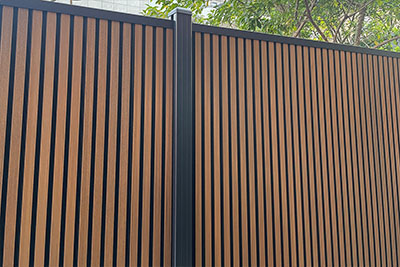
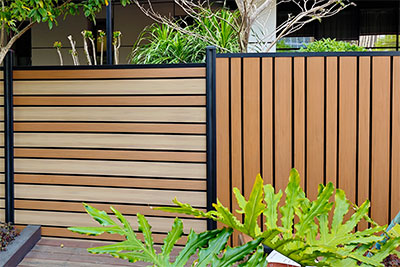
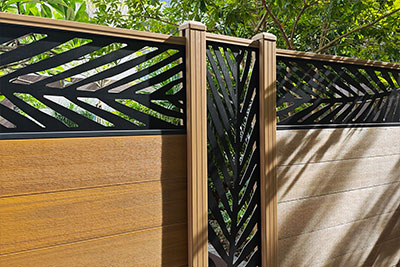
Every article about horizontal slat fence vs vertical privacy fence tells you the same thing: “Horizontal looks modern, vertical is traditional.” Then they slap up a stock photo and call it a day.
That advice is useless — especially if you’re a contractor pricing a 200-foot run, or a homeowner about to spend $5,000+ on a fence that needs to survive real weather.
The orientation of your fence boards changes everything: how wind loads distribute across the structure, how much you’ll spend on posts, how much privacy you actually get, and whether the fence sags within two years.
Important scoping note: This guide covers composite fencing specifically — not wood, not vinyl. That distinction matters more than you think. Most horizontal-vs-vertical comparisons are written with wood in mind, and the performance claims are radically different for composite. If you’re reading this with wood-fence assumptions, several conclusions here — especially about sag and moisture — will not match what you’ve heard elsewhere. That’s intentional. Composite fencing plays by different structural rules.
Quick disclosure: We manufacture composite fences. Our Dual-Tone Slat Wall Fence can be installed in either orientation — so we don’t have a horse in this race. We just want you to pick the right direction for your project.
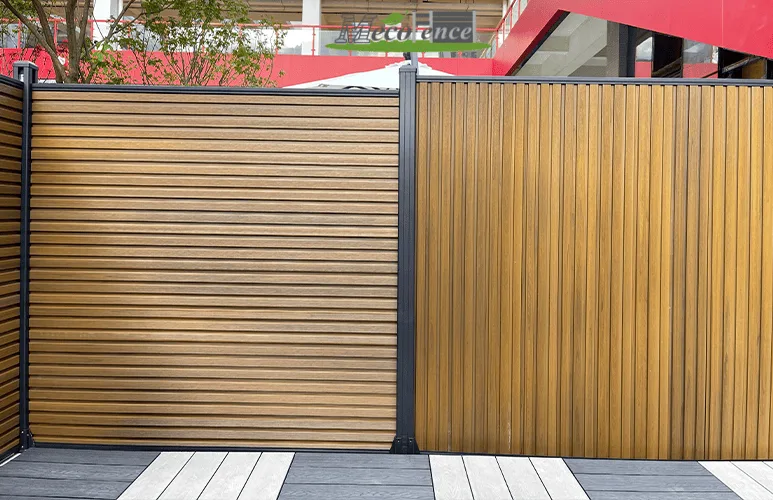
Why Composite Changes the Horizontal vs Vertical Debate
Before we compare orientations, you need to understand why this comparison even works for composite — and why it fails for wood.
The answer is one material property: moisture absorption and dimensional stability.
Wood boards absorb water. When a wood board sits horizontally, its top surface collects rain and morning dew. That moisture soaks into the grain, causing the board to swell, warp, and cup. Over months, the swelling and drying cycles accelerate sag — the board’s own weight pulls it into a permanent downward bow between the posts. This is why contractors have warned against horizontal wood fencing for decades. It’s not superstition. It’s physics.
Composite fencing absorbs almost no moisture. MecoFence boards test at 0.89% moisture content under EN 322:1993 standards. For comparison, pressure-treated pine in service typically sits at 15–19% moisture content — roughly twenty times higher.
Because composite holds its dimensions through wet-dry cycles, the swelling-warping-sag chain that destroys horizontal wood boards simply doesn’t apply. A composite board installed horizontally today will hold the same profile five years from now.
That’s the key. Composite’s low moisture uptake and dimensional stability are the specific properties that make horizontal composite fencing viable where horizontal wood fencing fails. Every performance comparison in this article flows from that material difference.
The numbers back it up: MecoFence boards are tested to 3,758 MPa modulus of elasticity (EN 15534-1:2004) and 26.8 MPa bending strength. That means they resist bending under sustained load far better than even premium hardwood — and they maintain that resistance regardless of weather exposure.
So when you read the sag, cost, and structural sections below, remember: these comparisons apply to composite fencing. Wood and vinyl follow entirely different failure curves.
Here’s where most guides get it completely wrong.
A solid vertical privacy fence acts like a sail — the entire panel surface catches wind, and all that lateral pressure transfers directly to the posts. With a standard 6-foot fence, a 60 mph gust generates roughly 15 pounds of force per square foot. Over a 100-foot fence line, that’s over 9,000 pounds of lateral pressure trying to rip your posts out of the ground.
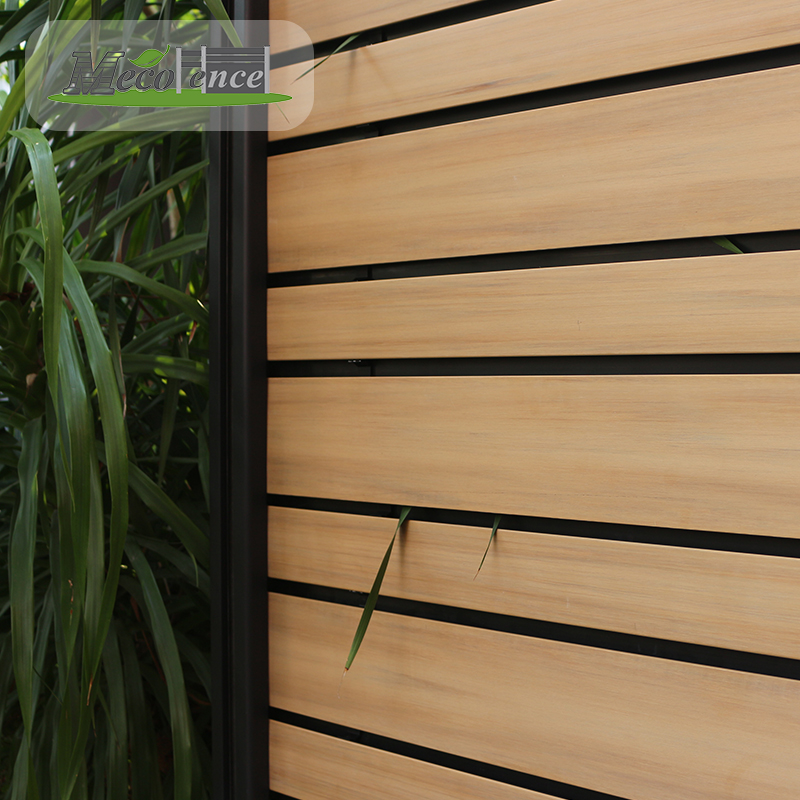
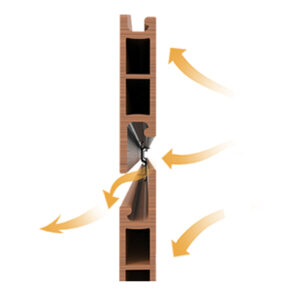
A horizontal slat fence with even small gaps between boards (5–10mm) lets air pass through. That’s not a design flaw — it’s aerodynamic engineering. Those gaps reduce the effective wind-load area by 15–30%, depending on slat spacing.
But here’s the catch: a solid horizontal fence — boards tight together, no gaps — catches just as much wind as a vertical panel. Orientation alone doesn’t save you. Spacing does.
This is why MecoFence engineered our FlowShield ASA louvered fence — it guarantees 100% visual privacy while allowing wind to pass through internal channels.
What Intertek Level 9 Wind Certification Actually Means
You’ll see “Level 9 wind rated” on our spec sheets. Here’s what that means in practical terms.
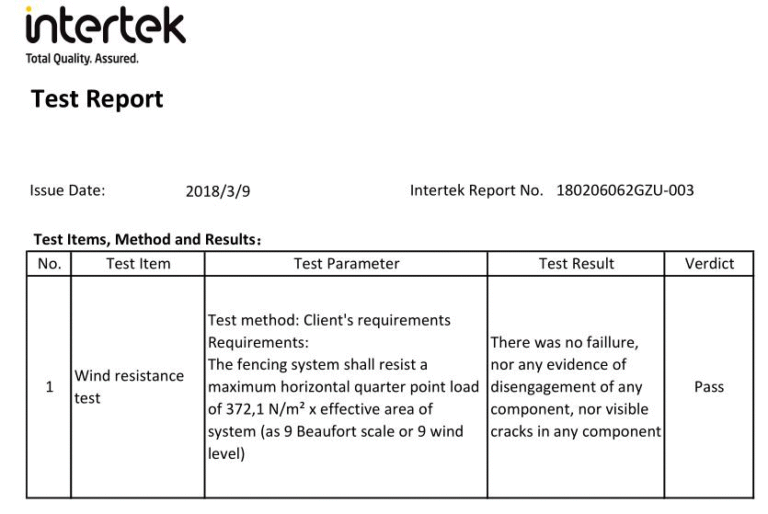
Level 9 refers to the Beaufort wind scale — it corresponds to sustained wind speeds of approximately 75–88 km/h (47–55 mph). That’s classified as a “strong gale” — strong enough to cause minor structural damage to buildings and snap large tree branches.
For context: most residential fences fail at Beaufort Level 6–7 (40–60 km/h / 25–37 mph). A Level 9 certification means MecoFence’s aluminum post system, tested by Intertek (report #180206062GZU-003), handles wind loads roughly 50% higher than the point where typical residential fences start failing.
If you’re in a coastal area, exposed hilltop, or hurricane-adjacent zone, this certification tells you the system is engineered for your climate. If you’re in a sheltered suburban backyard, it’s overkill — but overkill in your favor. For more detail, read our full storm-proof composite fencing breakdown.
Board Sag and Deflection — The Two Variables That Determine Risk
This is the #1 concern homeowners have about horizontal fencing. And it’s legitimate — but only if you don’t control for the right variables.
Board sag is the product of two interacting factors: board thickness and post spacing. Neither one alone determines whether your horizontal fence will deflect. It’s the combination that matters.
A 15mm board spanning a 6-foot gap will bow noticeably under its own weight — especially in summer heat when composite materials soften slightly. But a 24mm board spanning a 4-foot gap stays ruler-straight. The relationship is multiplicative, not additive: double the span and you roughly quadruple the deflection for the same board thickness.
Here’s why this matters differently for each orientation.
Why Post Spacing Differs Between Orientations
In a vertical fence, the boards hang from horizontal top and bottom rails. Gravity pulls straight down along the length of each board, and the load transfers directly into the ground through the posts. The boards aren’t spanning anything — the rails are. Because rails are reinforced by the posts at both ends, vertical systems can handle post spacing of 6–8 feet comfortably.
In a horizontal fence, each board becomes a beam. Even though top and bottom rails frame the panel, they only secure the edges — the individual boards in between must span the full gap between posts while supporting their own weight plus wind load. No rail runs behind each board to prop it up.
The practical implication: with standard composite boards (18–20mm thickness), horizontal fences need post spacing of 4–6 feet maximum, while vertical systems can stretch to 6–8 feet. That gap means 30–50% more posts for horizontal over the same fence line — more material, more post-hole digging, more cost.
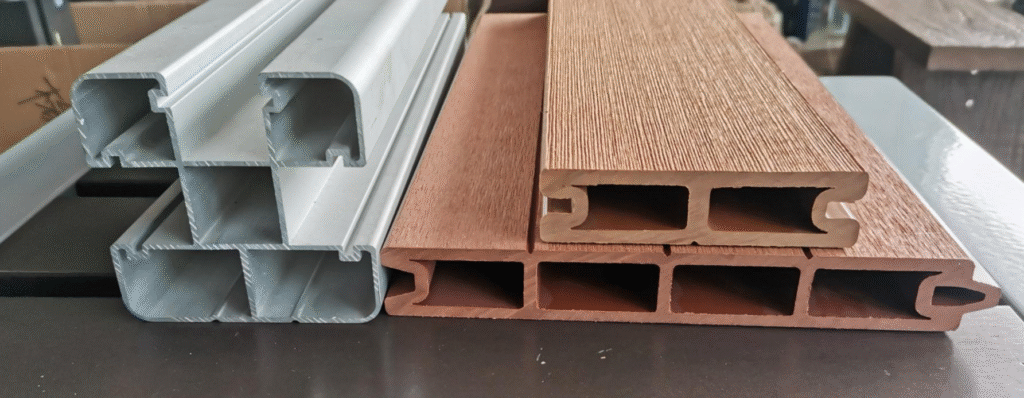
MecoFence’s 24mm-thick boards with internal multi-chamber profiles close that gap. They’re designed to resist deflection at 1.8m (≈6ft) post spacing even in horizontal orientation — the same spacing most vertical systems use. That means with the right board spec, horizontal doesn’t automatically require more posts.
The rule is simple: if you’re going horizontal, spec boards at 24mm minimum and keep posts at 6 feet or closer. That’s where 90% of sag complaints come from — thin boards on wide spans. Control both variables, and sag is essentially eliminated.
And here’s where composite’s moisture absorption and dimensional stability circles back: because composite boards don’t swell, warp, or lose structural integrity through wet-dry cycling, the sag risk you calculate on installation day stays the same sag risk five years later. Wood boards degrade into sag over time. Composite boards don’t. That’s the mechanistic link that makes horizontal composite viable where horizontal wood is not.
Privacy Performance and the Security Trade-Off
The common claim: “Vertical fences offer more privacy.”
That’s only true for wood fences with gaps. With composite panels — especially tongue-and-groove or interlocking systems — both orientations achieve 100% visual privacy when boards are installed tight.
There is a subtle optical difference, though. A horizontal fence with even a 3mm gap between boards allows more visibility at oblique angles than the same gap in a vertical fence. Why? Because your eyes naturally align with horizontal lines at standing height. A vertical gap forces your eye to align at an angle that rarely matches your natural sight line.
Here’s the trade-off most guides leave for you to figure out on your own: privacy performance and climb resistance are linked, and they pull in opposite directions.
A fence with tight board spacing maximizes privacy — and it also tends to offer better climb resistance, because there are no exposed footholds or handholds. But a gapped horizontal slat design — the style that many homeowners choose precisely for its modern, airy look — trades some security for aesthetics. Each horizontal slat becomes a built-in foothold.
If security matters — schools, commercial properties, pool enclosures — vertical privacy fence panels are inherently safer. No footholds. Period.
You can mitigate the climbing issue with tighter horizontal board spacing or anti-climb features, but physics is physics. The key decision: if maximum privacy and maximum security both matter to you, tight-board vertical delivers both. If you want the modern horizontal look, accept that you’re optimizing aesthetics over climb resistance, and plan accordingly.
Bottom line: If maximum privacy is your #1 goal and you want a modern slat fence design, go with a solid tongue-and-groove horizontal panel — zero gap, maximum privacy, modern look. Our slat composite fence interlocking design guide covers the full range of options.
Terrain and Slope Compatibility — Where Orientation Gets Decided For You
This is where the rubber meets the road for contractors.
Vertical fences handle slopes naturally. You simply “rack” the panels — angle them to follow the grade — or step them down in increments. Either way, the vertical boards stay plumb and the result looks clean.
Horizontal fences on slopes are brutal. Racking a horizontal panel means every board tilts at a visible angle — and your eye catches that immediately because horizontal lines should be level. The only clean option is stepping, which creates triangular gaps at each drop that need custom infill.
The Y-Slot Aluminum Post: A Partial Solution for Mild Slopes
MecoFence’s patented Y-slot aluminum post was designed specifically for this problem. Here’s how it works:
The post has a Y-shaped internal channel instead of a standard rectangular slot. The boards slide into this channel and can pivot slightly within the groove — accommodating small-angle adjustments without visible tilting. The Y-shaped notch also functions as a drain trough, evacuating rainwater quickly so it doesn’t pool against the board edge.
- Mild slopes (under 5% grade / roughly 3° of incline): The Y-slot post handles this comfortably. Boards adjust within the channel, and the visual result is clean — no visible tilt, no custom infill needed. Most suburban yards with gentle front-to-back grades fall into this range.
- Moderate slopes (5–10% grade): The Y-slot post can still accommodate the angle, but installation requires more precision. A contractor with horizontal-fence experience can make this work; a DIY homeowner may struggle.
- Steep slopes (over 10% grade): Stepping or racking becomes structurally impractical for horizontal orientation. The angle exceeds what the Y-slot can absorb gracefully, and stepped panels leave large triangular gaps. Vertical panels remain the professional choice for grades above 10%.
Why Slope Compounds Installation Difficulty
Here’s the connection most guides miss: installation difficulty is directly worsened by terrain challenges. Horizontal installation already demands precise leveling on flat ground — every board must be ruler-straight, or the misalignment screams at you from across the yard. On sloped ground, that precision requirement compounds with grade calculations, custom post-height cuts, and potential stepping gaps.
A horizontal fence on flat ground is an intermediate DIY project. A horizontal fence on a sloped lot can push beyond intermediate skill level quickly — especially without the right post system. For sloped lots, either invest in a contractor or switch to vertical orientation. That’s the honest answer.
For a deeper dive into slope installation, see our composite fencing installation guide for slopes and uneven ground.
Installation Cost — Why Horizontal Costs 15–25% More
Nobody publishes this math, so we will.
The extra cost of horizontal isn’t in the materials — with MecoFence’s Dual-Tone Composite Fencing system, both orientations use the same boards, the same top and bottom rails, and the same aluminum post frame. The difference is almost entirely labor.
Every slightly out-of-level board screams at you from across the yard. Vertical boards are much more forgiving of minor imperfections because the eye doesn’t track plumb lines as aggressively as level lines. That means horizontal installation demands 20–30% more labor time for precision leveling alone.
On top of that, if you’re using thinner boards or want extra sag protection, you may opt for tighter post spacing (4–5 feet instead of 6 feet) — which adds more posts and more post-hole labor. At MecoFence’s standard 24mm board thickness, 6-foot spacing works fine for horizontal, so this is avoidable with the right spec.
Why Aluminum Posts Matter More for Horizontal Fences
Here’s something most guides skip: your choice of post material interacts directly with post spacing decisions — and that interaction hits harder in horizontal orientation.
Aluminum posts (like MecoFence’s 80×80mm Y-slot system) have an excellent strength-to-weight ratio. They can handle the lateral loads of horizontal orientation — the combined weight of spanning boards plus wind pressure — at standard 6-foot spacing without additional bracing.
Weaker post materials — thin-wall steel, WPC composite posts, or undersized wood 4×4s — may not handle those same lateral loads at 6-foot spacing. To compensate, you’d need even tighter post spacing (4–5 feet), which drives costs up further. Or you over-engineer with concrete footings and cross-bracing, adding labor and complexity.
The bottom line: for horizontal composite fences, aluminum posts at 6-foot spacing are the cost-efficient sweet spot. Downgrading the post material doesn’t save money — it shifts the cost into more posts or more labor.
Cost Comparison: 100-Linear-Foot Fence
| Cost Component | Horizontal (6ft post spacing) | Vertical (6ft post spacing) |
|---|---|---|
| Posts (80×80mm aluminum) | 17 posts | 17 posts |
| Boards (24mm composite) | Same quantity | Same quantity |
| Top & bottom rails | 2 per bay (same frame structure) | 2 per bay (same frame structure) |
| Labor: Post installation | Same | Same |
| Labor: Leveling precision | +20–30% more labor | Standard |
| Net Cost Difference | +15–25% total | Baseline |
For contractors: if you’re bidding a horizontal job, add 20% to your labor estimate or you’ll eat the difference.
For homeowners: the extra cost is real, but manageable. A horizontal fence typically adds $400–$800 to a typical residential project. If you love the look, it’s worth it.
Horizontal Slat Fence vs Vertical Privacy Fence: Head-to-Head Comparison
Here’s the table you actually need. Every spec applies to composite fencing specifically — not wood, not vinyl.
| Factor | Horizontal Slat Fence | Vertical Privacy Fence |
|---|---|---|
| Aesthetic | Modern, contemporary, visually widens space | Classic, timeless, adds visual height |
| Wind Resistance (solid) | Same as vertical — full sail effect | Full sail effect — all pressure to posts |
| Wind Resistance (gapped/louvered) | 15–30% lower wind load with 5–10mm gaps | Gaps possible but less common in design |
| Post Spacing | 4–6 ft (boards span between posts) | 6–8 ft (boards hang from rails) |
| Posts Needed (100 ft) | ~17–25 posts | ~13–17 posts |
| Board Thickness Needed | 24mm minimum to avoid sag | 18–24mm (less critical) |
| Key Structural Property | Moisture stability prevents sag degradation over time | Moisture stability prevents warp/rot |
| Privacy (tight-board) | 100% — same as vertical | 100% |
| Privacy (gapped) | More visible at oblique angles | Less visible at oblique angles |
| Climb Resistance | Lower — slats act as footholds | Higher — no footholds |
| Slopes & Terrain | Mild slopes OK (Y-slot post); steep = difficult | Easy — racks or steps cleanly |
| Installation Difficulty | Higher — precise leveling critical; slopes compound difficulty | Lower — more forgiving of minor errors |
| Ideal Post Material | Aluminum (handles lateral loads at standard spacing) | Aluminum or WPC (less lateral load) |
| Typical Cost (per linear ft) | $25–$55 installed (labor premium; more posts if thinner boards) | $20–$45 installed |
* Cost ranges reflect composite fencing with aluminum posts, professionally installed, US market 2025–2026. Actual prices vary by region and supplier. MecoFence offers factory-direct B2B pricing that typically undercuts these ranges by 20–35%.
The Decision Framework: Which Orientation Should You Pick?
Stop overthinking it. Answer these four questions, and your choice becomes obvious.
Question 1: Is your lot flat or sloped?
- Flat → Either orientation works.
- Mild slope (under 5%) → Horizontal is possible with Y-slot aluminum posts.
- Moderate slope (5–10%) → Horizontal requires an experienced contractor. Consider vertical.
- Steep slope (>10% grade) → Vertical. Every time.
Question 2: Is wind a serious concern?
- Yes (coastal, exposed hilltop) → Horizontal with gaps or louvered profile reduces wind load 15–30%. Or use Level 9 wind-rated aluminum posts (Beaufort scale, 75–88 km/h sustained) with either orientation. See our composite fence for coastal areas guide.
- No → Choose based on aesthetics.
Question 3: Is security or child/pet safety a priority?
- Yes → Vertical. No built-in footholds. A tight-board vertical fence gives you maximum privacy and maximum climb resistance in one shot.
- No → Choose based on aesthetics.
Question 4: What architectural style are you matching?
- Modern / mid-century / minimalist → Horizontal. Clean lines complement low-profile architecture.
- Traditional / craftsman / colonial → Vertical. Classic proportions respect the existing language of the home.
- Not sure → Go horizontal. It’s the dominant 2026 design trend and generally adds more perceived property value.
If you answered “vertical” to any of the first three questions, go vertical. If all three are neutral, go with your gut on aesthetics. That’s it.
One Panel, Two Orientations: How MecoFence Solves the Dilemma
Here’s something most fence manufacturers won’t tell you: not every composite board works in both directions.
Boards designed only for vertical installation often have directional tongue-and-groove joints that don’t lock properly when rotated 90°. Water drains differently. The aesthetic changes. The structural performance drops.
MecoFence’s Dual-Tone Slat Wall Fence is specifically engineered for both horizontal and vertical installation:
- 204mm × 24mm board profile — thick enough to span 1.8m horizontally without sag (3,758 MPa modulus of elasticity)
- 360° co-extrusion cap layer — UV and moisture protection works identically in either orientation (0.89% moisture content)
- Interlocking snap-fit design — boards lock securely without screws, horizontal or vertical
- Double-sided finish — no “bad neighbor side” regardless of direction
- 80×80mm aluminum Y-slot posts — Intertek-certified Level 9 wind resistance (75–88 km/h / 47–55 mph sustained) in both configurations, with built-in slope adjustment for mild grades
For contractors and wholesalers, this is a logistics win too: one SKU covers two design options. Stock less, sell more. The same palette serves both the client who wants a sleek horizontal composite fence and the one who wants classic vertical privacy fence panels.
Frequently Asked Questions
Yes, typically 15–25% more for composite fencing. With MecoFence’s 24mm boards at 6-foot post spacing, materials are essentially the same — the extra cost comes from increased labor, because horizontal boards require precise leveling and any misalignment is immediately visible. With thinner boards (under 20mm), you may also need tighter post spacing, which adds further cost.
They can — if board thickness and post spacing aren’t properly matched. A thin 15mm board over a 6-foot span will deflect visibly. Use 24mm-thick boards with post spacing of 6 feet or less and sag is essentially eliminated. Unlike wood, composite’s low moisture absorption means it won’t degrade into sag over time through swelling and warping cycles.
A horizontal fence with gaps or a louvered profile reduces wind load by 15–30% compared to any solid panel. However, a solid horizontal fence catches the same wind as a vertical fence. The key factor is spacing and post strength, not orientation alone. MecoFence’s aluminum posts are Intertek-certified for Level 9 wind resistance — that’s Beaufort scale 9, corresponding to sustained winds of 75–88 km/h (47–55 mph) — in both orientations.
Yes, but the difficulty depends on the grade. On mild slopes (under 5%), MecoFence’s Y-slot aluminum posts accommodate small-angle adjustments within the channel. On moderate slopes (5–10%), it’s workable but demands contractor-level precision. For steep grades (over 10%), vertical fencing is significantly easier and cleaner — stepping horizontal panels at that grade creates large gaps and compounds installation difficulty.
Not always. Many composite boards have directional joints or drainage channels that only function correctly in one orientation. MecoFence’s Dual-Tone Slat Wall boards (204mm × 24mm) are specifically engineered for both horizontal and vertical installation — same interlocking system, same wind rating, same appearance.
With tight-board composite installation, both orientations provide 100% visual privacy. However, vertical fences are inherently more secure — horizontal slats create footholds for climbing. If you need both maximum privacy and maximum climb resistance (schools, pools, commercial), tight-board vertical delivers both in one design.
The Bottom Line
The horizontal slat fence vs vertical debate isn’t about which looks better. It’s about matching the right orientation to your terrain, wind exposure, security needs, and budget.
If your lot is flat, wind isn’t extreme, and you want maximum curb appeal — a horizontal composite fence is the smart, modern choice. Budget the extra 15–25%, use 24mm boards minimum, and insist on aluminum posts with adequate strength-to-weight specs for the lateral loads.
If your property slopes beyond a mild grade, you need anti-climb security, or you want to keep costs leaner — vertical privacy fence panels are the proven, practical call.
Either way, composite is the right material. Its low moisture absorption and dimensional stability remove the rot, warp, and progressive-sag penalties that make horizontal wood fencing a long-term liability. And with a system like MecoFence’s Dual-Tone panels — where one board works in both orientations — you don’t even have to commit until installation day.
Next step: Request a free sample kit and test both orientations side by side. Seeing the board in your hand — horizontal, then vertical — tells you more than any article ever could.
Written by
Steven He
Co-Founder & Head of Product · MecoFence
Steven leads product development and B2B partnerships at MecoFence, a WPC composite fence manufacturer based in Guangdong, China. 10+ years in composite material manufacturing, covering formulation, extrusion process engineering, and export supply chain.
Table of Contents
Not Sure Whether Horizontal or Vertical Fits Your Project?
MecoFence's Dual-Tone WPC Fencing panels install in either direction — same board, same Level 9 wind rating, same 15–20 year warranty. Our composite fence system is engineered for both orientations from the ground up. Request a free sample to test both firsthand.
Request a Free Sample Kit →