
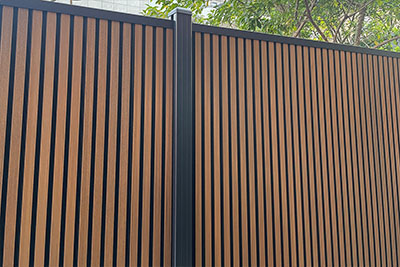
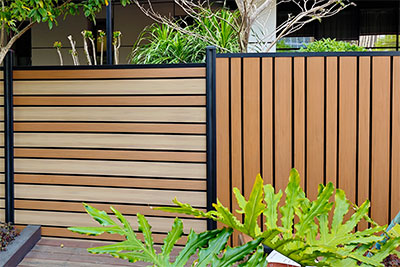
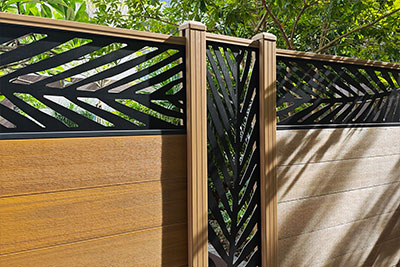
Every article about horizontal slat fence vs vertical privacy fence tells you the same thing: “Horizontal looks modern, vertical is traditional.” Then they slap up a stock photo and call it a day.
That advice is useless — especially if you’re a contractor pricing a 200-foot run, or a homeowner about to spend $5,000+ on a fence that needs to survive real weather.
The orientation of your fence boards changes everything: how wind loads distribute across the structure, how much you’ll spend on posts, how much privacy you actually get, and whether the fence sags within two years. Yet almost nobody talks about these differences for composite fencing specifically.
We’re going to fix that. This guide breaks down the horizontal composite fence vs vertical privacy fence panels debate using real engineering specs, Intertek wind-test data, and cost math from actual projects — not marketing fluff.
Quick disclosure: We manufacture composite fences. Our Dual-Tone Slat Wall Fence can be installed in either orientation — so we don’t have a horse in this race. We just want you to pick the right direction for your project.
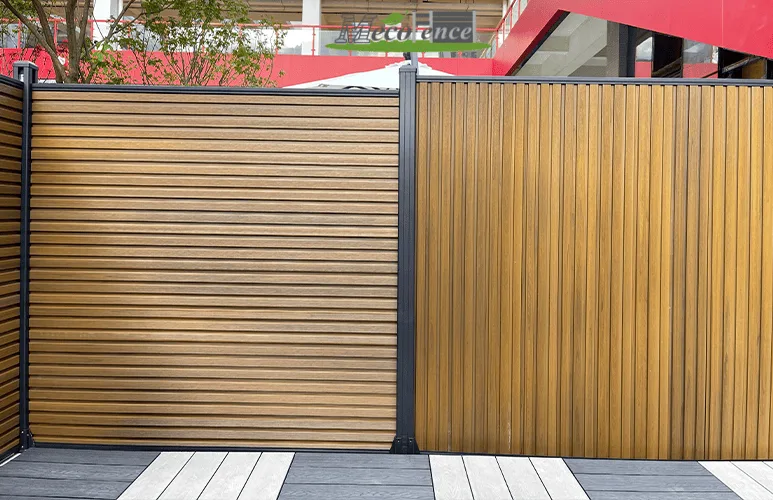
The Real Differences Between Horizontal and Vertical Composite Fences
Let’s skip the vague “pros and cons” lists. Here are the five factors that actually change your project outcome.
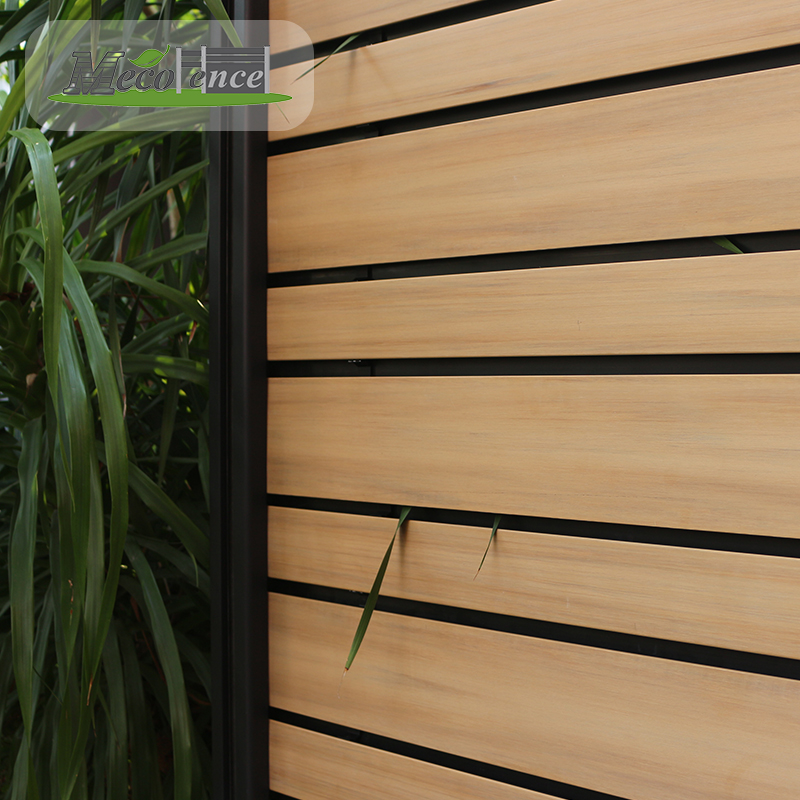
Here’s where most guides get it completely wrong.
A solid vertical privacy fence acts like a sail — the entire panel surface catches wind, and all that lateral pressure transfers directly to the posts. With a standard 6-foot fence, a 60 mph gust generates roughly 15 pounds of force per square foot. Over a 100-foot fence line, that’s over 9,000 pounds of lateral pressure trying to rip your posts out of the ground.
A horizontal slat fence with even small gaps between boards (5–10mm) lets air pass through. That’s not a design flaw — it’s aerodynamic engineering. Those gaps reduce the effective wind-load area by 15–30%, depending on slat spacing.
But here’s the catch: a solid horizontal fence — boards tight together, no gaps — catches just as much wind as a vertical panel. Orientation alone doesn’t save you. Spacing does.
This is why MecoFence engineered our FlowShield ASA louvered fence — it guarantees 100% visual privacy while allowing wind to pass through internal channels. The result? Intertek-certified Level 9 wind resistance (Beaufort scale, approximately 75–88 mph sustained) without a single gap visible from the outside.
That’s the key. For more detail, read our full storm-proof composite fencing breakdown.
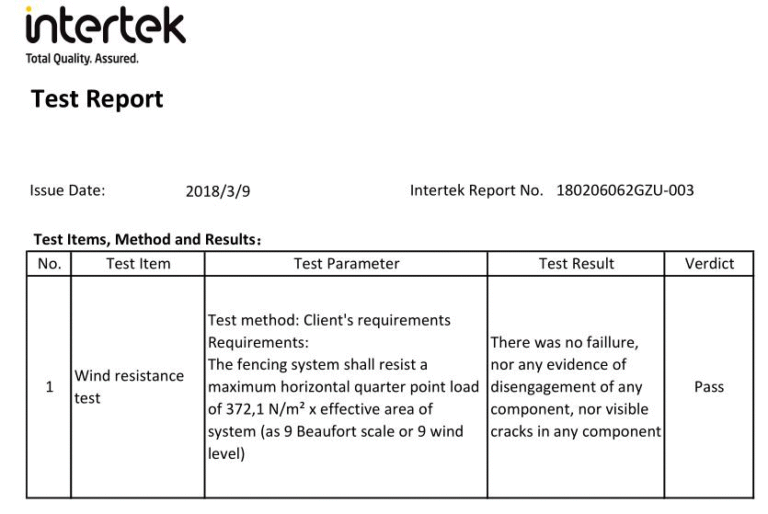
2. Structural Demand — Horizontal Boards Need Closer Posts
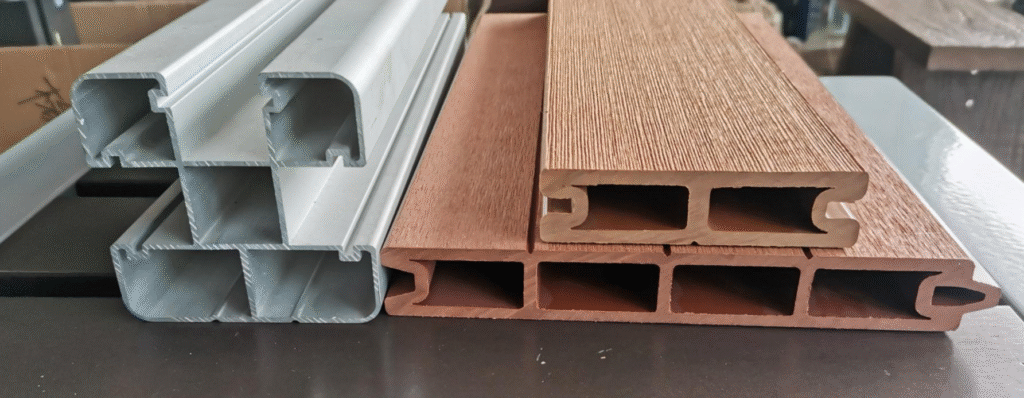
In a vertical fence, the boards are supported along their entire length by top and bottom horizontal rails. Gravity works with the board.
In a horizontal composite fence, each board spans between the vertical posts. The board itself becomes a beam. If your posts are too far apart, the boards sag under their own weight — especially in summer heat when composite materials soften slightly.
Rule of thumb: Horizontal composite fences need post spacing of 4–6 feet max to prevent visible deflection, compared to 6–8 feet for vertical panel systems.
That’s 30–50% more posts for a horizontal fence over the same run.
Board thickness matters enormously here. A thin 15mm board will bow noticeably over a 6-foot span. MecoFence’s 24mm-thick boards with internal multi-chamber profiles resist deflection significantly better — allowing 1.8m (≈6ft) post spacing even in horizontal orientation.
This is the key. If you’re going horizontal, don’t cheap out on board thickness. That’s where 90% of sag complaints come from.
3. Privacy — Vertical Isn't Always Better
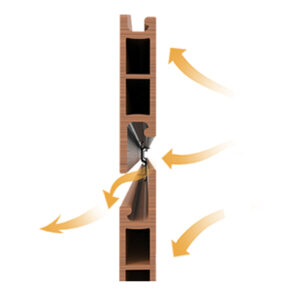
The common claim: “Vertical fences offer more privacy.”
That’s only true for wood fences with gaps. With composite panels — especially tongue-and-groove or interlocking systems — both orientations achieve 100% visual privacy when boards are installed tight.
There is a subtle optical difference, though. A horizontal fence with even a 3mm gap between boards allows more visibility at oblique angles than the same gap in a vertical fence. Why? Because your eyes naturally align with horizontal lines at standing height. A vertical gap forces your eye to align at an angle that rarely matches your natural sight line.
Bottom line: If maximum privacy is your #1 goal and you want a modern slat fence design, go with a solid tongue-and-groove horizontal panel — zero gap, maximum privacy, modern look. Our slat composite fence guide covers the full range of options.
4. Terrain Compatibility — Slopes Change Everything
This is where the rubber meets the road for contractors.
Vertical fences handle slopes naturally. You simply “rack” the panels — angle them to follow the grade — or step them down in increments. Either way, the vertical boards stay plumb and the result looks clean.
Horizontal fences on slopes are brutal. Racking a horizontal panel means every board tilts at a visible angle — and your eye catches that immediately because horizontal lines should be level. The only clean option is stepping, which creates triangular gaps at each drop that need custom infill.
MecoFence’s patented Y-slot aluminum post accommodates small-angle adjustments — the boards can pivot slightly within the channel, making gentle slopes workable in horizontal orientation without visible tilting. But for grades steeper than 10%, vertical panels remain the professional choice.
5. Security — The Climbing Factor
Let’s be blunt: horizontal slats are easier to climb. Each board acts as a built-in foothold. If security matters — schools, commercial properties, pool enclosures — vertical privacy fence panels are inherently safer.
You can mitigate this with tighter board spacing or by adding anti-climb features, but physics is physics. Vertical = no footholds. That’s the advantage.
Horizontal Slat Fence vs Vertical Privacy Fence: Head-to-Head Comparison
Here’s the table you actually need. Every spec applies to composite fencing specifically — not wood, not vinyl.
| Factor | Horizontal Slat Fence | Vertical Privacy Fence |
|---|---|---|
| Aesthetic | Modern, contemporary, visually widens space | Classic, timeless, adds visual height |
| Wind Resistance (solid) | Same as vertical when no gaps — full sail effect | Full sail effect — all pressure to posts |
| Wind Resistance (gapped/louvered) | 15–30% lower wind load with 5–10mm gaps | Gaps possible but less common in design |
| Post Spacing | 4–6 ft (boards span between posts) | 6–8 ft (boards hang from rails) |
| Posts Needed (100 ft) | ~17–25 posts | ~13–17 posts |
| Board Thickness Needed | 24mm minimum to avoid sag | 18–24mm (less critical) |
| Privacy (tight-board) | 100% — same as vertical | 100% |
| Privacy (gapped) | More visible at oblique angles | Less visible at oblique angles |
| Slopes & Terrain | Difficult — stepping required, gaps appear | Easy — racks or steps cleanly |
| Climb Resistance | Lower — slats act as footholds | Higher — no footholds |
| Installation Difficulty | Higher — precise leveling critical | Lower — more forgiving of minor errors |
| Typical Cost (per linear ft) | $25–$55 installed (more posts + labor) | $20–$45 installed |
* Cost ranges reflect composite fencing with aluminum posts, professionally installed, US market 2025–2026. Actual prices vary by region and supplier. MecoFence offers factory-direct B2B pricing that typically undercuts these ranges by 20–35%.
Cost Breakdown: Why Horizontal Composite Fences Cost 15–25% More
Nobody publishes this math, so we will.
Let’s compare the material and labor cost for a 100-linear-foot, 6-foot-tall composite fence with aluminum posts, using the same board profile in both orientations.
| Cost Component | Horizontal (6ft post spacing) | Vertical (6ft post spacing) |
|---|---|---|
| Posts (80×80mm aluminum) | 17 posts | 17 posts |
| Boards (24mm composite) | Same quantity | Same quantity |
| Additional horizontal rails | Not needed — boards are the rails | 2 per bay (top + bottom rail) |
| Labor: Post installation | Same | Same |
| Labor: Leveling precision | +20–30% more labor — every line must be perfectly level | Standard — plumb is easier to eyeball |
| Net Cost Difference | +15–25% total | Baseline |
The extra cost of horizontal isn’t in the boards — it’s in the labor. Every slightly out-of-level board screams at you from across the yard. Vertical boards are much more forgiving of minor imperfections because the eye doesn’t track plumb lines as aggressively as level lines.
For contractors: if you’re bidding a horizontal job, add 20% to your labor estimate or you’ll eat the difference.
For homeowners: the extra cost is real, but manageable. A horizontal fence typically adds $400–$800 to a typical residential project. If you love the look, it’s worth it.
The Decision Framework: Which Orientation Should You Pick?
Stop overthinking it. Answer these four questions, and your choice becomes obvious.
Question 1: Is your lot flat or sloped?
- Flat → Either orientation works.
- Sloped (>5% grade) → Vertical. Every time.
Question 2: Is wind a serious concern?
- Yes (coastal, exposed hilltop) → Horizontal with gaps or louvered profile. Or use Level 9 wind-rated posts with either orientation. See our composite fence post types guide.
- No → Choose based on aesthetics.
Question 3: Is security or child/pet safety a priority?
- Yes → Vertical. No built-in footholds.
- No → Choose based on aesthetics.
Question 4: What architectural style are you matching?
- Modern / mid-century / minimalist → Horizontal. Clean lines complement low-profile architecture.
- Traditional / craftsman / colonial → Vertical. Classic proportions respect the existing language of the home.
- Not sure → Go horizontal. It’s the dominant 2026 design trend and generally adds more perceived property value.
If you answered “vertical” to any of the first three questions, go vertical. If all three are neutral, go with your gut on aesthetics. That’s it.
Why This Decision Is Easier With Composite Than With Wood
Most horizontal slat fence vs vertical guides are written with wood in mind. That’s a problem, because composite eliminates several wood-specific disadvantages of horizontal installation.
With wood, horizontal boards trap moisture on their top surfaces, accelerating rot. Composite doesn’t rot — it has a moisture absorption rate of just 0.89% (per EN 322:1993 testing standards). Orientation doesn’t affect lifespan.
With wood, horizontal boards warp and twist over time. Co-extruded composite boards with internal chamber profiles maintain dimensional stability — our boards are tested to 3,758 MPa modulus of elasticity (EN 15534-1:2004), which means they resist bending under load far better than even premium hardwood.
With wood, horizontal fences need repainting every 2–3 years. Composite needs zero maintenance.
The upshot? If you want a modern slat fence design, composite removes most of the practical objections to going horizontal. The only remaining factors are wind, terrain, and security — the three questions above.
For a deeper dive into composite materials and engineering, check out our complete guide to composite fencing.
One Panel, Two Orientations: How MecoFence Solves the Dilemma
Here’s something most fence manufacturers won’t tell you: not every composite board works in both directions.
Boards designed only for vertical installation often have directional tongue-and-groove joints that don’t lock properly when rotated 90°. Water drains differently. The aesthetic changes. The structural performance drops.
MecoFence’s Dual-Tone Slat Wall Fence is specifically engineered for both horizontal and vertical installation:
- 204mm × 24mm board profile — thick enough to span 1.8m horizontally without sag
- 360° co-extrusion cap layer — UV and moisture protection works identically in either orientation
- Interlocking snap-fit design — boards lock securely without screws, horizontal or vertical
- Double-sided finish — no “bad neighbor side” regardless of direction
- 80×80mm aluminum Y-slot posts — Intertek-certified Level 9 wind resistance in both configurations
For contractors and wholesalers, this is a logistics win too: one SKU covers two design options. Stock less, sell more. The same palette serves both the client who wants a sleek horizontal composite fence and the one who wants classic vertical privacy fence panels.
Frequently Asked Questions
Yes, typically 15–25% more for composite fencing. The extra cost comes primarily from increased labor — horizontal boards require precise leveling, and any misalignment is immediately visible. Material costs are usually similar when using the same board profile.
A horizontal fence with gaps or a louvered profile reduces wind load by 15–30% compared to any solid panel. However, a solid horizontal fence catches the same wind as a vertical fence. The key factor is spacing and post strength, not orientation alone. MecoFence’s aluminum posts are Intertek-certified for Level 9 wind resistance in both orientations.
Not always. Many composite boards have directional joints or drainage channels that only function correctly in one orientation. MecoFence’s Dual-Tone Slat Wall boards (204mm × 24mm) are specifically engineered for both horizontal and vertical installation — same interlocking system, same wind rating, same appearance.
They can — if the boards are too thin or the post spacing is too wide. Boards thinner than 20mm spanning more than 5 feet will show visible deflection, especially in hot climates. Use 24mm-thick boards (like MecoFence’s standard) with post spacing of 6 feet or less and sag is essentially eliminated.
With composite fencing installed tight (no gaps), both orientations provide 100% visual privacy. However, if you choose a gapped or semi-private style, vertical fences offer slightly less see-through at oblique viewing angles because the human eye naturally aligns with horizontal sightlines.
Yes, but it’s harder. On gentle slopes (under 5%), MecoFence’s Y-slot posts allow small-angle adjustments. For steeper grades, you’ll need to step the fence panels, which creates gaps that may need custom infill. Vertical fencing is significantly easier and cleaner on sloped terrain.
The Bottom Line
The horizontal slat fence vs vertical debate isn’t about which looks better. It’s about matching the right orientation to your terrain, wind exposure, security needs, and budget.
If your lot is flat, wind isn’t extreme, and you want maximum curb appeal — a horizontal composite fence is the smart, modern choice. Budget the extra 15–25%, use 24mm boards minimum, and insist on aluminum posts.
If your property slopes, you need anti-climb security, or you want to keep costs leaner — vertical privacy fence panels are the proven, practical call.
Either way, composite is the right material. It removes the rot, warp, and maintenance penalties that make horizontal wood fencing a long-term liability. And with a system like MecoFence’s Dual-Tone panels — where one board works in both orientations — you don’t even have to commit until installation day.
Next step: Request a free sample kit and test both orientations side by side. Seeing the board in your hand — horizontal, then vertical — tells you more than any article ever could.
Written by
Steven He
Co-Founder & Head of Product · MecoFence
Steven leads product development and B2B partnerships at MecoFence, a WPC composite fence manufacturer based in Guangdong, China. 10+ years in composite material manufacturing, covering formulation, extrusion process engineering, and export supply chain.
Table of Contents
Not Sure Whether Horizontal or Vertical Fits Your Project?
MecoFence's Dual-Tone Slat Wall panels install in either direction — same board, same Level 9 wind rating, same 25-year warranty. Request a free sample to test both orientations firsthand.
Request a Free Sample Kit →