
Most “composite fence panel” guides give you a color chart and a link to add-to-cart.
That’s not what you need.
If you’re a contractor pricing a 200-linear-foot job, or a wholesaler deciding which SKUs to container-load — you need to understand profiles, board dimensions, and thickness trade-offs before you commit a single dollar.
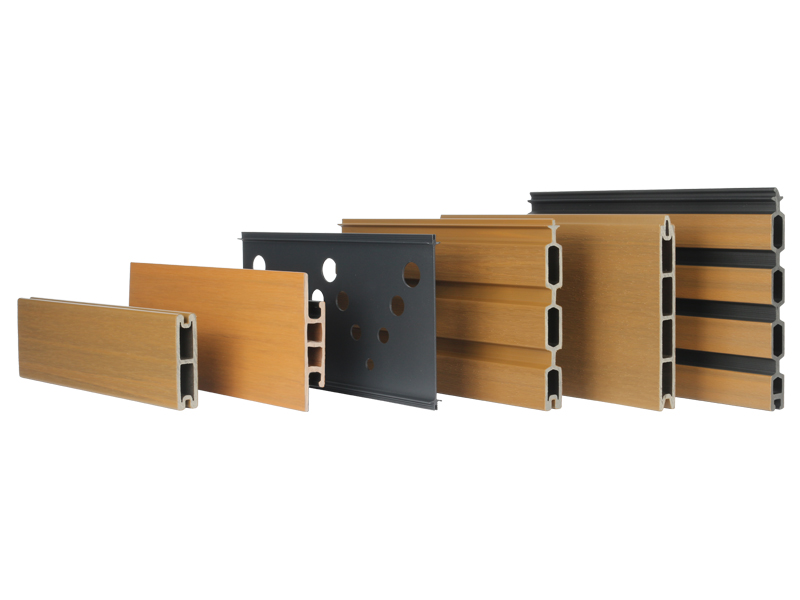
Here’s the problem: “composite fence panel” is a category with at least seven fundamentally different board profiles on the market right now. They look different, install differently, cost differently, and perform differently under wind load.
Pick the wrong one and you’re eating callbacks. Pick the right one and you’re the hero who delivered a fence that still looks brand-new five years later.
This guide breaks down every major composite fence panel profile — with real dimensions, real specs, and a framework for choosing. No fluff.
Heads up: this isn’t an exhaustive encyclopedia of every product on earth. It’s the most useful decision framework we’ve found after manufacturing composite fences since 2009 and shipping to 50+ countries.
What Actually Counts as a "Composite Fence Panel
Let’s get the terminology straight — because this industry is messy with naming.
A composite fence panel isn’t a single slab of material. It’s a system: multiple boards slotted into posts via rails and clips. When someone says “6ft composite fence panel,” they usually mean a complete 1.8m × 1.8m assembled section — boards + rails + post hardware.
The boards (also called slats or planks) are the visible face. They’re the part you choose by profile.
The posts, rails, L-brackets, base plates, and caps make up the structural skeleton — almost always aluminum in any system worth specifying.
So when we talk about “panel profiles” below, we’re really talking about board profiles — the individual plank shape that defines the look, weight, wind behavior, and price of your fence.
Need the full primer on composite vs wood vs vinyl? Start with our What Is Composite Fencing? pillar guide.
Standard Composite Fence Panel Sizes: The Numbers That Matter
Before we get into profiles, let’s nail the universal dimensions.
Almost every serious composite fence manufacturer has converged on a standard panel size of 6ft × 6ft (approximately 1.8m × 1.83m). This matches existing post spacing on most residential and light-commercial projects, which means retrofit jobs don’t require re-digging.
Here’s where board thickness separates the serious products from the cheap ones:
| Spec | Budget Tier | Mid-Range | Professional Grade |
|---|---|---|---|
| Board Thickness | 10–15mm | 18–20mm | 22–24mm |
| Board Width | 120–140mm | 150–180mm | 170–204mm |
| Panel Height | 1.5–1.8m | 1.8m | 1.8–2.0m |
| Wind Rating | Level 5–6 | Level 7–8 | Level 9+ (Beaufort) |
The takeaway: If your boards are under 20mm thick, they’re going to flex in wind. At 24mm with an 80mm aluminum post, you’re looking at Intertek-tested Level 9 wind resistance — the benchmark for coastal and exposed installations.
The 7 Major Composite Fence Panel Profiles (And What Each Is Actually For)
This is where most buyers get lost. “Composite fence” sounds like one product. It’s not.
There are at least seven distinct board profiles — each with different dimensions, aesthetics, installation methods, and ideal use cases.
Let’s walk through every one.
1. Privacy Fence Panel (Wide-Board Solid)
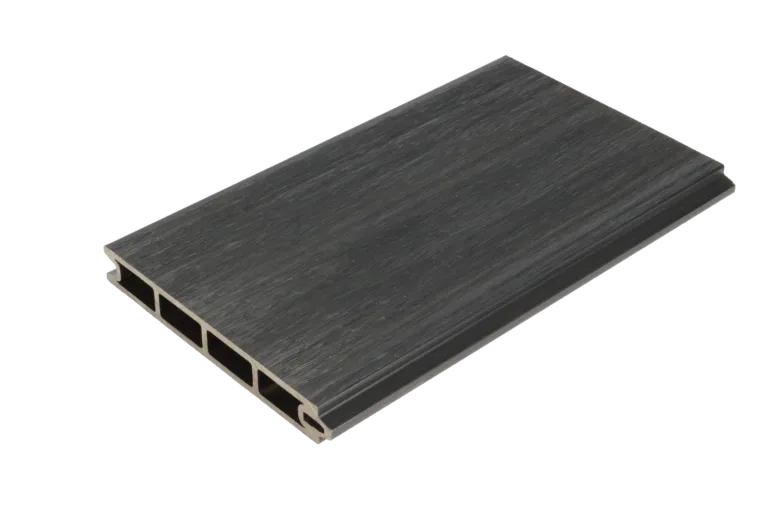
This is the workhorse. The bestseller. The one most people picture when they hear “composite fence.”
- Board dimensions: 180mm wide × 24mm thick
- Panel size: 1.8m × 1.8m (6ft × 6ft)
- Colors: Teak, Dark Grey, Ashwood, IPE, Antique, Walnut
- Key feature: Maximum privacy. Zero visibility. Effective noise barrier.
The wide 180mm board means fewer boards per panel — faster installation, fewer joints, cleaner look. The 24mm thickness gives it genuine structural rigidity under wind load.
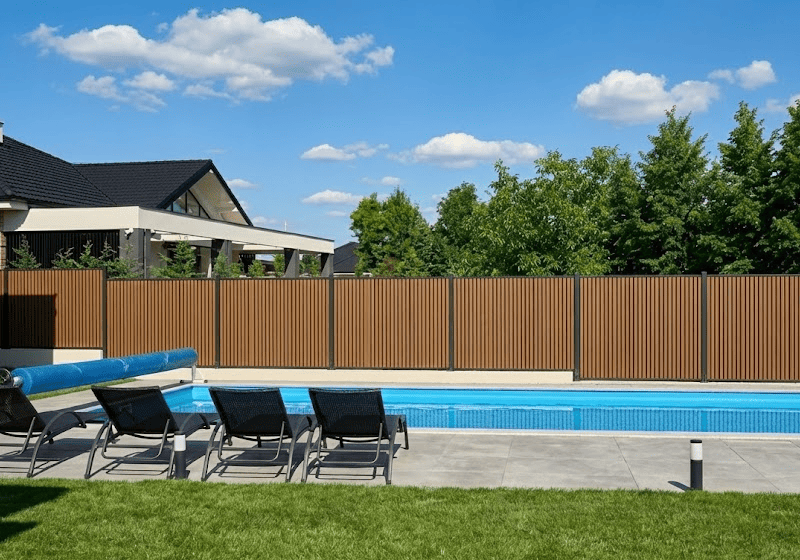
Best for: Residential backyards, pool enclosures, property boundaries, any project where complete visual screening is the priority.
This is the profile to default to if you’re unsure. It sells everywhere.
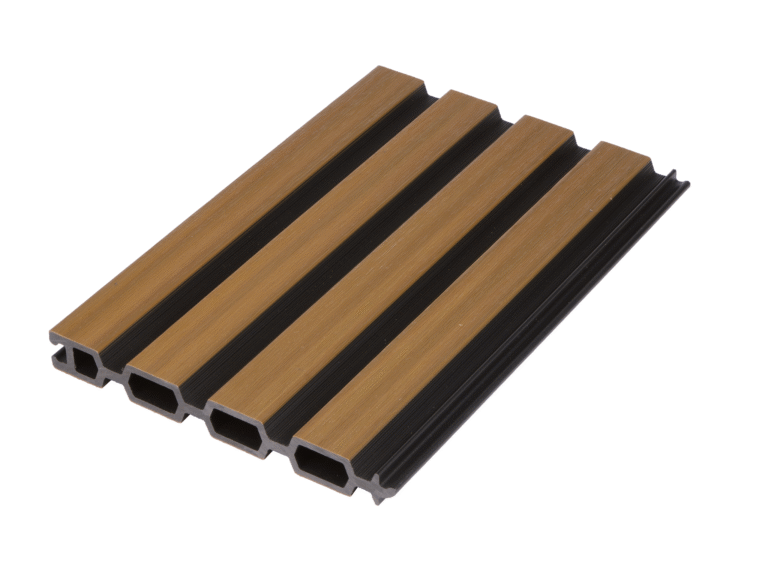
This is the one architects keep specifying. And for good reason.
- Board dimensions: 204mm wide × 24mm thick
- Panel size: 1.8m × 1.83m
- Colors: Teak+Black, Dark Grey+Black, Ashwood+Black, White+Black, Antique+Black, Black+Black, IPE+Black, Walnut+Black
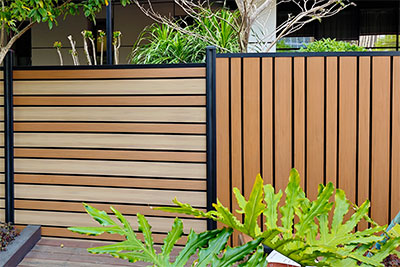
- Key feature: Double-sided composite panel. Horizontal or vertical install. Two distinct looks per board.
The 204mm width is the widest standard board profile in the market. Each board has two visually different faces — so you’re essentially stocking one SKU that delivers two design options.
Install boards all facing the same direction for a uniform look, or alternate them for a dual-tone striped effect.
Best for: Modern residential, commercial feature walls, architectural projects where design flexibility is a selling point.
Pro tip: This profile works both horizontal and vertical — making it one of the most versatile panels for horizontal slat vs vertical fence projects.
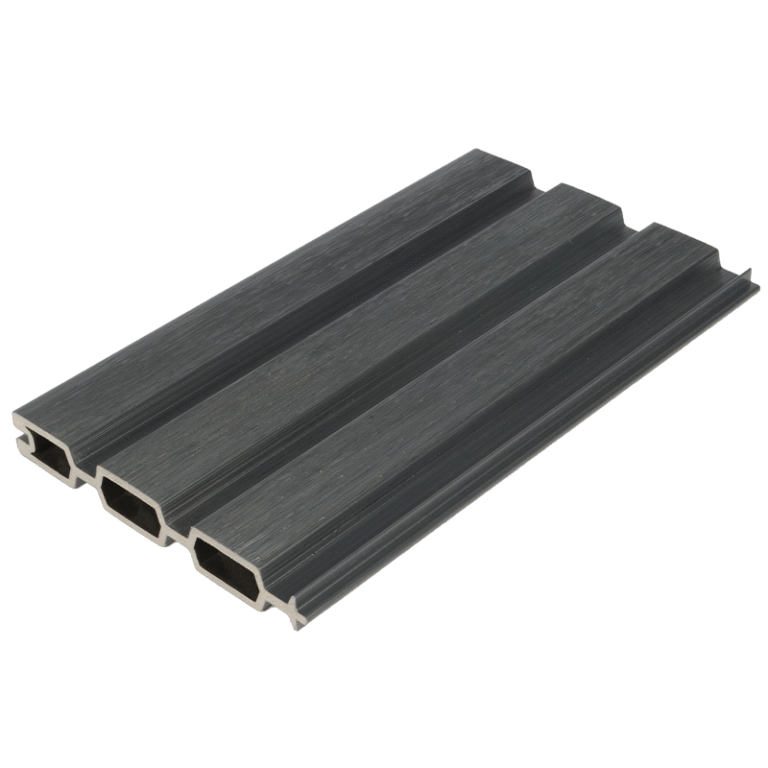
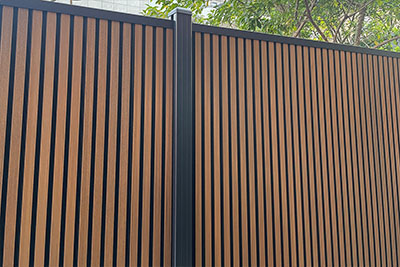
Think of this as the dual-tone’s cleaner, more minimalist sibling.
- Board dimensions: 176mm wide × 24mm thick
- Panel size: 1.8m × 1.8m
- Colors: Teak, Dark Grey, Ashwood, IPE, Antique, Walnut
- Key feature: Fluted design panel with 360° co-extrusion outer layer. Creates shadow lines that give architectural depth.
The fluted profile is where the market is heading in 2026. Flat boards are becoming commoditized — fluted panels command premium pricing because they look like architectural cladding, not just a fence.
The 360° co-extrusion cap layer means this board is protected on every surface — not just the face. That matters for UV resistance and moisture management. Learn more about co-extrusion vs traditional WPC.
Best for: Contemporary homes, feature walls, commercial facades, any project where the fence is the design statement.
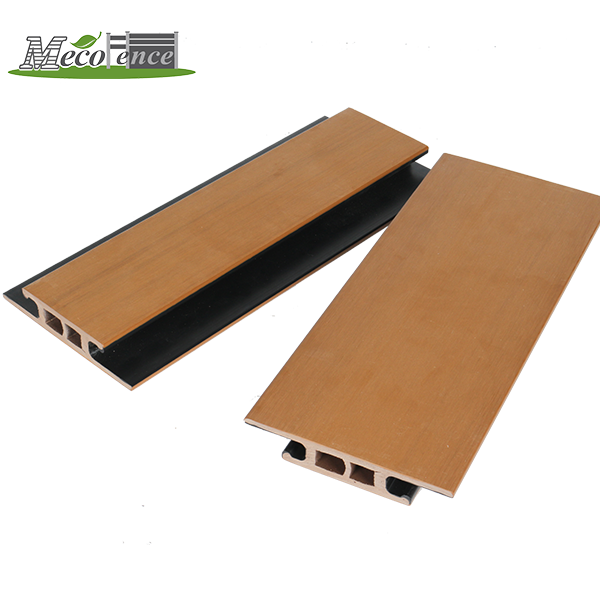
Here’s one most guides completely ignore — and it solves a real problem.
- Board dimensions: 129mm wide × 24mm thick (louvered profile, 80mm visible face)
- Panel size: 1.8m × 1.8m
- Colors: Rosewood, Golden, Antique, Oak, Teak, Caramel
- Key feature: Privacy guaranteed with airflow. Lightweight ASA construction.
Solid privacy panels are great — until you’re in a hot climate and you’ve essentially built a wall that traps heat.
The FlowShield’s angled louvre profile blocks sightlines while allowing continuous air circulation. It’s also significantly lighter than solid WPC boards, which reduces shipping costs and simplifies handling on-site.
Best for: Hot climates, pool surrounds, rooftop terraces, and any project where ventilation matters as much as privacy.
5. Super Kit Fence (WPC Post System)
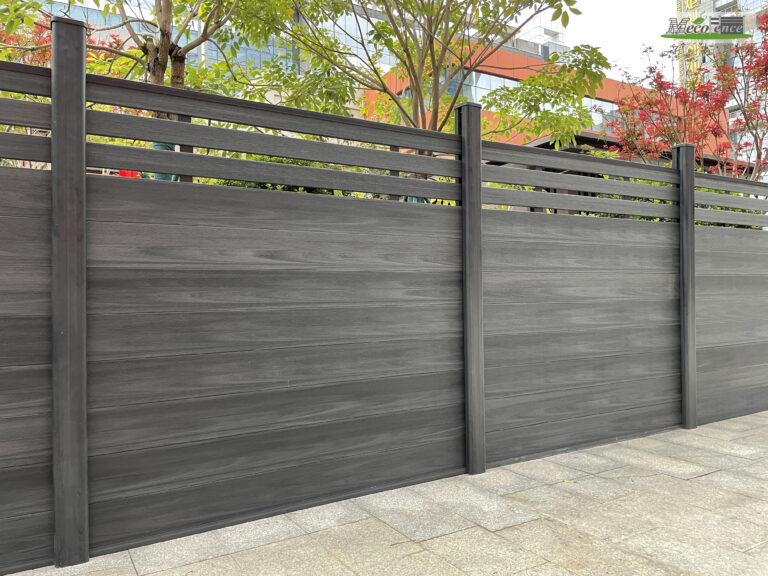
- Panel size: 1.8m × 1.8m
- Post: 110mm × 110mm co-extruded WPC (HDPE inner / co-extrusion outer)
- Colors: Dark Grey, Antique, Teak
- Key feature: Posts and panels in the same color and material. Complete color-matched system.
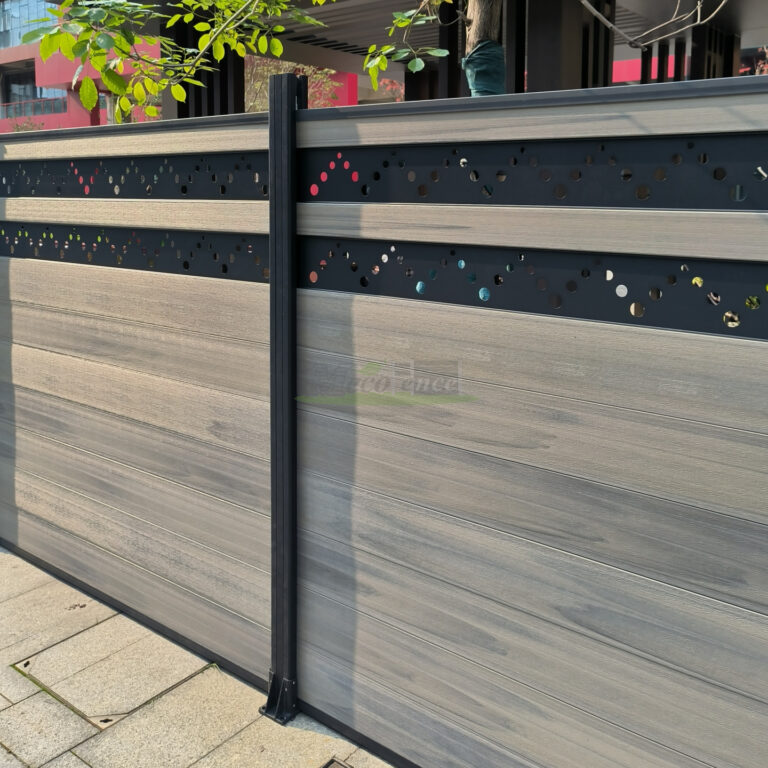
This is where composite fencing stops being “just a fence” and becomes an outdoor design element.
- Panel size: 1.8m × 1.8m
- Colors: Teak, Dark Grey, Ashwood, IPE, Antique, Walnut
- Patterns: Snow, Leaf Vein, Tree Trunk, Wave, Mountain (custom available)
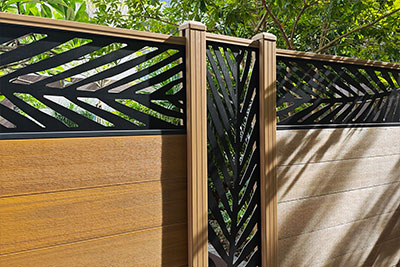
- Key feature: Decorative cutout patterns on the upper section. Partial privacy with visual transparency.
The carving fence combines a solid privacy base with a decorative upper section featuring laser-cut nature-inspired patterns. Light passes through the cutouts, creating shadow play on the ground — a detail landscape designers love.
Best for: Front yards, garden partitions, hospitality venues, any project where the fence is visible and needs to look intentional — not just functional.
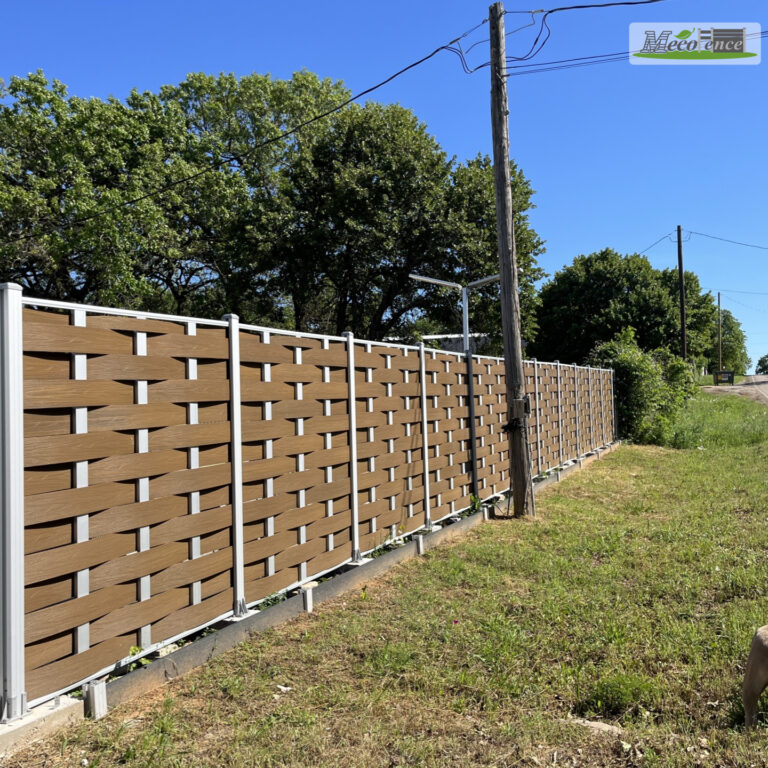
The outlier. And one of the most interesting profiles in the lineup.
- Board dimensions: 140mm wide × 11mm thick (thin, flexible strip)
- Panel size: 1.8m × 1.8m
- Colors: Teak, Dark Grey, Ashwood, IPE, Antique, Walnut
- Key feature: Natural woven/basket-weave look. Excellent flexibility for curved installations.
At just 11mm thick, these strips are deliberately thin — they’re designed to weave between vertical spacers, creating a basket-weave texture that mimics natural willow or rattan fencing.
Here’s the hidden advantage: because they flex, woven panels handle curved property lines better than any rigid profile.
Best for: Rustic or natural-themed gardens, curved fence lines, boutique hospitality, anywhere you want a hand-crafted look without the rot and maintenance of real woven wood.
All 7 Profiles at a Glance: The Master Spec Table
Here’s the comparison you actually need — all profiles, side by side:
| Profile | Board Width | Thickness | Panel Size | Privacy Level | Airflow | Best For |
|---|---|---|---|---|---|---|
| Privacy | 180mm | 24mm | 1.8 × 1.8m | ★★★★★ | None | Backyards, pools, boundaries |
| Dual-Tone Slat | 204mm | 24mm | 1.8 × 1.83m | ★★★★★ | None | Modern residential, commercial |
| Single-Tone Fluted | 176mm | 24mm | 1.8 × 1.8m | ★★★★★ | None | Contemporary, feature walls |
| FlowShield ASA | 129mm | 24mm | 1.8 × 1.8m | ★★★★☆ | Yes | Hot climates, pools, terraces |
| Super Kit WPC | Varies | 24mm | 1.8 × 1.8m | ★★★★★ | None | Color-matched residential |
| Carving | 180mm (base) | 24mm | 1.8 × 1.8m | ★★★☆☆ | Partial | Front yards, hospitality |
| Woven | 140mm | 11mm | 1.8 × 1.8m | ★★★★☆ | Minimal | Rustic gardens, curved lines |
How to Choose the Right Panel Profile: The 5-Question Framework
- Complete privacy → Privacy, Dual-Tone Slat, or Single-Tone Fluted
- Privacy + airflow → FlowShield ASA
- Decorative accent → Carving Fence
- Rustic character → Woven Fence
- Sheltered garden → Any profile works. WPC posts are fine.
- Moderate exposure → 24mm boards + aluminum posts minimum.
- Coastal / hilltop → 24mm boards + 80mm aluminum posts + concrete footings. Consider FlowShield for wind load reduction.
- Clean and modern → Single-Tone Fluted or Dual-Tone Slat
- Warm and natural → Privacy or Super Kit in Teak/Antique
- Artistic / garden feature → Carving or Woven
- Horizontal only → Privacy, FlowShield, Woven
- Both directions → Dual-Tone Slat Wall (the only profile purpose-built for either orientation)
- Budget-conscious → Privacy panel with aluminum posts (best value per linear foot)
- Mid-range → Single-Tone Fluted or FlowShield
- Premium → Dual-Tone Slat Wall or Carving panels
Why Board Thickness Matters More Than You Think
Here’s something most composite fence sellers won’t tell you.
A 15mm board and a 24mm board can look identical in a product photo. Same color, same texture, same 6ft × 6ft panel size.
But under real-world conditions, they’re completely different products.
The 24mm board advantage:
- Wind resistance: Tested to Beaufort Level 9 (372.1 N/m² load) by Intertek — no failure, no disengagement, no visible cracks.
- Rigidity: 24mm hollow profiles with internal ribbing don’t flex or vibrate in gusts. 15mm boards oscillate visibly.
- Longevity: Thicker walls mean more material to resist UV degradation, moisture ingress, and thermal cycling over time.
If you’re sourcing from China: always ask for board cross-section photos. The internal chamber structure tells you everything about structural integrity. More chambers with consistent wall thickness = better engineering.
Cheap boards have thin walls and fewer chambers. They save on material cost. They also fail first.
Don't Forget the System: Posts, Rails & Hardware
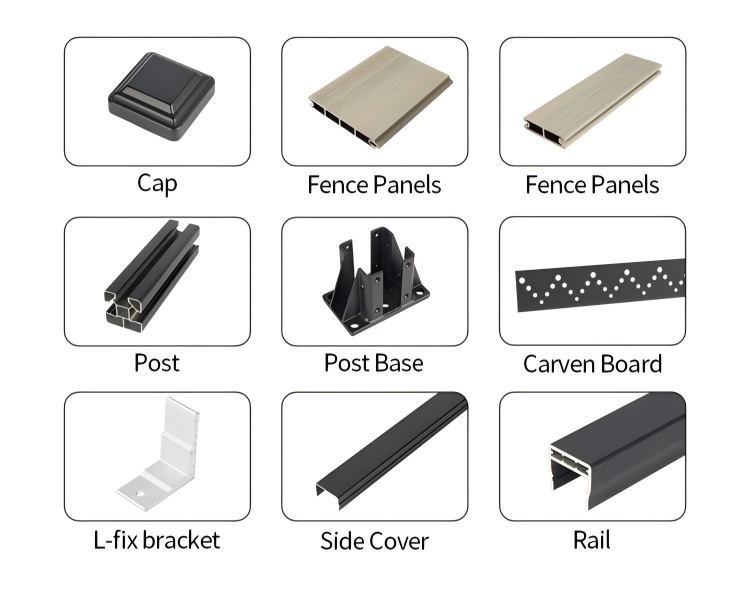
A composite fence panel is only as good as what holds it up.
Every profile listed above ships as part of a complete fence kit. Here’s what’s in the box:
- Post — 80mm × 80mm aluminum (or 110mm WPC for Super Kit). The post is the structural backbone.
- Top & bottom rails — Aluminum channels that hold boards in place and distribute load.
- Side cover / spacer — Covers the gap between post and panel edge. Upgraded Y-slot design on aluminum posts prevents board pinching during thermal expansion.
- L-fix bracket — Connects rail to post. Look for rubber padding that absorbs expansion movement.
- Post base — Surface mount or embedded. Upgraded versions include anti-wobble teeth and 10.5mm wall thickness for maximum stability.
- Post cap — The finishing touch. Quality caps are injection-molded with tight tolerances. Cheap ones fall off.
Pro tip: All aluminum components should be anticorrosive — either powder-coated (60μm+) or anodized. If your supplier uses plain galvanized steel clips, that’s a red flag for coastal or humid installations.
For the full breakdown of post options, read our guide on aluminum vs composite vs steel fence posts.
What About Gates? Matching Panel Profiles to Gate Systems

A fence without a matching gate looks unfinished. Full stop.
Modern composite fence systems offer gate options that use the same board profile and color as the fence panels — mounted on an aluminum frame for structural rigidity.
Available gate configurations typically include:
- Single swing gate — standard pedestrian access
- Double swing gate — vehicle/driveway entry
- Electrical sliding gate — motorized, for driveways up to 6m
- Telescopic gate — for tight spaces with limited slide-back room
Gate infill designs typically mirror the fence: privacy, mid-trellis, full-trellis, or custom patterns.
When specifying a fence project, always include gates in the initial order. Color-matching between production batches isn’t guaranteed — ordering everything together ensures consistency.
Frequently Asked Questions
The industry standard is 6ft × 6ft (approximately 1.8m × 1.8m). This matches existing post spacing on most residential properties, making composite panels a direct replacement for timber without re-digging post holes.
For professional-grade performance, look for boards that are 22–24mm thick. At 24mm with proper aluminum posts, composite fences can withstand Beaufort Level 9 winds. Boards under 18mm are budget tier and more prone to flexing.
Major profiles include: privacy (solid wide-board), dual-tone slat wall, single-tone fluted, FlowShield (louvered ASA), super kit (WPC post), carving (decorative laser-cut), and woven (basket-weave). Each has different dimensions, aesthetics, and ideal applications.
Most profiles install horizontally. The dual-tone slat wall is the primary profile specifically designed for both horizontal and vertical installation, giving contractors maximum design flexibility from a single product.
A standard 40-foot high-cube container holds approximately 180–220 complete fence sets (6ft × 6ft panels with hardware), depending on the board profile and packing method. Lighter ASA panels can increase density by up to 35%.
Next Steps: From Profile to Project
You now know more about composite fence panel profiles than 90% of the people selling them.
That's not an exaggeration. Most suppliers list "composite fence" as a single product line and hope you don't ask questions. You're past that.
Here's what to do next:
- Need to compare materials? Read Co-Extrusion vs Traditional WPC
- Ready to price a container? Check the 2026 WPC Fence Wholesale Pricing Guide
- Want to see all products? Browse the full MecoFence composite fence collection
- Planning installation? Our step-by-step install guide covers every ground type
Written by
Steven He
Co-Founder & Head of Product · MecoFence
Steven leads product development and B2B partnerships at MecoFence, a WPC composite fence manufacturer based in Guangdong, China. 10+ years in composite material manufacturing, covering formulation, extrusion process engineering, and export supply chain.
Table of Contents
Not Sure Which Panel Profile Fits Your Project?
MecoFence offers 7 composite fence panel profiles — from solid privacy to architectural slat walls — with factory-direct pricing for contractors and distributors worldwide. Get spec sheets, sample boards, and a personalized recommendation.
Request a Free Sample Kit →