
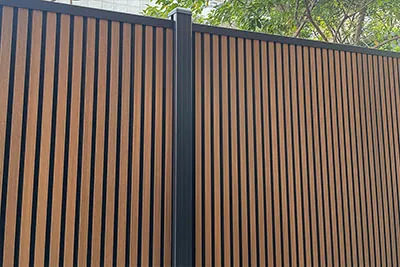
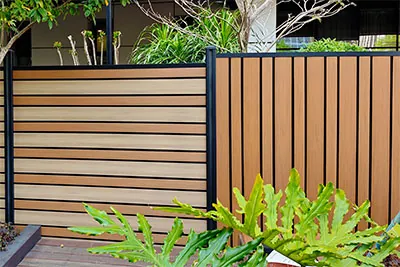
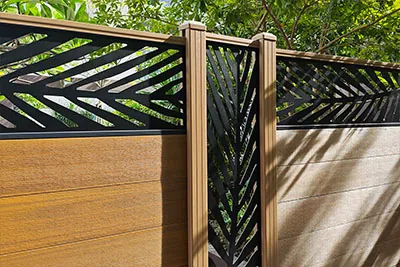
The MOQ listed on a Chinese WPC fence factory’s website is almost never the MOQ you’ll see on the real quote.
Sometimes it’s lower — a trading company quoting 20 sets to bait your inquiry. Sometimes it’s higher — a factory saying “100 sets” in the brochure but “200 sets minimum per color” once they send the PI.
Either way, you can’t budget a container, plan a product mix, or compare suppliers honestly until you know what MOQ actually means — and where the numbers come from.
This guide breaks down realistic 2026 MOQ figures for co-extrusion WPC fence from Chinese factories — the per-SKU minimums, the per-order minimums, the custom-color thresholds, and what’s actually negotiable on a first order. Based on current industry norms and what we quote distributors every week.
Quick honesty note: these numbers reflect what established factories typically quote and what we see across our own orders. Your specific supplier may differ — always verify MOQ in writing before you wire a deposit.
First: Three Different Things Get Called "MOQ"
When a factory says “our MOQ is 100 sets,” they could mean three very different things. Getting this wrong is how importers end up with wrong inventory or surprise charges.
1. MOQ per SKU
The minimum order for one specific product variant — a single profile in a single color. Example: 100 sets of Teak Privacy Panel.
If you want that same profile in two colors (Teak + Dark Grey), most factories treat it as two separate SKUs — each subject to its own minimum. That turns a “100-set MOQ” into effectively 200 sets for a two-color trial.
2. MOQ per Order
The minimum total across all SKUs in one purchase order. This is the number that matters for mixed-product trials — when you want to test 2–3 profiles without committing 100 sets each.
Reputable factories will usually quote this flexibly. Trading companies almost never do.
3. MOQ per Container
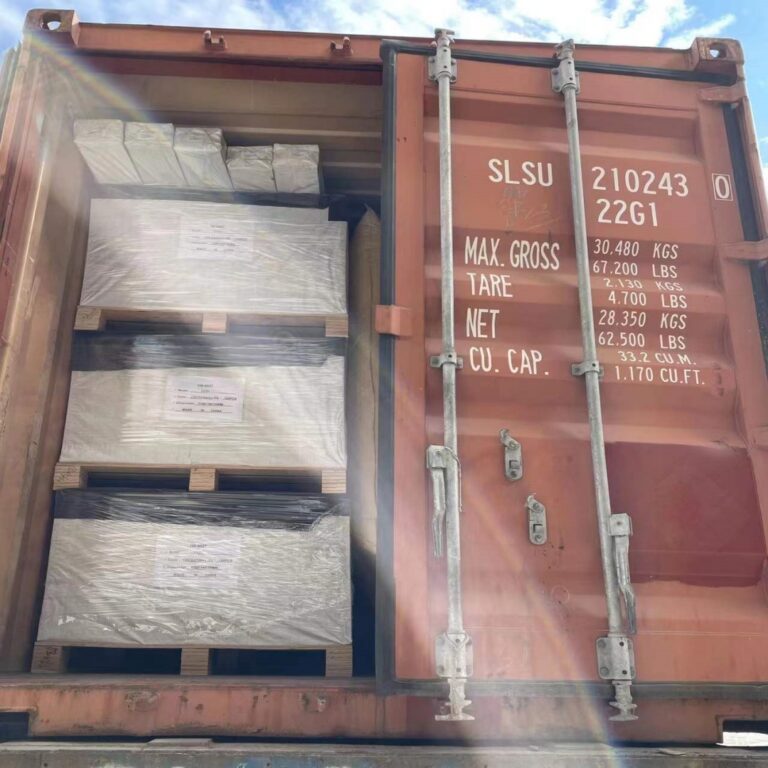
The practical minimum to make ocean freight economical. A standard 40HQ container holds roughly 400 complete 6ft × 6ft fence sets. A 20ft container loads 200 sets.
Here’s the trap: some factories will let you order below their quoted MOQ (say, 50 sets), but your shipping cost per set balloons because a half-empty container still pays full freight. You technically met MOQ. You also blew up your unit economics.
When you ask about MOQ, specify which one you’re asking about. “What’s the MOQ per SKU and the MOQ per order?” — that one sentence filters out half the sketchy suppliers.
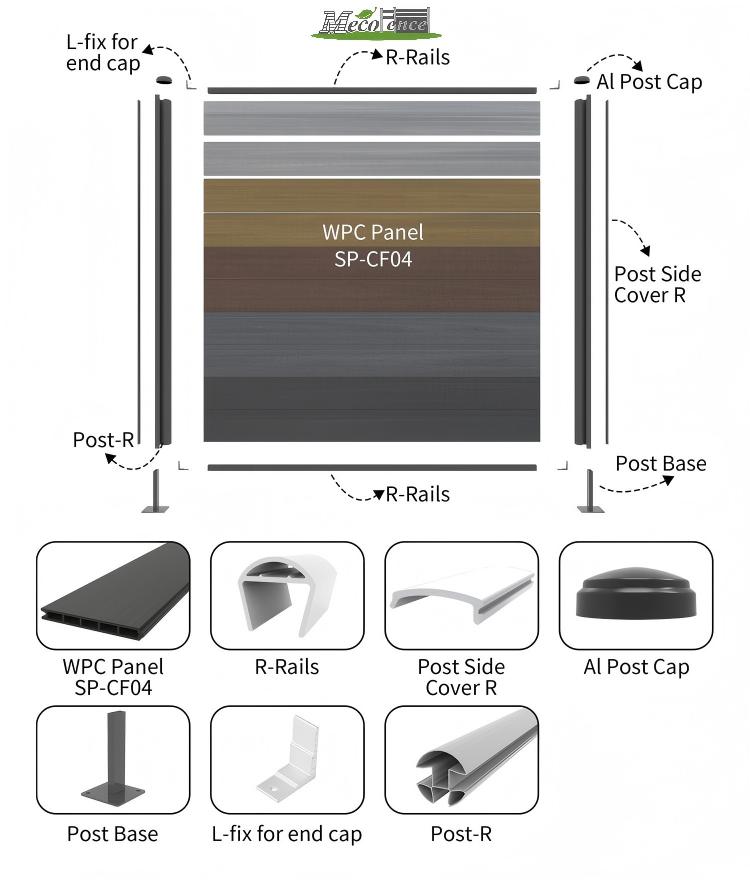
Here’s what established co-extrusion WPC fence factories in Guangdong, Zhejiang, and Shandong actually quote in Q1–Q2 2026. Units are complete 6ft × 6ft sets unless noted.
| Order Type | Typical MOQ | Notes |
|---|---|---|
| Standard profile, stock color | 100 sets | Privacy, Slat, Fluted in Teak, Dark Grey, Walnut, etc. |
| Specialty profile (stock) | 30–40 sets | Woven Fence, Full Trellis, Carving profiles — lower because lower demand |
| Dual-tone / premium slat | 100 sets | Same as standard; volume production line |
| Custom color | 500+ sqm | Requires a new color masterbatch batch; sampling + approval adds 2–3 weeks |
| Custom board size | 1,000+ sqm | Non-standard width or thickness; mold modification charges usually apply |
| Private label (OEM) | 200–500 sets | Branded packaging + stickers; uses existing product SKUs |
| ODM / exclusive design | 2,000+ sqm annually | Custom mold tooling; usually requires volume commitment across 12 months |
| Full 40HQ container | 400 sets | Practical economic minimum per shipment; below this, freight-per-set destroys margin |
Two numbers really matter for most first-time importers: 100 sets per SKU and 200 sets per container. Plan around those two, and everything else falls into place.
If you’re still deciding which profile to stock, our composite fence panel profiles guide walks through the seven profile types and which market each one serves best.
Where Custom Work Blows Up Your MOQ
The 100-set figure is for stock products. The moment you ask for customization, minimums jump — often sharply. Here’s why.
Custom colors: 500+ sqm minimum
A factory can’t run 50 sets of a brand-new color. The extruder has to purge, switch masterbatch, calibrate color consistency, then do it all again when you’re finished.
The 500 sqm figure (roughly 150 sets at standard panel size) is the break-even point where the changeover cost gets absorbed. Below that, the factory either refuses or charges a setup fee that kills your unit price.
The workaround: check if the color already exists in the factory’s decking line. Many WPC manufacturers run fence panels and decking on the same masterbatch — so a “custom fence color” might just be their standard decking color ported over. That can bring MOQ back down to 100–200 sets.
Custom sizes: 1,000+ sqm and mold fees
Custom board width or thickness means modifying the extrusion die. That’s 1,000+ sqm minimum plus a one-time mold fee ($800–$3,000 depending on complexity).
If you hear “no mold fee” on a non-standard size, be suspicious. Either the mold already exists (not truly custom), or the fee is buried in the unit price.
Private label vs ODM — know the difference
Private label (OEM) = existing product, your brand name + packaging. MOQ: 200–500 sets. Lead time adds 1–2 weeks for printing.
ODM (exclusive design) = new profile, new mold, new formulation. MOQ: 2,000+ sqm annually, often with a 12-month volume commitment. Factories won’t tie up mold capacity for a one-off.
Most distributors think they want ODM. They actually want private label. Ask yourself: does your end-customer care that this fence has a unique board width — or do they just want your brand on a proven product? Answer that before you commit to 2,000 sqm.
The Mixed Container Strategy: Hit MOQ Without Overstocking
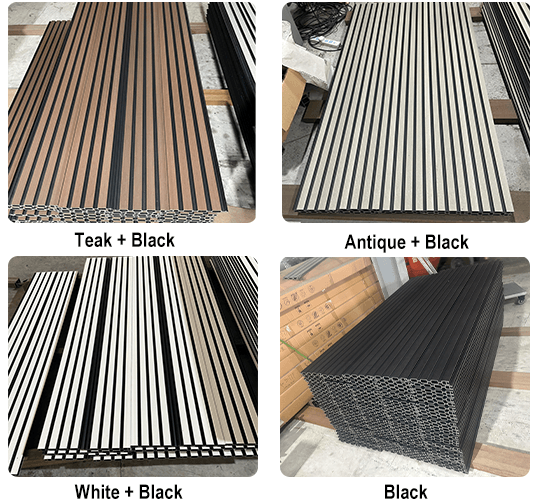
Here’s what most first-time importers get wrong. They hear “100-set MOQ” and assume they have to buy 100 sets of one thing. Then they either skip the trial or end up sitting on 100 sets of a color their market didn’t want.
Most established factories — including ours — allow mixed-SKU containers that let you spread the MOQ across multiple products.
How a typical mixed 40HQ looks
A practical first order for a new distributor testing the market:
- 60 sets Privacy Panel, Teak (your likely bestseller)
- 60 sets Dual-Tone Slat Wall, Dark Grey + Black (premium tier)
- 40 sets Fluted Board, Walnut (architectural buyers)
- 30 sets of matching gates + accessories
Total: around 190 sets plus gates. One 40HQ container. Three profile tiers tested at once. And you’ve hit the per-order MOQ without committing 100 sets of any single SKU.
The 60/40 and 70/30 splits
Two common patterns work well for splitting between co-extrusion and traditional WPC tiers:
- 60/40 split: Premium co-extrusion as the main line, traditional WPC as the value alternative. Good for markets where you’re still learning the price sensitivity.
- 70/30 split: Heavier on co-extrusion. Use when your market is commercial/HOA/coastal and willing to pay for warranty tier.
Our deep-dive on co-extrusion vs traditional WPC fence covers the performance differences in detail — worth reading before you decide on the split.
What factories usually won’t mix
Flexibility has limits. Most factories won’t mix custom-color orders with stock-color orders in the same container, because the production sequencing gets expensive. If you want a custom color, treat it as a separate order with its own MOQ.
For the full math on how many sets actually fit in a 40HQ and how loading density varies by profile, contact us for container loading guide .
What Their MOQ Quote Tells You About the Supplier
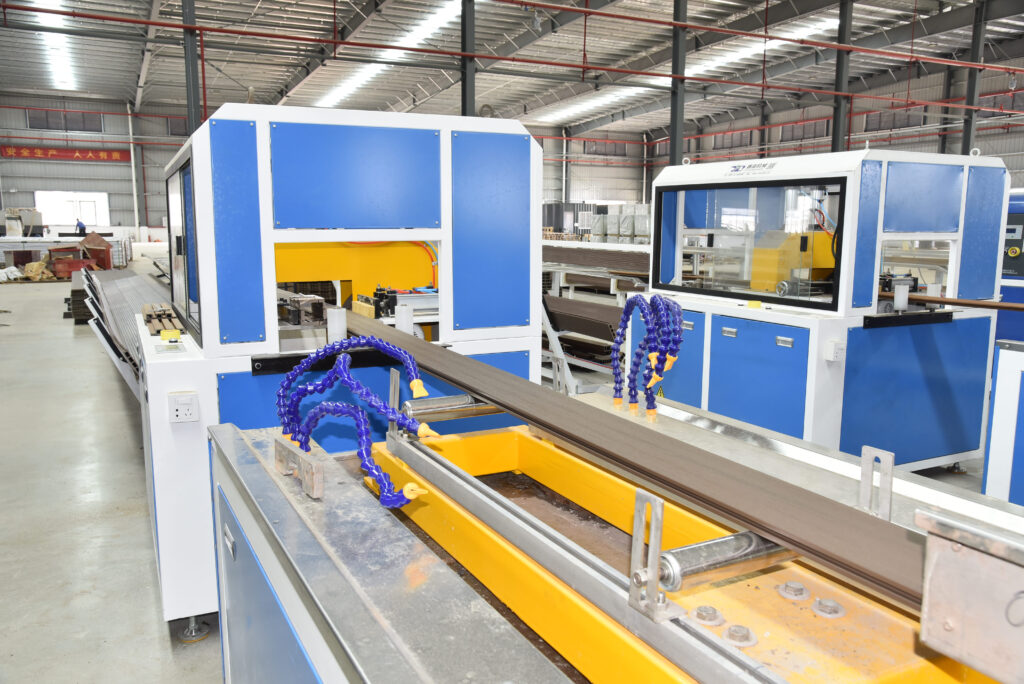
Before you dig into unit prices, the way a supplier answers your MOQ question reveals almost everything about who they actually are. Three patterns to watch for.
Pattern 1: “No MOQ” or 10–20 sets
Almost certainly a trading company. Real factories can’t economically run production for 20 sets — the die setup and changeover costs alone exceed the margin.
What’s actually happening: the “supplier” is taking your order, buying from a factory at whatever small-quantity premium exists, marking it up 20–40%, and shipping it to you. You pay for the middleman and lose direct factory relationship.
This isn’t always bad for a tiny sample order. But it’s never the right choice for a container.
Pattern 2: 5+ full containers minimum
Usually an enterprise-focused factory, wholesaler, or one that’s not set up for distributor relationships. Some Chinese manufacturers only serve large retail chains (Home Depot-scale) and won’t engineer their systems or logistics for smaller distributors.
Fine if you’re Lowe’s. Bad news if you’re a regional distributor testing a new market.
Pattern 3: Flexible 100–200 sets with mixed SKUs allowed
Almost always a genuine factory that regularly serves distributors. They’ve built their production scheduling around this volume, their packaging is set up for it, and they have internal processes for mixed-SKU orders.
This is the sweet spot. A factory that quotes “100 sets per SKU, 180 sets per order, mixed containers allowed” is telling you three things at once:
- They’re a factory, not a broker
- They work with distributors regularly
- Their logistics are container-optimized
One more question that filters suppliers fast
Ask: “What happens if my first order is 70 sets instead of 100?”
A real factory will say something like “we can do 70 as a trial, but unit price goes up ~8–12% and you should plan a full 200 set container for order #2.” That’s honest math.
A trading company will just say “no problem, same price” — because they’re sourcing from somewhere else anyway.
A poor-fit factory will refuse outright. Which is also information.
First-Order Negotiation: What's Actually Possible
Here’s the honest picture of what most factories will and won’t flex on for a first order. None of this is secret — but none of it is on the brochure either.
What’s usually negotiable
- Trial below standard MOQ — often down to 50–70 sets for a good-faith first order, with a 8–15% unit price premium.
- Mixed-SKU ratios — splitting the 100 set minimum across 2–3 colors in the same profile.
- Gate + accessory add-ons — including a small number of gates or flower boxes doesn’t usually affect panel MOQ negotiations.
- Deposit percentage — standard is 30% T/T deposit, 70% balance before shipment. Factories will sometimes accept 20% from repeat customers, but rarely on first orders.
What’s almost never negotiable
- Custom color MOQ — the 200 sets is a production reality, not a negotiating position.
- Mold fees for custom sizes — the mold is a hard cost the factory can’t absorb.
- Certifications on stock products — you get CE/SGS/FSC that already exists; you don’t get new certifications done for your order.
- Split shipment discounts — ordering 200 sets but splitting into two 100-set shipments usually means paying full freight twice.
What you trade for flexibility
Getting a below-MOQ trial order usually costs you in three small ways:
- Slightly higher unit price (8–15%)
- Longer lead time (production gets sequenced around full orders)
- Higher deposit requirement (35–50% instead of 30%)
Fair trades if you’re validating a product-market fit. Bad trades if you’re just trying to squeeze the factory.
The best move: be upfront about what you’re doing. “This is a 70-set trial to validate demand; I’m targeting a 200-set container order in Q3 assuming the market accepts it.” Factories work with honest distributors. They stop returning calls from the ones who pretend the 70-set order is “all we ever need.”
Full pricing context — FOB ranges, shipping math, and landed cost calculations — lives in our WPC fence prices wholesale guide. Read it alongside this MOQ piece to build your complete first-order budget.
First-Order Decision Framework
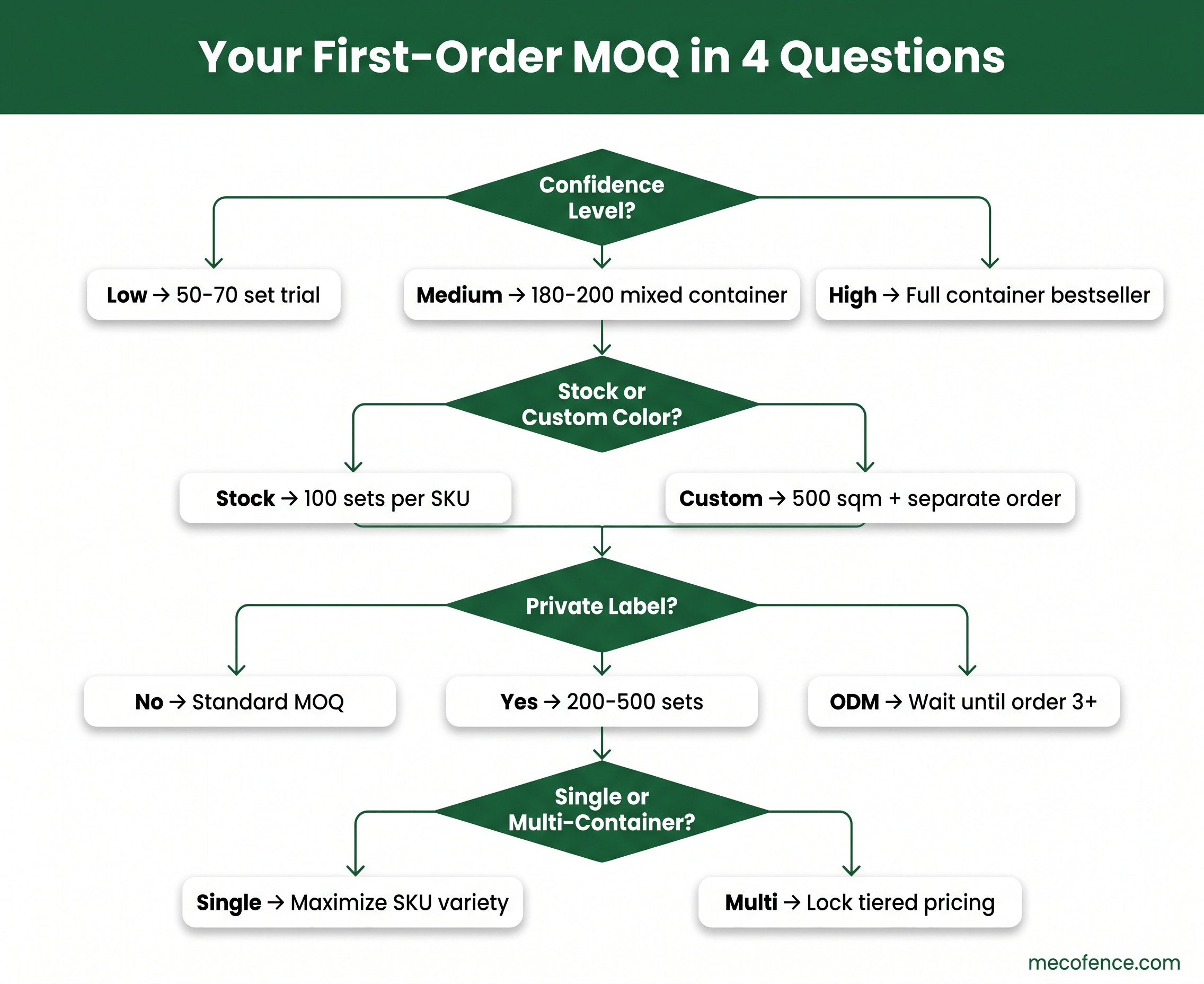
Cut through the noise with this quick decision tree. Answer four questions honestly and your MOQ strategy writes itself.
Question 1: What’s your market-validation confidence level?
- Low (no customers yet): Start with 50–70 set trial, one or two SKUs, accept the unit price premium. Validate before you commit.
- Medium (some signed interest): 180–200 set mixed container, 3 SKUs, stock colors only.
- High (pre-sold orders): Full container of your proven bestseller SKU, consider adding private label in the same shipment.
Question 2: Stock colors or custom?
- Stock: 100-set MOQ per SKU applies. You can mix freely within one container.
- Custom: 500 sqm minimum per color, plan it as a separate second-order project, don’t mix with trial.
Question 3: Branded packaging?
- No (factory packaging is fine): No additional MOQ burden, fastest lead time.
- Yes (private label): 200–500 set minimum, 1–2 weeks added for printing.
- Full exclusive brand (ODM): Reserve for order #3+ once you’ve proven volume. Don’t start here.
Question 4: Single container or multi-container plan?
- Single: Maximize SKU variety within the container for maximum market-testing coverage.
- Multi-container (annual contract): Lock in tiered pricing, reserve production capacity for your peak season, ask for trade-credit terms on container #3+.
Four questions. Four answers. You now know exactly what MOQ shape your first order should take — before you contact a single supplier.
That’s the entire playbook.
Still unsure what composite fencing actually is and whether it fits your market? Start with our foundational piece on what composite fencing is in 2026 — then come back to this MOQ guide once you’ve decided to move forward.
Frequently Asked Questions
For co-extrusion WPC fence in stock colors, the standard MOQ is 100 complete 6ft × 6ft sets per SKU across most established Chinese factories. Specialty profiles like Woven or Full Trellis often drop to 30–40 sets. Custom colors start at a 200-set minimum (≈500 sqm).
Yes, reasonable factories usually allow trial orders down to 50–70 sets with an 8–15% unit price premium and possibly a higher deposit. Be upfront that it is a market-validation trial with a larger follow-up order planned. Factories that refuse any flexibility — or agree without any trade-offs — are usually signaling problems.
Custom colors typically require a 200-set minimum (≈500 sqm at standard panel size). This floor exists because the extrusion line has to purge, switch masterbatch, and recalibrate — costs that only amortize across a larger production run. The workaround: check if your desired color already exists in the factory's decking line.
Most established factories allow mixed-SKU containers combining 2–3 profiles and multiple colors in one 40HQ shipment. Typical splits are 60/40 or 70/30 between premium co-extrusion and traditional WPC tiers. A full 40HQ container holds ~400 complete sets total. Custom-color SKUs usually can't be mixed with stock-color orders in the same production run.
Usually, yes. Real factories cannot economically run WPC extrusion lines for 10–20 sets — setup and changeover costs alone exceed the margin. A "no MOQ" or very low MOQ (under 30 sets) is almost always a trading company or reseller who sources from a factory, marks it up 20–40%, and ships it to you. Fine for a tiny sample, never right for a container.
Unit price tiers typically step down at 100, 200, 500, and 1,000+ sets. Below-MOQ trial orders usually carry an 8–15% premium. Above 500 sets in a single SKU, expect 5–8% better pricing. Beyond 1,000 sets annually, direct factory contracts with locked quarterly volumes can unlock another 5–10%. Always request tier pricing in the initial quote so you know what scaling up actually buys you.
Your Next Move
MOQ shouldn’t be the gatekeeper of whether you ever enter the WPC fence market. It’s a production-economics reality — but every reputable factory has flexibility built in for distributors who plan their orders properly.
Here’s what to do this week:
- Decide your confidence level (trial, validated, or pre-sold). That sets your MOQ target.
- Pick stock over custom for your first order. Always. Save customization for order #3+.
- Design a mixed-SKU container that hits 200 total sets without over-committing to any single color.
- Ask three questions of every supplier: “MOQ per SKU?” / “MOQ per order?” / “What happens at 70 sets?” Their answers filter the list fast.
The distributors who struggle with MOQ are the ones who treat it as a barrier. The ones who scale treat it as a budgeting input — one number among many, and one that has real negotiating room on the margins.
That’s the whole difference.
Written by
Steven He
Co-Founder & Head of Product · MecoFence
Steven leads product development and B2B partnerships at MecoFence, a WPC composite fence manufacturer based in Guangdong, China. 10+ years in composite material manufacturing, covering formulation, extrusion process engineering, and export supply chain.
Table of Contents
Planning Your First WPC Fence Container Order?
MecoFence works with distributors at every stage — from 50-set validation trials to multi-container annual programs. Source certified composite fencing direct from our Foshan factory with flexible MOQ, mixed-SKU containers, and transparent FOB pricing.
Request a Custom MOQ Quote →