
Scale profitability with the No-Dig Fence Installation System: build faster, rot-proof steel infrastructure for professional projects.
For professional fencing contractors, time is the single most expensive commodity. Every hour a crew spends digging holes, hauling spoil piles, or waiting for concrete to cure is non-billable downtime. In a competitive bidding environment, the ability to deploy structurally superior fencing faster than the competition is the key to protecting margins.
Recently, a high-efficiency installation methodology showcased by US-based industry constructor Haxman has redefined the speed of deployment for privacy wooden fencing. While this case study originates from the American residential market, the engineering principles behind the “No-Dig” Steel Post Fence System offer universal solutions for contractors facing specific soil and climate challenges globally.
At Mecofence, our role as a professional composite fencing supplier places us at the intersection of material science and installation efficiency. We closely monitor emerging construction techniques to help our partners—wholesalers and contractors—optimize their field operations. After analyzing this steel-driven method, we believe it offers a significant operational advantage for modern fence builders.
Fence Project Case Study: Material Costs & Specs Snapshot
To evaluate the commercial viability of this method, we analyzed the specific data points from the installation case study. This breakdown demonstrates how the fence construction budget shifts from “concrete heavy” to “steel heavy” while drastically reducing labor time.
Fence Project Specifications:
Total Fence Line: Approx. 100 feet
Installation Time: 1 Day (Completion)
Post Depth: Minimum 3 feet driven into ground.
Post Spec: SS40 / WT40 High-Strength Steel Pipe (approx. 50,000 PSI)
Material & Cost Breakdown (US Market Reference):
- Steel Fence Posts: 13 posts × $35.00 each = $455.00
- Fence Pickets (Premium): 213 pickets × $3.28 each = $698.64
- Fence Rails (Stringers): 21 rails (16ft length) × $11.98 each = $251.58
- Fasteners & Hardware: Nails, screws, and Ramset loads = ~$221.34 (Estimated)
- Equipment Rental: Gas-powered Post Driver (1 day) = ~$85.00
- Total Project Material Cost: $1,711.56
Key Takeaway: By reallocating the budget typically spent on concrete, auger rental, and extra labor hours into higher-quality steel fence posts and premium pickets, the project achieves a superior lifespan without inflating the total bid price.
The Contractor’s Edge: Why Steel Fence Posts Outperform Wood
The traditional 4×4 wood fence post set in concrete behaves differently depending on geography, but it almost always fails eventually. Based on the data from this case study and community feedback, here is how the “No-Dig” Steel method adapts to specific environmental challenges:
1. For Frost Zones (Northern Climates): Eliminating Heave In regions with deep frost lines, concrete footings are notorious for “frost heaving.” The rough surface of a concrete bulb allows frozen ground to grip and lift the fence post.
- The Solution: Smooth steel pipe, driven 3–4 feet deep, minimizes the surface area for frost to grab onto. This significantly reduces vertical displacement compared to traditional concrete footings.
2. For High-Wind Corridors (Coastal & Plains): Superior Flex Rigidity is the enemy in high-wind zones. Wood fence posts snap because they cannot absorb energy.
The Solution: The industrial-grade steel pipes used in this method (10-12 gauge, 50k PSI) are designed to flex slightly under heavy wind loads rather than snapping. This resilience is critical for durability in open plains or coastal areas.
3. For Humid Environments (The South & Tropics): Zero Rot In high-moisture regions, wood rot at the ground line is the primary cause of warranty callbacks.
The Solution: Galvanized steel is immune to biological decay, termites, and moisture absorption. Adopting this method eliminates the “rotted base” warranty call entirely.
High-Efficiency Fence Installation: A Step-by-Step Guide
We have broken down the case study into critical execution phases, highlighting specific “Pro Tips” that ensure efficiency and safety.
Phase 1: Fence Line Prep & Safety (Locates & Layout)
Before driving any steel, accurate locating is non-negotiable.
The “Locates” Rule: As emphasized in the case study, you must call 811 (or your local utility) to mark underground lines before driving fence posts. Hitting a gas or electric line with a driven steel pipe is a catastrophic failure.
The String Line: Run a string line for alignment. Crucial Tip: Do not let your posts touch the string line as you drive them. If a post pushes the string, it throws off the alignment for every subsequent post. Keep a slight gap to ensure a laser-straight fence line.
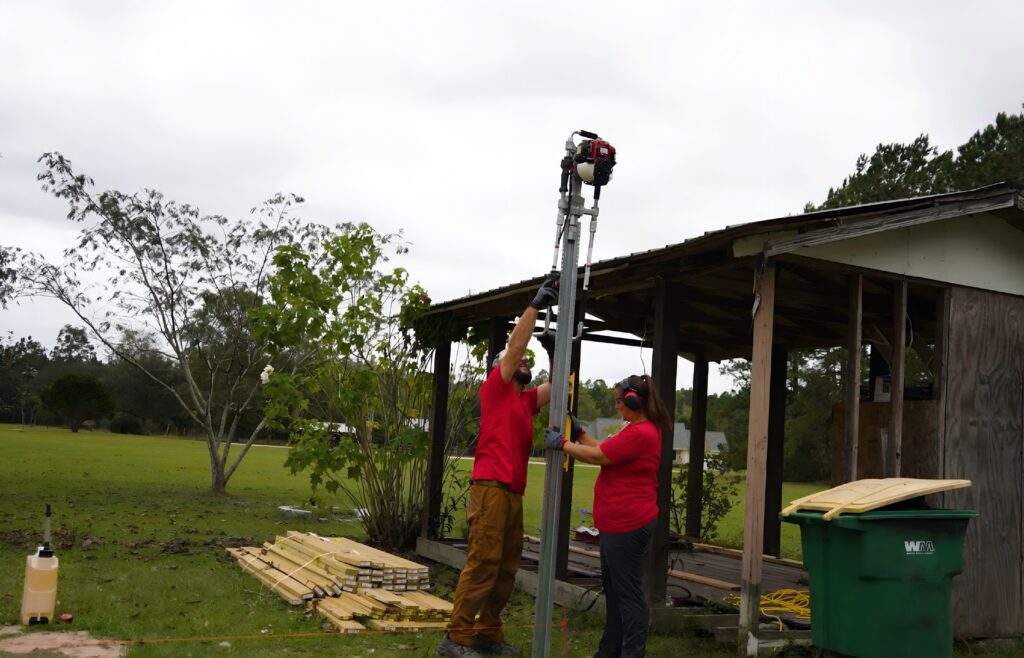
Phase 2: Driving Steel Fence Posts (Speed & Adaptation)
Equipment: Use a gas-powered driver (e.g., Rhino Multi-Pro XA) to sink posts in seconds.
Handling Obstructions: For difficult terrain or wooded lots with roots, the case study suggests beveling (sharpening) the tip of the pipe with an angle grinder to act as a punch. This ensures your schedule isn’t derailed by subsurface obstructions—an adaptability that is crucial when installing fencing on slopes and uneven ground.
Phase 3: The “Boxed Post” Technique for Straight Fences
Since driven pipes may not be perfectly plumb or height-aligned, the “Box” is where you correct it.
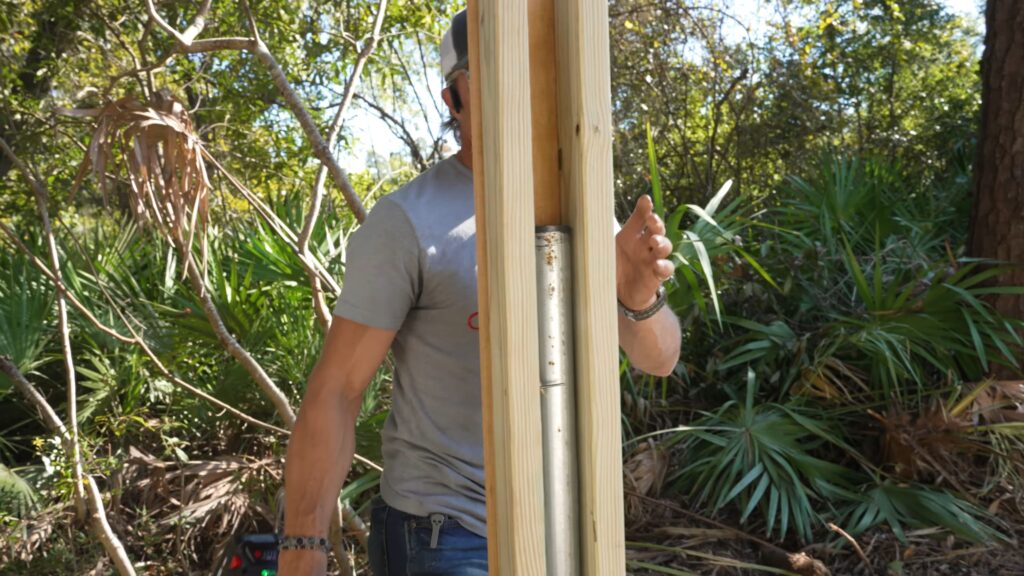
The Method: Build a wooden sleeve (box) around the pipe using 2×4 scraps and pickets. Use a Ramset gun (powder-actuated nailer) or heavy-duty self-tapping screws to fix the wood to the steel.
The Jig: Create a simple jig to hold the box components in place while fastening. This allows for rapid repetition.
Correction: Use the wooden box to adjust for level and height. The steel anchors it; the wood levels it.
Phase 4: Installing Fence Rails (The “Run Wild” Method)
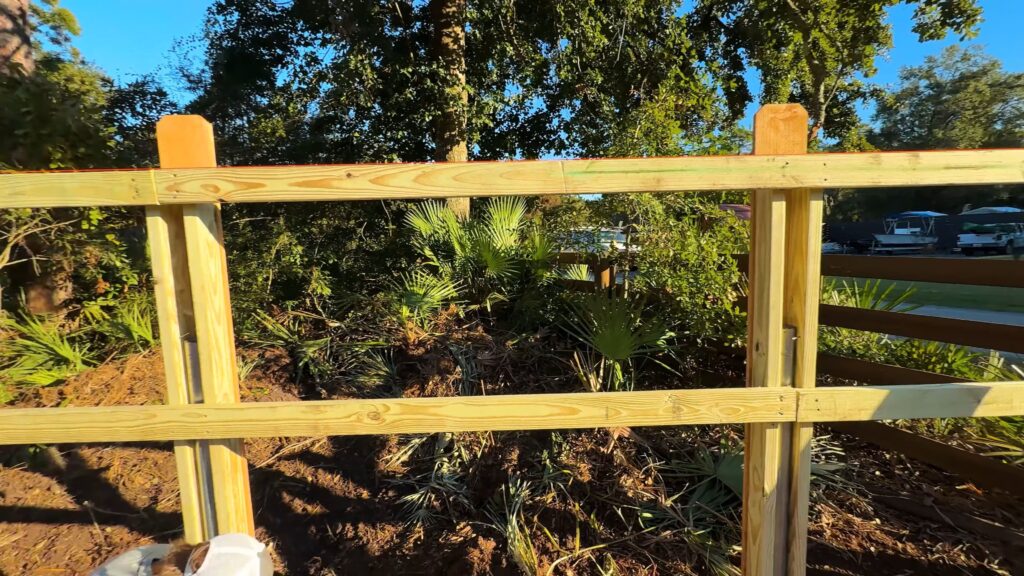
16-Foot Rails: Use 16-foot 2x4s to span three posts, staggering the seams so they don’t all break on the same post.
Pro Speed Tip: Don’t measure and cut every single board before installing. The case study demonstrates nailing the long rails up and letting them run past the post (“run wild”), then cutting them in place with a circular saw. This is significantly faster than measuring twice and cutting once for every bay.

Phase 5: Attaching Fence Pickets (The Zero-Gap Rule)
Zero-Gap Rule: When using wet pressure-treated lumber, install pickets tight against each other with zero gap. As the wood dries, a natural gap will form.
The “Buddy Picket”: To ensure consistent height without measuring every board, use a “Buddy Picket” (a jig or scrap block) at the bottom. Rest your new picket on this block to guarantee perfect ground clearance and uniform top height instantly.
For clients interested in aesthetic variations of this strength, see our woven fence panel complete DIY guide.
The Bottom Line: Fence Construction Cost vs. Profit
While steel fence posts have a higher SKU cost than wood 4x4s, the “No-Dig” method improves the contractor’s margin through labor reduction.
Concrete Savings: Eliminates the purchase and transport of concrete entirely.
Labor Velocity: A crew can complete installation in a fraction of the time it takes to dig, mix, and pour.
Total Project Cost: As noted in the data snapshot, the ~$1,711 total cost is highly competitive against traditional methods when labor hours are monetized. For a deeper dive on estimating, review our composite fence installation guide on costs, materials, and steps.
Industry Note: Elevating Your Wood Fencing Standards
While Mecofence specializes in premium composite materials, we recognize that pressure-treated wood remains a core revenue stream for many professional contractors. However, traditional wood posts are also the primary source of warranty claims.
This “No-Dig” steel post method is specifically designed to upgrade those wood fence installations. By adopting this system for your standard lumber projects, you solve the “rotting post” liability and deliver a product that outlasts the competition.
At Mecofence, we believe in supporting the entirety of your business. We share these technical insights to help you maximize efficiency and reputation across all your projects—whether you are refining a traditional wood build with steel infrastructure or installing our maintenance-free composite lines for high-end clients.