
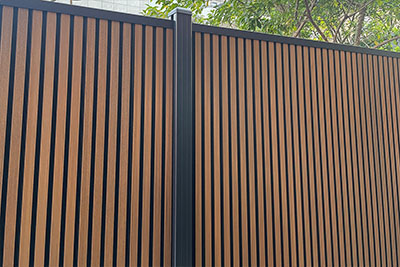
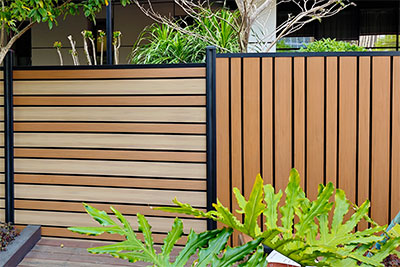
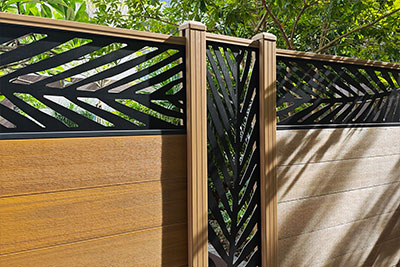
Most importers shopping for a composite fence manufacturer in China start the same way. They pull up a shortlist of factories, compare price sheets, maybe request a few samples, and wait to see who replies fastest. It feels productive. It also misses the most important part entirely. Here is what nobody tells you: a fence panel’s quality is decided long before you ever see a sample.
It is locked in by a series of production decisions made deep inside a factory — decisions that look identical on a spec sheet but produce wildly different results in the field.
This post breaks down exactly what a composite fence manufacturer in China controls at the production level, and what that means for the performance of every panel that arrives at your job site.
The Assumption Most Buyers Get Wrong
The standard belief about sourcing from China goes something like this: quality is a function of price. Pay more, get better. Pay less, accept risk.
That assumption is not entirely wrong, but it is dangerously incomplete.
Two factories can quote you the same price per linear meter, use the same surface color, and ship panels that look identical in a sample box. But six months after installation — one fence looks brand new. The other is warping, fading, and triggering warranty calls.
The difference was never visible in the sample. It was built into the material formulation, the extrusion process, and the QC checkpoints the manufacturer runs before your order ships.
So instead of asking “which composite fence manufacturer in China is cheapest?” — the more useful question is: “what production variables actually drive durability, and can this factory prove they control them?”
Variable 1: The Polymer Blend Ratio
Every WPC fence board is a mixture of wood fiber and thermoplastic polymer — typically HDPE or polypropylene — combined with performance additives. The exact ratio of these inputs determines almost everything about how the finished panel behaves outdoors.
Too high a wood-fiber content and the board absorbs moisture. Too low and you lose the structural rigidity that makes it feel solid underfoot. Too little coupling agent and the wood and plastic bond weakly, creating internal delamination that only shows up after a year of thermal cycling.
Here is the problem: “This ratio is invisible in a sample box.” A panel made with 70% wood fiber and cheap regrind plastic can look and feel nearly identical to one made with 55% fiber and virgin HDPE — until the first summer heat cycle.
What to ask your manufacturer: Can they provide the raw material certification for their HDPE or PP resin? Is it virgin resin or recycled regrind? What MAPE (maleic anhydride polyethylene) coupling agent loading rate do they run?
A manufacturer that cannot answer those questions in a sentence is almost certainly not the one controlling the formula.
Variable 2: Co-Extrusion vs. Single-Pass Extrusion
This is the single most important production decision a composite fence manufacturer in China makes — and it is the one most buyers know the least about.
Single-pass extrusion produces a board where the core and the surface are made from the same blend. It is simpler, faster, and cheaper. It is also the reason why so many “budget WPC” fences turn chalky grey after 18 months of UV exposure.
Co-extrusion wraps the board in a separate, high-performance cap layer during manufacturing — typically made from ASA (Acrylonitrile Styrene Acrylate) or Surlyn. That cap layer is what provides UV resistance, color retention, and scratch resistance. It is not a coating that can peel. It is fused to the substrate at the molecular level during extrusion.
The difference in field performance is dramatic. An ASA-capped co-extruded board maintains its color and surface integrity years longer than an uncapped one. But both products can legally be sold as “WPC composite fence” on any spec sheet or Alibaba listing.
If your manufacturer does not have a separate co-extrusion line — a physical piece of capital equipment, not just a checkbox on their capabilities page — their fence is not co-extruded.
| Production Variable | Budget Single-Pass Extrusion | MecoFence Co-Extrusion (ASA/Surlyn Cap) |
| Manufacturing Process | Core and surface are the same mixed material. Fast and cheap to produce. | Board is wrapped in a dedicated, high-performance protective cap layer fused at the molecular level. |
| UV Resistance & Color Fade | Low: Often turns a chalky grey after 12–18 months of UV exposure. | High: ASA or Surlyn cap layer locks in color and resists extreme UV rays for 10+ years. |
| Core Protection (Moisture) | Vulnerable: Wood fibers on the surface are exposed and can absorb moisture over time. | Fully Sealed: The 360° shield prevents water penetration, swelling, and rot. |
| Scratch & Stain Resistance | Poor: Scratches easily during transport and installation. | Excellent: Hardened outer shell resists scuffs, dirt, and stains on the job site. |
| Field Lifespan | 3 – 5 Years (High risk of warping, fading, and triggering warranty calls). | 15 – 25+ Years (Engineered for stability in extreme climates like Australia and the US Southwest). |
| Distributor ROI | Low: Cheaper upfront, but costly in reputation damage and replacement claims. | High: Protects your margins, eliminates callbacks, and builds contractor trust. |
Variable 3: UV Stabilizer Loading Rate
UV stabilizers are the chemical additives that prevent the polymer matrix from breaking down under sunlight. All WPC manufacturers use them. Very few use enough of them.
Loading rate — the percentage of UV stabilizer relative to total material weight — is the variable that determines whether a fence looks the same in year three as it did in year one, or whether you are fielding calls from distributors about chalking and color fade.
The industry standard minimum is typically around 0.3–0.5%. Premium manufacturers run 0.8–1.2%, particularly for markets with intense UV exposure like Australia, the American Southwest, or the Middle East. That difference in chemistry costs money. It is almost always the first place a factory cuts costs when margins get squeezed.
Ask for the UV stabilizer type (HALS — hindered amine light stabilizers — is the current benchmark) and the loading rate per batch. If a manufacturer hesitates on that question, treat it as a red flag.
Variable 4: Structural Aluminum Integration
One of the quietest engineering debates in the composite fencing industry is whether WPC panels need internal structural support — and what happens to performance in high-heat environments when they do not get it.
Composite fence boards expand and contract with temperature changes. In moderate climates, this thermal movement is manageable. In climates where temperatures swing 40°C or more between seasons — or where panels run long spans without intermediate posts — unsupported boards can bow or sag noticeably over time.
The solution a well-engineered composite fence manufacturer in China builds into their system is integrated aluminum rails — aluminum structural members either inserted into panel channels or co-built into the fence frame system. This aluminum skeleton carries the span load while the WPC boards handle the weather.
It also creates an interesting supply chain advantage: a fence system with integrated aluminum structural components classifies differently under customs HS codes than a pure aluminum fence. That classification matters significantly for importers navigating the 2026 tariff landscape on aluminum products.
Not every fence system needs this. But if you are selling to contractors doing commercial perimeter fencing, multi-unit residential, or large span applications — ask your manufacturer whether their panel system accounts for thermal movement, and how.
Variable 5: In-Process Quality Control vs. End-of-Line Inspection
This variable is about when quality gets checked — not just whether it does.
Many factories run what is called end-of-line inspection: a visual check of finished panels before packing. If a panel looks wrong, it gets pulled. If it looks fine, it ships.
The problem is that most structural defects in WPC manufacturing are not visible. They are internal. Voids in the extrusion core. Inconsistent cap layer thickness. The moisture content in the wood fiber that was too high when it entered the extruder. These defects produce panels that pass visual inspection, load beautifully into a 40HQ container, and fail in the field.
A manufacturer running genuine in-process QC is monitoring the extruder parameters continuously — temperature profiles, die pressure, line speed, cap layer thickness — and has documented acceptable ranges for each variable. They are also running incoming material tests (moisture content, melt index, density) before any raw material enters production.
This is expensive to operate. It requires trained technicians, calibrated instruments, and a manufacturing culture that will actually stop a production run when something is out of spec. It is also the only version of quality control that catches the defects that matter.
Ask your shortlisted manufacturer what happens when an in-process parameter falls outside tolerance. If the answer is vague — or if they look surprised by the question — you have learned something important.
What This Means When You Are Evaluating a Manufacturer
The five variables above — polymer blend ratio, co-extrusion capability, UV stabilizer loading, structural integration, and in-process QC — are not things you can verify from a price sheet. They require direct technical dialogue, documentation requests, and in some cases a factory audit.
But here is what makes this framework useful for a first conversation.
Any composite fence manufacturer in China that is operating at a serious production level will be able to discuss all five of these topics without hesitation. They will have data. They will have certifications. They will have a technical person who can answer questions about their co-extrusion line setup.
A manufacturer that deflects these questions with vague claims about “premium quality” or “strict quality control” without the data to back it up is telling you something about their process — even if they do not realize it.
Quality is not manufactured in the marketing department. It is manufactured on the extrusion line, at 5:30 in the morning, when the third shift operator catches a temperature deviation and decides what to do about it.
The composite fence manufacturers worth sourcing from are the ones who have already built the systems to make that call correctly — before your order ever ships.
Ready to Dig Into the Details?
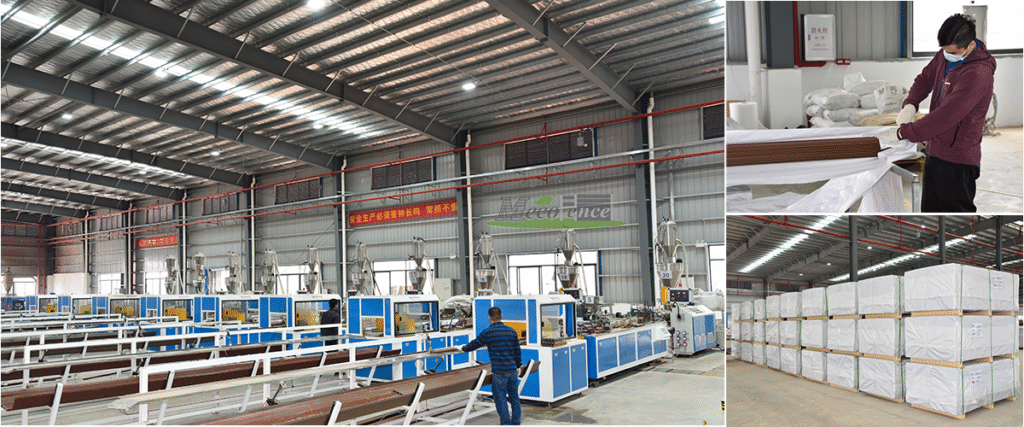
At MecoFence, we run a fully integrated co-extrusion facility in Guangdong Province — including ASA/Surlyn cap layer lines, incoming material QC, and in-process monitoring at every extrusion stage.
If you are evaluating composite fence manufacturers in China and want to know exactly how we stack up on each of the five variables above, contact our technical team for a “production capability sheet” or request a “sample kit” to see the material quality yourself.
Because the right fence starts with the right factory.
MecoFence is a WPC composite fencing manufacturer based in Guangdong, China, supplying distributors, contractors, and OEM partners across North America, Europe, and Australia.
View MecoFence’s full composite fence range →
Email us directly: sales@mecofence.com
MecoFence — WPC Composite Fencing for Trade Partners Worldwide
Resources:
The tariff classification of wood plastic composite (WPC) fence systems from China
Monthly prices for HDPE in United States, China, Middle East, Southeast Asia and Europe
Global container freight benchmark (live, IOSCO-compliant)