
Two weeks ago, geopolitical tensions escalated as strikes were launched on Iran, resulting in the mining of the Strait of Hormuz and the rerouting of global shipping vessels. Within days, tanker traffic dropped 70% and then collapsed to near-zero, with major carriers like Maersk, MSC, CMA CGM, and Hapag-Lloyd suspending Gulf transits.
For fence wholesalers and fence distributors sourcing wood plastic composite (WPC) fencing from China, this is not a peripheral energy story. If you operate in highly competitive outdoor building material markets like North America, Australia, or France, the disruption has already worked its way into your supply chain at multiple levels simultaneously.
WPC fencing is one of the most oil-exposed products in the entire outdoor category. Here is the data-driven reality of what this means for a composite fence manufacturer and how distributors can hedge against rising landed costs.
The Crisis in Numbers:
$119.50: Brent crude peak ($/bbl), before easing to ~$90 by March 9 as conflict resolution signals emerged.
$1,500 – $3,500: War risk shipping surcharge added per container by major carriers like Hapag-Lloyd.
8.39%: Iran’s share of China’s total PE (Polyethylene) imports—a supply gap that directly impacts domestic Chinese resin availability.
1. Why the Hormuz Closure Hits WPC Fence Manufacturers Harder
Most building materials discussions focus on steel, aluminum, and ceramics. WPC composite fence rarely features in those headlines—which is a critical blind spot for buyers.
A standard WPC fence board is composed of 50–60% thermoplastic polymer (predominantly HDPE or polypropylene), blended with wood flour and performance additives (such as MAPE coupling agents and UV stabilizers). (For a deeper dive into how these material ratios affect durability and product grading, read our comprehensive guide on what exactly a composite fence is and its material evolution.) Every major polymer input in that formula has a direct cost line running back to crude oil.
Crucially, Iran was China’s 4th-largest PE supplier, accounting for over 1.125 million tons (8.39% of total Chinese PE imports). For a WPC fence manufacturer sourcing HDPE domestically in China, the Hormuz closure is not just a price event; it is a rapid supply availability event.
2. The Resin Market: Factory-Level Cost Mathematics
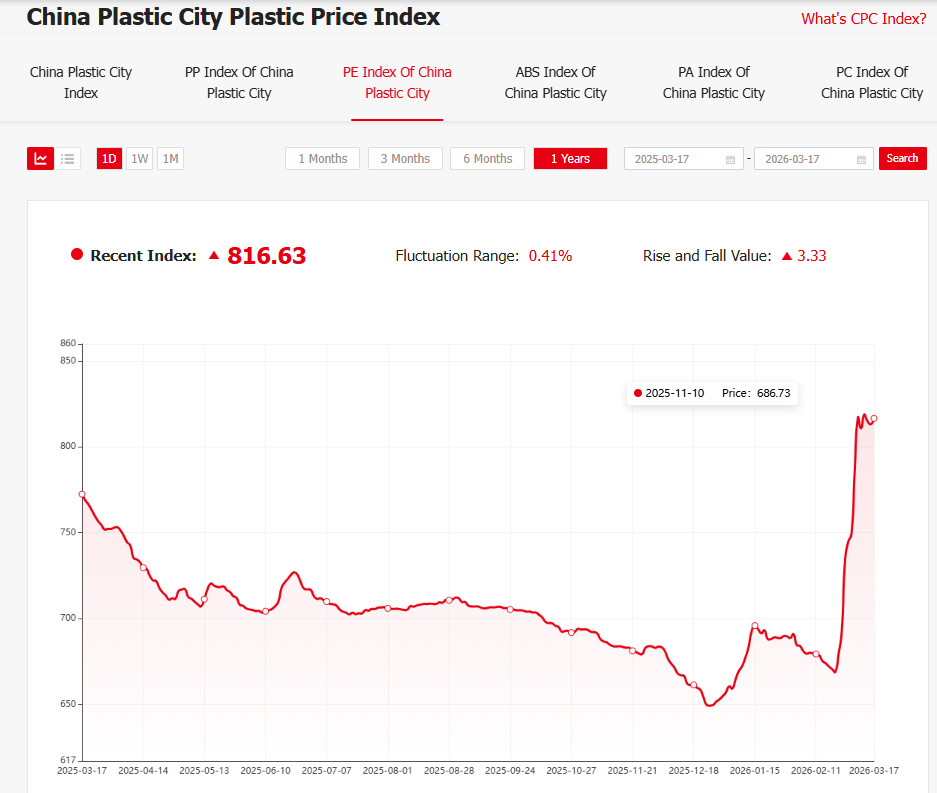
The week of the crisis marked the highest weekly resin transaction volume in the 25-year history of the Plastics Exchange. The dynamic is more complex than a simple oil price pass-through. While elevated domestic Chinese PE/PP inventories (up 104% from pre-holiday levels at Sinopec and PetroChina) have slightly buffered the initial shock, spot prices are inevitably climbing.
WPC fence manufacturers buying HDPE on spot in China are seeing prices move from a Q4 2025 baseline of approximately $1,074/MT toward the $1,200–$1,300/MT range.
The Revised 40HQ Container Math: A standard 40HQ container of composite fence panels contains roughly 9–13 MT of HDPE/PP resin content.
Resin Cost Jump: At a $150–$250/MT resin increase, that translates to $1,400–$3,200 in added raw material costs per container at the factory level.
Shipping Surcharges: Combined with a $1,500–$3,500 war risk surcharge and extended Cape of Good Hope transit times, the total additional landed cost per 40HQ lands in the $3,000–$6,500 range.
Expect a 5–15% increase on landed costs for composite fencing arriving over the next 60–90 days, especially for routes servicing France and broader Europe that traditionally rely on Suez/Gulf transits.
And crucially, Iran was China’s 4th-largest PE supplier in 2025, accounting for 1.125 million tons — 8.39% of total Chinese PE imports. That’s not just a price story. That’s a supply availability story for WPC fence manufacturers sourcing HDPE domestically in China.
| Raw material | WPC fence share | Pre-crisis baseline (China) | Hormuz impact |
|---|---|---|---|
| HDPE / PP resin | 50–60% | ~$1,074/MT (China, Q4 2025) | Very high |
| MAPE / MAPP coupling agents | 2–5% | Indexed to polyolefin spot | Very high |
| PE wax/lubricants | 1–3% | Petroleum wax fraction | Moderate |
| UV stabilizers & colorants | 1–3% | Specialty petrochemical downstream | Moderate |
| Wood flour/bamboo fiber | 30–40% | Energy & transport indexed | Low–moderate |
3. The resin market: what’s actually happening at the factory level
The week of the crisis marked the highest weekly resin transaction volume in the 25-year history of the Plastics Exchange. The dynamic is more complex than a simple oil price pass-through, and WPC fence buyers need to understand it clearly.
There is a partial buffer that does not exist in most other disruptions: Chinese PE and PP inventories at Sinopec and PetroChina reached 940,000 tons as of late February — up 104% from pre-holiday levels. This elevated domestic inventory has slowed the price surge inside China relative to other regions. However, it does not eliminate the pressure. As global buyers scramble for alternatives to Gulf-origin resin and Iranian-origin PE, Chinese bonded cargoes are being redirected to export markets at higher prices — which tightens domestic Chinese availability and pushes spot prices upward from a different direction.
PP spot prices climbed $0.10/lb domestically in the US in the first week of March, driven by soaring propylene monomer feedstock costs. In Asia, the trajectory is upward but moderated by the inventory overhang. WPC fence manufacturers buying HDPE on spot in China are seeing prices move from a Q4 2025 baseline of approximately $1,074/MT toward the $1,200–$1,300/MT range in current spot indications.
4. The MecoFence Advantage: Securing Your Supply Chain in a Volatile Market
When global supply chains fracture, the difference between a trading company and a true source manufacturer becomes your profit margin. During times of raw material volatility and freight uncertainty, distributors need a manufacturing partner with deep financial reserves and structural scale.
Here is how MecoFence, as a leading composite fence manufacturer, protects our B2B partners’ margins during the Hormuz crisis:
Forward Resin Purchasing Power: Unlike small assembly workshops that rely on daily spot market prices for HDPE and PP resins, MecoFence leverages massive economies of scale. Our forward contracts and bulk resin purchasing buffer our clients from the immediate, chaotic spikes of the spot market.
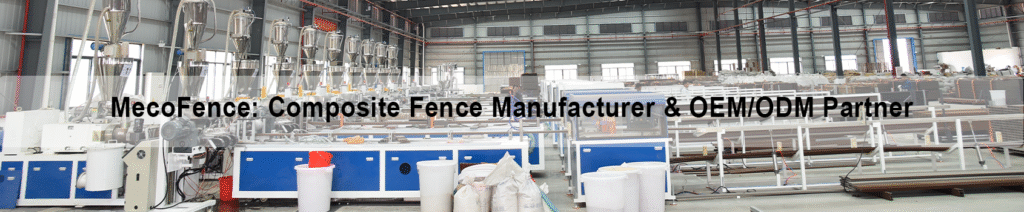
50,000-Ton Annual Capacity: With 60+ advanced extrusion lines, our production capability means your 40HQ containers are manufactured on schedule. We ensure you hit the critical 45–90 day production window without factory-level bottlenecks, getting your goods on the water exactly when freight lanes normalize.
100% Transparent FOB Pricing: We do not use shipping crises as an excuse to pad factory margins. MecoFence provides crystal-clear FOB pricing, separating raw material costs from forwarder surcharges, allowing you to quote your downstream contractors with absolute confidence.
Premium ASA Co-Extrusion Alternatives: Looking to pivot from highly volatile traditional plastics? MecoFence offers state-of-the-art ASA co-extrusion and aluminum-framed systems that provide premium margins and potentially different feedstock dynamics to diversify your risk.
Take Action Now:
Do not wait for peak spot prices to dictate your Q3 and Q4 inventory costs.
[Contact the MecoFence B2B Team today]to lock in current factory pricing for your next container-load order and secure your 2026 supply chain.
Resource
CNBC: Strait of Hormuz closure and shipping economy
Al Jazeera: Maritime insurers cancel war risk cover in the Gulf
NPR: Iran war, oil and energy crisis
Fastmarkets: Strait of Hormuz lifts commodity freight rates
CNN: Oil prices surge amid Iran war
CNBC: Oil supertanker rates hit all-time high
Al Jazeera: Trump says Iran war projected 4–5 weeks
Fastmarkets: China commodity exports to Persian Gulf face setback
Seoul Economic Daily: Hormuz insurance premiums surge fivefold
The National: US $20B reinsurance plan for Hormuz shipping
PlasticsToday: Resin prices climb as Iran war disrupts global markets (Mar 13, 2026)
IMARC Group: HDPE price trend — China Q4 2025 baseline $1,074/MT